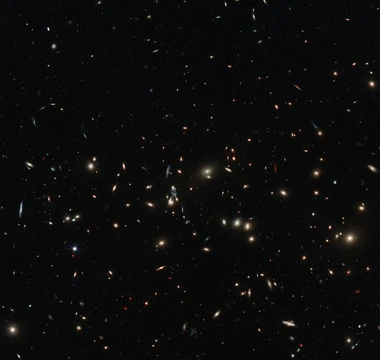
MACS J0717.5+3745
First observed collision of four galaxy clusters.

MACS J0717.5+3745, also called MACS J0717 or MACS 0717, is a large galaxy cluster in the constellation Auriga, about 5.4 billion light-years away, and is listed in the Massive Cluster Survey (MACS). It is the first known case of a collision involving four separate galaxy clusters. This repeated merging is driven by a 13-million-light-year-long stream of galaxies, gas, and dark matter—called a filament—flowing into an already dense region. When two or more clusters collide, the hot gas in the interstellar medium slows down, but the galaxies, which are mostly empty space, do not decelerate as much. By measuring the offset between the galaxies and the gas, astronomers can estimate the speed and direction of each colliding cluster. Among the four subclusters (labeled A, B, C, and D), subcluster B moves quickly relative to the other three, which are nearly at rest with respect to one another. This fast-moving subcluster B shows the kinetic Sunyaev-Zel'dovich effect—the first time this effect has been observed in a single object rather than statistically. It was identified because it lacks a thermal Sunyaev-Zel'dovich effect, unlike the other three subclusters. MACS J0717 also forms one of the largest known Einstein rings, as gravitational lensing distorts light from several background phenomena.
Quick Facts
- Credit
- NASA, ESA, CXC, NRAO/AUI/NSF, STScI, and R. van Weeren (Harvard-Smithsonian Center for Astrophysics) Acknowledgment: NASA, ESA, and J. Lotz (STScI), and the HFF team
- Epoch
- J2000
- Ra
- 07 · 17 · 36.50
- Dec
- +37 · 45 · 23
- Velocity Dispersion
- 1660
- Redshift
- 0.5458
- Mass
- 0
- Other Names
- ClG J0717+3745, MCS J0717.5+3745, PLCKESZ G180.24+21.04, 1RXS J071733.8+374520, BAX 109.3900+37.7600, MCXC J0717.5+3745, RX J0717.5+3745
Facts from the source article.
Lore & Background
The cluster was formed by four separate galaxy clusters that have been involved in a collision, a phenomenon observed for the first time. The repeated collisions in MACS J0717 are caused by a 13-million-light-year-long stream of galaxies, gas, and dark matter, known as a filament, pouring into a region already full of matter. When two or more of the galaxy clusters collide, the hot gas in the interstellar medium slows down, but the galaxies, composed mostly of empty space, do not slow as fast. The speed and direction of each of the clusters involved in the collision can thus be approximated through examining the offset between the galaxies and the gas.
Of the four subclusters—A, B, C, D—subcluster B is moving quickly relative to the other three subclusters, which are relatively at rest in relation to each other. The quick moving B exhibits kinetic Sunyaev-Zel'dovich effect (SZ effect for short), the first time this has been observed in an object, instead of statistically. The B subcluster's kinetic SZ effect was discovered due to its lack of a thermal SZ effect, unlike the other three subclusters. MACS J0717 forms one of the largest known Einstein rings, with gravitational lensing distorting the light that reaches us from several adjacent phenomena.
Reader's Guide
MACS J0717.5+3745 holds significance as the first observed collision of four separate galaxy clusters, providing a unique laboratory for studying cluster dynamics and dark matter. The repeated collisions, driven by a 13-million-light-year-long filament of galaxies, gas, and dark matter, allow astronomers to approximate the speed and direction of each subcluster by examining the offset between galaxies and gas. The detection of the kinetic Sunyaev-Zel'dovich effect in subcluster B—the first time this effect was observed in a single object rather than statistically—offers a new method for measuring the motion of galaxy clusters. Additionally, the cluster's gravitational lensing produces one of the largest known Einstein rings, distorting light from background phenomena. These features make MACS J0717 a key object for understanding large-scale structure formation and the behavior of matter in extreme collisions.
Frequently Asked Questions
What is MACS J0717.5+3745?
It is a massive galaxy cluster in the constellation Auriga, sitting roughly 5.4 billion light-years from Earth, and is catalogued under the Massive Cluster Survey (MACS).
What makes MACS J0717.5+3745 unique among known clusters?
It is the first confirmed case of four separate subclusters—designated A, B, C, and D—colliding at the same time, a record-setting multi-merger event never seen before.
Where is MACS J0717.5+3745 located and how far away is it?
The cluster lies in the constellation Auriga at a distance of approximately 5.4 billion light-years, placing it among the more distant massive structures observable with current instruments.
What role does the 13-million-light-year filament play in the MACS J0717.5+3745 merger?
A colossal stream of galaxies, hot gas, and dark matter stretching about 13 million light-years funnels new material into the already dense cluster core, fueling the repeated collisions between the four subclusters.
Why is MACS J0717.5+3745 important to astrophysics?
It offers a rare natural laboratory where the hot gas between galaxies decelerates during impact while the mostly empty-space galaxies plow through, giving researchers a direct window into dark-matter dynamics and how large-scale structure forms.
More in Galaxy Clusters and Groups, Part 2 1-24
Spotted an error? Know more?
Reader corrections go straight into our review queue. Suggest an edit · How this site is sourced