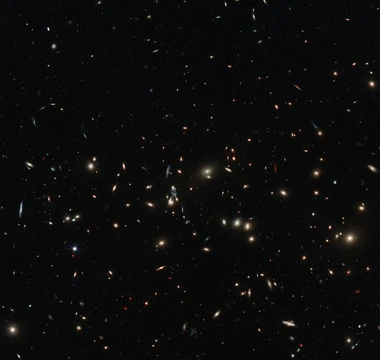
SPT2349-56
Brightest protocluster candidate from the South Pole Telescope survey.

SPT2349-56 is a candidate protocluster—a cluster of galaxies not yet fully bound by gravity—and the brightest one found so far in the South Pole Telescope survey. When astronomers observe it as it existed 12 billion years ago, they see a mix of hot plasma gas and newly forming galaxies coming together. The discovery was made using the Atacama Large Millimeter Array in northern Chile. Within this structure, which spans roughly 500,000 light-years (comparable to the dark-matter halo and ancient stars surrounding our own Milky Way), more than 30 galaxies are packed into a relatively small volume. Star formation there proceeds at a rate 5,000 times faster than in the Milky Way. The intracluster medium—the hot gas between the galaxies—was measured indirectly through the Sunyaev–Zeldovich effect and found to be at least five times hotter than expected. For a protocluster, which should not yet be this hot, the temperature suggests that current models of how galaxy clusters form and heat up are incomplete. Astronomers have also detected intense star formation and supermassive black holes within this system.
Quick Facts
- Credit
- European Southern Observatory (ESO)
- Epoch
- J2000
- Constellation
- Phoenix
- Ra
- 23 · 49 · 48
- Dec
- -56 · 37 · 40
- Redshift
- 4.3
- Distance
- 12 billion light years (light travel distance)
- Member No
- 30
Facts from the source article.
Lore & Background
SPT2349-56 is a protocluster, meaning it is a cluster yet to be completely bound by gravitation. It appears to contain an intracluster medium of hot gas, and over 30 galaxies grouped together into the relatively small space of only 500,000 light-years across—about the same size as the halo of dark matter and ancient stars that surrounds the Milky Way galaxy. Within its galaxies, stars are forming 5,000 times faster than in the Milky Way.
When measured indirectly using the Sunyaev–Zeldovich effect, the intracluster medium was found to be at least 5 times hotter than expected. Compared to newer clusters, it is hotter and more energetic. Models suggest that galaxy clusters form by the dynamical collapse of the galaxies, entering a gravitationally bound state that is stable, during which the intracluster medium becomes heated. As SPT2349-56 is a protocluster, it should not yet be as hot as it is, suggesting to astronomers that models of how galaxy clusters develop are not complete.
Reader's Guide
SPT2349-56 is significant because it challenges current models of galaxy cluster formation. As a protocluster observed 12 billion years ago, it should not yet have a hot intracluster medium, yet measurements using the Sunyaev–Zeldovich effect show it is at least 5 times hotter than expected. This discrepancy indicates that the standard picture—where clusters form by dynamical collapse and gradual heating—may be incomplete. The protocluster also hosts intense star formation, with stars forming 5,000 times faster than in the Milky Way, and contains over 30 galaxies packed into a region only 500,000 light-years across. Its discovery by astronomers at the Atacama Large Millimeter Array in northern Chile, as the brightest such candidate from the South Pole Telescope survey, provides a unique laboratory for studying the early stages of cluster assembly and the energetic processes that heat the intracluster medium before gravitational binding is complete.
Did You Know?
- SPT2349-56 is the brightest galaxy protocluster candidate discovered by the South Pole Telescope survey.
- Stars are forming 5,000 times faster in its galaxies than in the Milky Way.
More in Galaxy Clusters and Groups, Part 2 1-24
Spotted an error? Know more?
Reader corrections go straight into our review queue. Suggest an edit · How this site is sourced