SPT-CL J2106−5844
Most massive distant object known as of 2011.

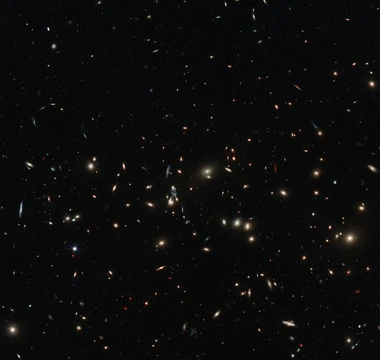
SPT-CL J2106−5844 is a galaxy cluster located 7.5 billion light years from Earth, discovered by scientists from the South Pole Telescope Collaboration using the South Pole Telescope. As of 2011, it is the most massive distant object known, with a weight of about 1.27 × 10^15 solar masses, approximately 60% heavier than the previously known object detected in 2008, SPT-CL J0546−5345.
- Distance from earth
- 7.5 billion light years
- Mass
- 1.27 × 10^15 solar masses
- Redshift
- z=1.132
- Discovery telescope
- South Pole Telescope
- Discovery survey
- South Pole Telescope Sunyaev-Zel'dovich (SPT-SZ) survey
- Substructure separation
- ~150 kpc
Lore & Background
SPT-CL J2106−5844 was found in the South Pole Telescope Sunyaev-Zel'dovich (SPT-SZ) survey, which used the Advanced Camera for Surveys and Wide Field Camera 3 on the Hubble Space Telescope. Many observations have been completed in x-ray and infrared imaging to discover new observations about this massive cluster. The central dump is resolved into two different substructures – northwestern and southeastern – separated by a distance of ~150 kpc.
Reader's Guide
The significance of SPT-CL J2106−5844 lies in its record-breaking mass for a distant object as of 2011, being about 60% heavier than the previous record holder SPT-CL J0546−5345 detected in 2008. Its substructure, with two components separated by ~150 kpc, is immense: the Milky Way galaxy could fit 20 times between them, and the actual diameter of the cluster is much larger than this gap. The cluster's redshift of z=1.132 places it at a great distance, and its discovery via the Sunyaev-Zel'dovich effect using the South Pole Telescope highlights the effectiveness of this method for finding massive clusters. The use of Hubble Space Telescope instruments and multi-wavelength observations in x-ray and infrared has enabled detailed study of its structure.
Did You Know?
- SPT-CL J2106−5844 is located 7.5 billion light years from Earth.
- It has a mass of about 1.27 × 10^15 solar masses.
- The cluster's central dump is resolved into northwestern and southeastern substructures separated by ~150 kpc.
More in Galaxy Clusters and Groups, Part 2 1-24
Spotted an error? Know more?
Reader corrections go straight into our review queue. Suggest an edit · How this site is sourced