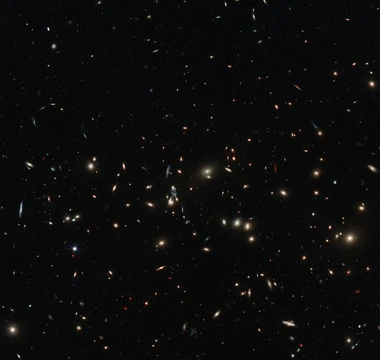
SPT-CL J0546−5345
First z>1 cluster found via Sunyaev–Zeldovich effect.

SPT-CL J0546−5345 is a massive galaxy cluster discovered at the South Pole Telescope in 2008. It was the first galaxy cluster discovered at a redshift greater than 1 using the Sunyaev–Zeldovich effect.
- Redshift
- 1.067
- Distance
- 7 billion light years
- Mass
- 4.85 × 10^14 M⊙
- Number of members
- 49
- X-ray temperature
- 6.7 −0.9 +1.4 keV
- Velocity dispersion
- 1179 −167 +232 km s−1
- Galaxy density
- 13.1 galaxies per arcminute−2
Lore & Background
SPT-CL J0546−5345 was discovered in 2008 using the South Pole Telescope and was the first galaxy cluster at z > 1 identified through the Sunyaev–Zeldovich effect. It is located approximately 7 billion light years away with a redshift of z = 1.067. The cluster hosts 49 galaxy members and has an estimated total mass of 4.85 × 10^14 M⊙ based on the Sunyaev–Zel'dovich effect. Chandra observations measured the cluster's X-ray temperature as 6.7 −0.9 +1.4 keV. Follow-up observations using Spitzer, Chandra, and optical telescopes allowed identification and redshift measurements of cluster members. Out of 49 members, 21 were studied, with 18 exhibiting spectral features of Ca H & K lines and 3 displaying singly ionized oxygen (O II) lines. The cluster was found to have a velocity dispersion of 1179 −167 +232 km s−1. At the time of its discovery, it was the most dynamically active high-mass cluster identified at z > 1.
Reader's Guide
SPT-CL J0546−5345 holds significance as the first galaxy cluster at z > 1 discovered using the Sunyaev–Zeldovich effect, marking a milestone in high-redshift cluster detection. It was the most massive galaxy cluster at z > 1 from its discovery in 2008 until 2011, when SPT-CL J2106−5844 surpassed it. The cluster formed early through major galaxy mergers and later experienced adiabatic expansion driven by AGN winds, causing mass loss. Its high velocity dispersion and X-ray temperature indicate it was the most dynamically active high-mass cluster at z > 1 at the time of discovery. The cluster field's galaxy density of 13.1 galaxies per arcminute−2, measured with ACS data, provides context for its richness. The study of 21 of its 49 members, revealing Ca H & K and O II spectral features, contributed to understanding galaxy evolution in dense environments at high redshift.
Did You Know?
- It was the most massive galaxy cluster at z > 1 until 2011 with the discovery of SPT-CL J2106−5844.
- Out of 49 cluster members, 21 were studied, with 18 showing Ca H & K lines and 3 showing O II lines.
More in Galaxy Clusters and Groups, Part 2 1-24
Spotted an error? Know more?
Reader corrections go straight into our review queue. Suggest an edit · How this site is sourced