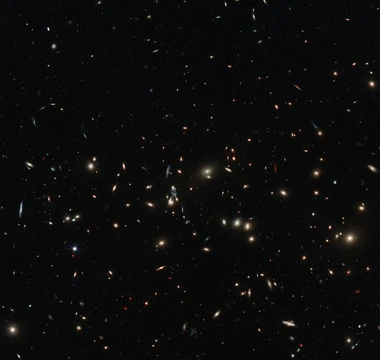
RX J1532.9+3021
Massive X-ray bright cool cluster with a mini radio halo.

RX J1532.9+3021 is a galaxy cluster located in the constellation of Corona Borealis. It is classified as one of the massive and strongest X-ray bright cool clusters in the universe at redshift z = 0.362, with a luminosity estimated at 6 × 10^45 erg s⁻¹. A mini radio halo is seen surrounding the cluster.
Quick Facts
- Epoch
- J2000.0
- Constellation
- Corona Borealis
- Ra
- 15 · 32 · 53.8
- Dec
- +30 · 20 · 59
- Brightest Member
- LEDA 1900245
- Redshift
- 0.362000
- Distance
- 3.9 billion light-years
- Notes
- One of the largest black holes discovered so far inside a galaxy cluster
- Names
- MACS J1532.9+3021, MCS J1532.8+3021, CIG J1532+3021
- Richness
- 1
Facts from the source article.
Lore & Background
The cluster RX J1532.9+3021 hosts the brightest cluster galaxy (BCG) LEDA 1900245, an elliptical galaxy with a dimension of about 120.56 kpc (~393,000 light-years). This galaxy is a LINER galaxy, meaning its nucleus contains an emission spectrum characterized by broad lines of weak ion atoms. First noted as a radio source in 1990, it is classified as a blazar producing extensive amounts of star formation, similar to other BCGs such as the Phoenix Cluster and NGC 1275. It also hosts a large amount of molecular gas with ultraviolet filaments.
Observations by the Chandra Space Telescope found that LEDA 1900245 hosts one of the most powerful and most massive black holes, measuring 10 billion solar masses. X-ray images show two large X-ray cavities or bubbles of emitted hot gas, each measuring 100,000 light-years across. These cavities cause shock fronts that release most energy, which then generates more hot gas, hampering any efforts to produce new stars in the galaxy.
A gravitational lensed supernova, known as SN CLN12Did, was discovered in early 2012 behind RX J1532.9+3021. It is located at redshift z = 0.851, with its host being an early-type possible elliptical galaxy.
Reader's Guide
RX J1532.9+3021 is notable as one of the most massive and strongest X-ray bright cool clusters known, with a high luminosity of 6 × 10^45 erg s⁻¹. Its significance is underscored by the presence of a mini radio halo surrounding the cluster, a feature studied in a 2013 publication. The cluster's brightest galaxy, LEDA 1900245, contains a black hole of 10 billion solar masses, one of the most powerful and massive known, and exhibits two large X-ray cavities that release energy through shock fronts, suppressing star formation. The discovery of a gravitational lensed supernova behind the cluster in early 2012 adds to its legacy as a site for studying distant supernovae and lensing effects. The cluster's distance of about 3.9 billion light-years and its classification as a cool core cluster make it a key object for understanding galaxy cluster evolution and the interplay between black holes and their environments.
Did You Know?
- RX J1532.9+3021 is located in the constellation Corona Borealis.
- The cluster has a velocity of 103,539 ± 8 km/s, equivalent to a Hubble distance of 1,527.1 ± 106.9 Mpc.
- Its brightest cluster galaxy, LEDA 1900245, hosts a black hole measuring 10 billion solar masses.
- A gravitational lensed supernova, SN CLN12Did, was discovered behind the cluster in early 2012 at redshift z = 0.851.
More in Galaxy Clusters and Groups, Part 2 1-24
Spotted an error? Know more?
Reader corrections go straight into our review queue. Suggest an edit · How this site is sourced