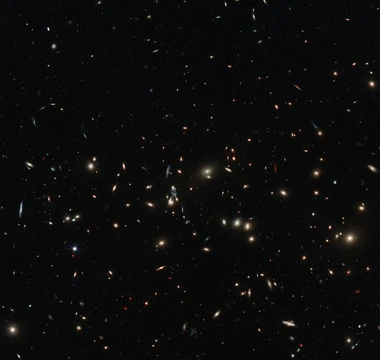
RX J1347.5−1145
One of the most massive and X-ray-luminous galaxy clusters known.

RX J1347.5−1145, discovered in X-rays by ROSAT, ranks among the most massive and X-ray-luminous galaxy clusters known, a brightness driven by its hot gas. Located about 5 billion light-years away in Virgo, it has a redshift of 0.451 and an X-ray luminosity of 10⁴⁵ erg s⁻¹ (as reported in 2002). In 2013, a study using data from the CLASH survey and other sources identified eight instances of the same object due to strong gravitational lensing, allowing photometric calculations to locate distant galaxies within the cluster at redshifts between 5.5 and 7.5. The cluster’s colors correspond to brightness levels: red, orange, and yellow indicate high intensity; blue-green and green medium; and blue and violet low. The brightest galaxy within it is the elliptical GALEX J134730.7-114509. Temperature and entropy maps show cool, entropic gases trailing a subcluster to the southwest, consistent with core shredding, while gas density, temperature, and metallicity align well. The hot intracluster medium extends to the southeast, with hints of two cD galaxies present.
Radio observations from 1999 and 2001 captured the Sunyaev-Zeldovich (SZ) effect in the cluster. Higher-resolution imaging at about 150 GHz revealed a stronger SZ signal southeast of the center, coinciding with the X-ray surface brightness extension. Since SZ intensity scales with integrated gas pressure along the line of sight, this strong signal suggests excess hot gas from a subcluster merging with the primary cluster. Chandra confirmed the presence of gas with kT ≥ 15 keV in that southeast region.
X-ray data analysis involved over 80 kiloseconds of Chandra observations across three windows: the first two using ACIS-S, the third ACIS-I. Background projection used the 2.5–7 keV and 9.0–12 keV bands, excluding point sources and cluster emission. Accurate X-ray background estimation was critical for spectral analysis of faint, extended emission, relying on blank-sky datasets from the Chandra calibration database, with overall normalization based on the high-energy (9–12 keV) count rate ratio.
Quick Facts
- Ra
- 13 · 47 · 33.5
- Dec
- -11 · 45 · 42
- Constellation
- Virgo
- Distance
- 5 billion ly (1.533 Gpc)
- Luminosity
- 1e45 ergs
Facts from the source article.
Lore & Background
The galaxy cluster RX J1347.5−1145 was discovered in X-rays with ROSAT. A 2002 paper noted its redshift as z=0.451 and X-ray luminosity of 10^45 ergs s−1. In 2013, a study using data from the Cluster Lensing and Supernova survey with Hubble (CLASH) and other sources found eight cases of the same object resulting from intense gravitational bending of light, enabling identification of remote galaxies inside the cluster with photometric calculations between 5.5 and 7.5. The colors in the cluster correspond to brightness levels: red, orange, and yellow indicate high intensity; blue-green and green medium intensity; blue and violet low intensity.
The brightest galaxy inside the cluster is the elliptical GALEX J134730.7-114509. Temperature and entropy maps show cool, entropic gases trailing a subcluster in a southwesterly direction, consistent with core shredding. The overall gas density, temperature, and metallicity are in good agreement. The hot intracluster medium has an extension to the southeast, with indication of two cD galaxies located within the cluster.
Radio observations from 1999 and 2001 of the Sunyaev-Zeldovich effect at approximately 150 GHz showed a stronger signal and enhancement southeast of the cluster's center, the same location as the X-ray surface brightness extension. The strong SZ signal was interpreted as due to too much hot gas, probably caused by merging of a subcluster with the primary cluster. The presence of gas with kT ≥ 15 keV in the southeast portion has been confirmed by Chandra.
Reader's Guide
RX J1347.5−1145 is significant as one of the most massive and X-ray-luminous galaxy clusters known, discovered in X-rays with ROSAT. Its extreme mass and brightness make it a key object for studying cluster physics, including gravitational lensing—a 2013 study identified eight lensed images of the same remote galaxy using CLASH data. The cluster's X-ray and radio observations reveal complex dynamics: the Sunyaev-Zeldovich effect indicates hot gas from a subcluster merger, while Chandra data confirm gas temperatures of at least 15 keV in the southeast. The presence of two cD galaxies and cool entropic gases trailing a subcluster suggests ongoing core shredding. The cluster's legacy lies in its role as a laboratory for understanding merging processes, intracluster medium properties, and gravitational lensing, with its high X-ray luminosity and brightness making it a benchmark for extreme cluster environments.
Did You Know?
- A 2013 study found eight lensed images of the same remote galaxy within the cluster.
- The cluster's colors correspond to brightness: red/orange/yellow for high intensity, blue/violet for low.
- Radio observations in 1999 and 2001 detected the Sunyaev-Zeldovich effect at ~150 GHz.
More in Galaxy Clusters and Groups, Part 2 1-24
Spotted an error? Know more?
Reader corrections go straight into our review queue. Suggest an edit · How this site is sourced