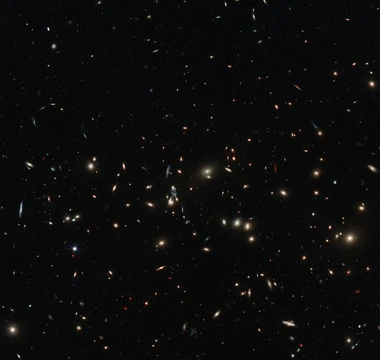
Robert's Quartet
A compact interacting galaxy group smaller than the Milky Way's disk.

Robert's Quartet is a tightly packed group of four galaxies about 160 million light-years away in the constellation Phoenix. The entire system spans roughly 75,000 light-years in radius—smaller than the width of the Milky Way's disk. Because the galaxies are so close together, their mutual gravity causes severe disruptions, warping their shapes and triggering bursts of star formation.
The quartet includes four galaxies that are being torn apart by tidal forces. NGC 87 is an irregular, gas-rich galaxy with at least 56 distinct H II regions scattered across it. Next to it, NGC 88 is a barred spiral wrapped in a diffuse outer gas envelope that has been stripped away by its neighbors. NGC 89 is an active galaxy with a Seyfert 2 nucleus; classified as a barred spiral, its spiral arms are heavily distorted. The largest member, NGC 92, is an unbarred spiral containing over 200 massive H II regions, each 500 to 1,500 light-years across. Gravitational shearing has pulled a tail of dust and stars from NGC 92 that extends more than 100,000 light-years into intergalactic space.
English astronomer John Herschel discovered all four galaxies on September 30, 1834, while surveying the southern sky from the Cape of Good Hope. In 1987, astronomers Halton Arp and Barry F. Madore cataloged the system as AM 0018-485 in *A Catalogue of Southern Peculiar Galaxies and Associations*. They named it "Robert's Quartet" after Robert Freedman, who calculated and updated the positional data for the catalog's peculiar galaxy systems.
- Distance
- 160 million light-years (49 Mpc)
- Constellation
- Phoenix
- Radius
- roughly 75,000 light-years
- Combined visual magnitude
- 13.0
- Number of member galaxies
- 4
- Discoverer
- John Herschel
- Discovery date
- September 30, 1834
Lore & Background
The system consists of four primary galaxies undergoing tidal disruption. NGC 87 is an irregular, gas-rich galaxy containing at least 56 distinct H II regions scattered across its disk. Adjacent to it sits NGC 88, a barred spiral galaxy encased in a diffuse outer gas envelope that has been stripped away by the gravitational pull of its neighbors. NGC 89 operates as an active galaxy, powered by a Seyfert 2 active galactic nucleus. Classified as a barred spiral, it displays heavily distorted spiral arms. The largest component of the group is NGC 92, an unbarred spiral containing over 200 massive H II regions spanning 500–1,500 light-years in diameter. Gravitational shearing forces have drawn out a tail of dust and stars extending over 100,000 light-years away from NGC 92 into the surrounding intergalactic medium.
English astronomer John Herschel discovered the four galaxies on September 30, 1834, during a southern sky survey conducted from the Cape of Good Hope. Astronomers Halton Arp and Barry F. Madore cataloged the system as AM 0018-485 in 1987 in A Catalogue of Southern Peculiar Galaxies and Associations. They named the group 'Robert's Quartet' after Robert Freedman, the astronomer who calculated and updated the positional data for the catalog's peculiar galaxy systems.
Reader's Guide
Robert's Quartet is notable as a compact interacting galaxy group where extreme physical proximity causes severe gravitational disruptions among its four member galaxies, driving structural distortion and starburst formation. The group's entire radius of roughly 75,000 light-years is smaller than the disk of the Milky Way, highlighting its unusually dense configuration. Discovered by John Herschel in 1834 and later cataloged by Arp and Madore in 1987, the system was named after Robert Freedman for his work on positional data. Its significance lies in the detailed tidal interactions observed: NGC 88's gas envelope stripped by neighbors, NGC 89's Seyfert 2 nucleus, and NGC 92's extended tail of dust and stars over 100,000 light-years. These features make it a key example of galaxy group dynamics and starburst activity in a compact environment.
Did You Know?
- The entire group is smaller across than the disk of the Milky Way.
- The group was named after Robert Freedman, who calculated positional data for the catalog of peculiar galaxies.
More in Galaxy Clusters and Groups, Part 2 1-24
Spotted an error? Know more?
Reader corrections go straight into our review queue. Suggest an edit · How this site is sourced