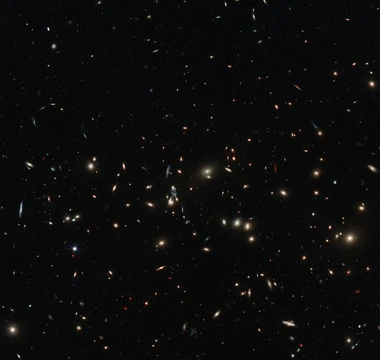
Radio halo
Diffuse radio emission in cluster centers, often linked to mergers.

In the centers of some galaxy clusters, vast clouds of faint radio emission called radio halos can be found. These structures come in two sizes: giant radio halos, which span about 700 kiloparsecs (2.3 million light-years), and mini-halos, which are typically smaller than 500 kiloparsecs. Giant radio halos are more common in clusters with high X-ray luminosity, while mini-halos appear in clusters with cooling cores, centered around a radio galaxy.
Unlike radio galaxies, which are tied to active galactic nuclei, radio halos have no obvious galaxy counterpart and are extremely dim. Their shape generally follows the distribution of hot gas in the intra-cluster medium. The origin of radio halos is still uncertain. One leading idea is that they form when merging galaxy clusters stir up turbulence in the intra-cluster plasma, generating magneto-hydrodynamic waves that accelerate mildly relativistic electrons (around 100 MeV) to energies of 10 GeV or more. Another model proposes that the electrons come from collisions between cosmic ray protons and protons in the intra-cluster medium.
A related phenomenon, radio relics, are similar to halos but appear at the edges of clusters. They are thought to be produced by synchrotron radiation from electrons accelerated by shock waves moving through magnetic fields of roughly 0.1 to 3 microgauss.
- Linear size giant halos
- about 700 kiloparsecs (2.3 million light-years)
- Linear size mini halos
- typically less than 500 kpc
- X ray luminosity threshold
- L_X ≤ 10^45 erg s^-1
- Magnetic field strength relics
- 0.1 - 3 μG
Lore & Background
Radio halos are classified into two types: giant radio halos and mini-halos. Giant radio halos have a linear size of about 700 kiloparsecs (2.3 million light-years), while mini-halos are typically less than 500 kpc. Giant radio halos are more often observed in highly X-ray luminous cluster samples than in less luminous X-ray clusters (L_X ≤ 10^45 erg s^-1) in complete samples. Their morphologies typically follow the distribution of gas in the intra-cluster medium. Mini-halos, while similar to giant halos, are found at the center of cooling core clusters but around a radio galaxy.
The cause of radio halos is still debated. One model suggests they may be caused by reacceleration of mildly relativistic electrons during a merger event between galaxy clusters, where generated turbulent motions of the intra-cluster plasma drive magneto-hydrodynamical waves that accelerate particles up to 10 GeV or more. An alternative model proposes they are caused by secondary electrons generated by collisions between cosmic ray protons and intra-cluster medium protons. Radio relics resemble halos but are found at the edge of clusters, likely resulting from synchrotron radiation from electrons accelerated by shock waves.
Reader's Guide
Radio halos are significant as large-scale diffuse radio sources in galaxy clusters, providing insight into non-thermal processes in the intra-cluster medium. Their presence in only some clusters and their association with cluster mergers suggests they trace dynamic events that reaccelerate relativistic particles. The distinction between giant halos and mini-halos, with the latter found in cooling core clusters around a radio galaxy, indicates different formation environments. The ongoing debate between the reacceleration model and the secondary electron model highlights the complexity of understanding particle acceleration mechanisms in clusters. Their low surface brightness and morphological alignment with the intra-cluster gas make them valuable probes of cluster physics, while the comparison with radio relics at cluster edges underscores the variety of diffuse radio structures in the universe.
Did You Know?
- Mini-halos are typically less than 500 kpc in size and found at the center of cooling core clusters around a radio galaxy.
- The cause of radio halos is still debated, with models involving reacceleration during mergers or secondary electrons from cosmic ray collisions.
More in Galaxy Clusters and Groups, Part 2 1-24
Spotted an error? Know more?
Reader corrections go straight into our review queue. Suggest an edit · How this site is sourced