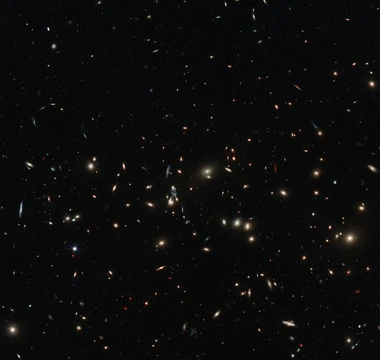
PKS 1353−341
A quasar hidden within a massive galaxy cluster.

PKS 1353−341 (also cataloged as LEDA 88936) is a quasar in the southern constellation Centaurus, with a 99% probability of being classified as such. It has an apparent magnitude of 18.5, meaning it can only be observed with large telescopes. Its luminosity places it at an estimated distance of 3.7 billion light-years from the Solar System, and it is moving away from the Milky Way at a heliocentric radial velocity of 66,854 km/s.
First identified by R.A. Preston in 1985, the object went unnoticed prior to that. Analysis in 1998 suggested it might be relatively dusty, based on its X-ray properties. Long thought to be an isolated quasar, the CHiPS (Clusters Hiding in Plain Sight) Survey later found that it is actually embedded within a massive galaxy cluster designated PSZ2 G317.79+26.63. This discovery came from analyzing data from the 2MASS, NVSS, ROSAT, SUMSS, and WISE all-sky surveys, which targeted powerful sources of infrared, radio, and X-ray light to uncover galaxy clusters previously misidentified as isolated X-ray sources due to the central quasar's brightness.
As an individual object, PKS 1353−341 has a central mass of 300 billion solar masses—about one-quarter the mass of the Milky Way. Its absolute magnitude in the blue passband is −22.4, making it extremely luminous. The host galaxy is a large elliptical. Typical of quasars, it features two jets emanating from the galaxy’s center. When the quasar and its surrounding cluster are combined, the total mass is 6.9+3.4−2.6×10¹⁴ solar masses, roughly a thousand times the mass of our own galaxy.
Quick Facts
- Epoch
- J2000.0 (ICRS)
- Constellation Name
- Centaurus
- Ra
- 13 · 56 · 05.38657
- Dec
- -34 · 21 · 10.8591
- Z
- 0.222928
- Dist Ly
- 1.14141 Gpc
- Group Cluster
- PSZ2 G317.79+26.63
- Appmag V
- 18.5
- Appmag B
- 17.47
- Absmag V
- −22.4
Facts from the source article.
Lore & Background
PKS 1353−341 was first identified by R.A. Preston in 1985; before then, it was unnoticed. Analysis in 1998 revealed that it might be relatively dusty based on the quasar's X-ray properties. Long thought to be solitary, the CHiPS Survey found PSZ2 G317.79+26.63, a massive galaxy cluster surrounding the quasar. The team analyzed data from the 2MASS, NVSS, ROSAT, SUMSS, and WISE all-sky surveys to locate powerful sources of infrared, radio, and X-ray light, aiming to discover new galaxy clusters previously misidentified as isolated X-ray sources due to the central quasar's brightness.
Reader's Guide
The significance of PKS 1353−341 lies in its role as a case study for how bright quasars can obscure the presence of surrounding galaxy clusters. The CHiPS Survey's discovery of PSZ2 G317.79+26.63 demonstrated that many previously cataloged isolated X-ray sources may actually be cluster cores, hidden by the quasar's luminosity. This finding has implications for understanding galaxy cluster populations and the environments of quasars. The system's combined mass of 6.9+3.4−2.6×10^14 solar masses makes it a thousand times more massive than the Milky Way, highlighting the scale of the structure. The quasar itself, with a central mass 300 billion times that of the Sun and an absolute magnitude of −22.4, is very luminous and hosts two jets typical of quasars, originating from the center of its host elliptical galaxy.
Did You Know?
- PKS 1353−341 has a 99% chance of being a quasar.
- It is receding from the Milky Way at 66,854 km/s.
- The surrounding cluster PSZ2 G317.79+26.63 was discovered by the CHiPS Survey.
- The combined mass of the quasar and cluster is 6.9+3.4−2.6×10^14 solar masses.
More in Galaxy Clusters and Groups, Part 2 1-24
Spotted an error? Know more?
Reader corrections go straight into our review queue. Suggest an edit · How this site is sourced