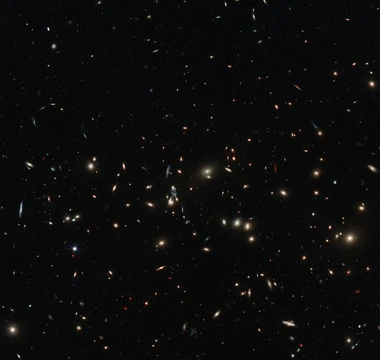
Phoenix Cluster
The most X-ray luminous and one of the most massive known galaxy clusters.

The Phoenix Cluster, also cataloged as SPT-CL J2344-4243, is a massive Abell-class type I galaxy cluster in the southern constellation Phoenix. It ranks among the most massive known clusters, with a mass around 2×10¹⁵ solar masses, and holds the record for the highest X-ray luminosity of any known massive cluster. Its comoving distance from Earth is 8.61 billion light-years (2.64 gigaparsecs).
The cluster was first reported in 2010 by R. Williamson and colleagues during a 2,500-square-degree survey of the southern sky using the South Pole Telescope. Detected at frequencies of 95, 150, and 220 GHz via the Sunyaev–Zeldovich effect, it was one of 26 clusters identified in the survey. Of these, 14 were previously known, while 12—including the Phoenix Cluster—were new discoveries. The survey noted its "largest X-ray luminosity of any cluster." A bright type-2 Seyfert galaxy, 2MASX J23444387-4243124 (later named Phoenix A), lies 19 arcseconds from the apparent cluster center.
The Phoenix Cluster exhibits an extremely strong cooling flow rate of roughly 3,280 solar masses per year, described as a runaway cooling flow—one of the highest ever measured in a cluster core. Unlike other clusters, this intense cooling may result from an inadequate feedback mechanism: the central black hole's heating is insufficient to prevent runaway cooling, unlike in the Perseus and Virgo clusters. This is supported by the central galaxy Phoenix A's high starburst activity, forming stars at 740 solar masses per year (compared to the Milky Way's 1 solar mass per year), and by its active galactic nucleus, which does not produce enough energy to ionize the gas and curb star formation.
The central elliptical cD galaxy, Phoenix A (also known as RBS 2043), hosts an active galactic nucleus with properties of both a quasar and a type-2 Seyfert galaxy, powered by a supermassive black hole. Its morphology is uncertain. In the K-band, its total aperture angular diameter is 16.20 arcseconds, corresponding to an isophotal diameter of 110.48 kiloparsecs (360,300 light-years), making it one of the largest known galaxies. Phoenix A contains vast amounts of hot gas, with more normal matter than all other cluster galaxies combined. Data show the hot gas is cooling in the central regions at 3,820 solar masses per year, the highest rate ever recorded.
Quick Facts
- Credit
- Chandra X-ray Observatory/Hubble Space Telescope
- Epoch
- J2000.0
- Constellation
- Phoenix
- Ra
- 23 · 44 · 40.9
- Dec
- -42 · 41 · 54
- Brightest Member
- Phoenix A (mag 18.2)
- Member No
- 42 known
- Redshift
- 0.597320 · 0.000150 (center)
- Distance
- 2640.6 ± / (present comoving) / 1796.38 Mpc / (light-travel)
- Other Names
- Phoenix Cluster, SPT-CL J 2344 -4243, SPT-CL J2344-4243
Facts from the source article.
Lore & Background
The Phoenix Cluster was first reported in a 2010 paper by R. Williamson and colleagues during a survey by the South Pole Telescope in Antarctica, being one of 26 galaxy clusters identified by the survey. It was detected at frequencies between 95, 150 and 220 GHz using the Sunyaev–Zeldovich effect. The cluster was noted for having the largest X-ray luminosity of any cluster described by the survey. A bright, type-2 Seyfert galaxy, 2MASX J23444387-4243124 (later named Phoenix A), lies 19 arcseconds from the apparent center.
Owing to its extreme properties, the Phoenix Cluster has been extensively studied. A multiwavelength study by M. McDonald and colleagues showed an extremely strong cooling flow rate of roughly 3,280 M☉ per year, described as a runaway cooling flow. This is one of the highest ever seen in the middle of a galaxy cluster. The very strong cooling flow, in contrast to other clusters, has been suggested to result from a feedback mechanism that may not yet be established in the Phoenix Cluster; the heating mechanism expected from the central black hole is inadequate to create feedback (unlike the Perseus and Virgo clusters). This is supported by the high starburst activity of Phoenix A, where stars form at 740 M☉ per year, and the central active galactic nucleus has not produced sufficient energy to ionize the galaxy's gas and prevent starburst activity.
The central elliptical cD galaxy Phoenix A hosts an active galactic nucleus sharing properties of both a quasar and a type 2 Seyfert galaxy, powered by a central supermassive black hole. The galaxy has an uncertain morphology. Its isophotal diameter is 110.48 kiloparsecs (360,300 light-years), making it one of the largest known galaxies. The central black hole's mass has been estimated on the order of 100 billion M☉, possibly exceeding this mass, though not yet measured through orbital mechanics. Such a high mass may place it into a proposed category of stupendously large black holes (SLABs).
Reader's Guide
The Phoenix Cluster's significance lies in its extreme properties, which challenge standard models of galaxy cluster evolution and feedback. Its runaway cooling flow and exceptionally high star formation rate in the central galaxy indicate that the usual feedback mechanism—where the central black hole heats the surrounding gas and prevents runaway cooling—has not yet become established. This makes the cluster a unique laboratory for studying the early stages of feedback and the interplay between cooling flows, starbursts, and active galactic nuclei. The estimated mass of its central black hole, potentially exceeding 100 billion M☉, places it among the most massive black holes known and raises questions about the upper limits of black hole growth. Observations by the James Webb Space Telescope in 2025 detected an intermediate-temperature cooling gas (~300,000 Kelvin) bridging the gap between hot and cool gas, a phenomenon unseen in other clusters, providing a key missing link in understanding the cluster's rapid star formation. The cluster's legacy is as a benchmark for extreme cooling flows and a testbed for theories of galaxy formation and black hole feedback.
Did You Know?
- The Phoenix Cluster was initially detected in 2010 during a 2,500-square-degree survey of the southern sky using the Sunyaev–Zeldovich effect by the South Pole Telescope.
- Its central galaxy, Phoenix A, has a star formation rate of 740 M☉ per year, compared to the Milky Way's 1 M☉ per year.
- The central black hole's estimated mass of 100 billion M☉ would have a Schwarzschild radius of 295.25 billion kilometers (0.031 light-years).
- In 2025, the James Webb Space Telescope detected an intermediate-temperature cooling gas (~300,000 Kelvin) in the cluster, a phenomenon unseen in other galaxy clusters.
More in Galaxy Clusters and Groups, Part 2 1-24
Spotted an error? Know more?
Reader corrections go straight into our review queue. Suggest an edit · How this site is sourced