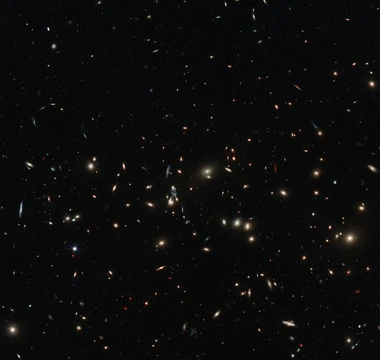
Perseus Cluster
One of the most massive objects in the known universe.

The Perseus Cluster (cataloged as Abell 426) lies in the constellation Perseus and ranks among the most massive structures known, with thousands of galaxies embedded in a superheated gas cloud reaching millions of degrees. It recedes at 5,366 km/s and spans 863 arcminutes. In X-ray observations, it shines as the brightest galaxy cluster in the sky.
X-ray emission from the cluster was first detected on March 1, 1970, during an Aerobee rocket flight, designated Per XR-1. This source may be linked to the central galaxy NGC 1275 (also known as Per A or 3C 84), with an X-ray luminosity of roughly 4 × 10⁴⁵ ergs/s if that identification holds. The Uhuru satellite later confirmed the detection and its location within the cluster. At the cluster’s core, NGC 1275 hosts the radio source 3C 84, which inflates bubbles of relativistic plasma. These bubbles push aside the X-ray-emitting gas, creating visible holes in X-ray images. Because the bubbles emit radio waves due to their relativistic particles, they are called radio bubbles.
In 2003, a team led by Andrew Fabian at Cambridge University used 53 hours of Chandra observations to detect one of the deepest notes ever found. The sound waves, with a period of 9.6 million years between oscillations, lie 57 octaves below the middle keys of a piano—far too low for human hearing. These waves arise from the central active galactic nucleus in NGC 1275 inflating the relativistic plasma bubbles. The ripples become visible in X-rays because the brightness of the intracluster medium depends strongly on plasma density. In May 2022, NASA released a sonification of the pressure waves from the black hole at the cluster’s center, converting the astronomical data into sound. A similar phenomenon occurs in the nearby Virgo Cluster, where an even larger supermassive black hole in Messier 87 generates variable tones—56 octaves below middle C during minor eruptions and as low as 59 octaves below middle C during major ones, also inaudible to humans.
- Recession speed
- 5,366 km/s
- Diameter
- 863′
- X ray brightness
- brightest cluster in the sky in X-ray band
- Central galaxy
- NGC 1275
- Radio source
- 3C 84
- First x ray detection
- March 1, 1970, during an Aerobee rocket flight
- X ray luminosity if ngc 1275
- 4 × 10^45 ergs/s
Lore & Background
The Perseus Cluster contains the radio source 3C 84, which blows bubbles of relativistic plasma into the cluster's core. These bubbles appear as holes in X-ray images, pushing away the X-ray emitting gas, and are known as radio bubbles due to their radio wave emission. The galaxy NGC 1275 is located at the center of the cluster, where X-ray emission is brightest. The first detection of X-ray emission from the cluster, designated Per XR-1, occurred during an Aerobee rocket flight on March 1, 1970, and was reported in 1971; the source may be associated with NGC 1275 (Per A, 3C 84). More detailed observations from Uhuru confirmed the earlier detection and its source within the cluster.
In 2003, a team led by Andrew Fabian at Cambridge University discovered one of the deepest notes ever detected after 53 hours of Chandra observations. The note has a time period between oscillations of 9.6 million years, 57 octaves below middle C on a piano, and is generated by the inflation of bubbles of relativistic plasma by the central active galactic nucleus in NGC 1275. The bubbles are visible as ripples in the X-ray band. In May 2022, NASA reported the sonification of the black hole at the center of the Perseus cluster. A similar case occurs in the nearby Virgo Cluster, generated by an even larger supermassive black hole in Messier 87, with a tone variable from 56 to 59 octaves below middle C.
Reader's Guide
The Perseus Cluster's significance lies in its extreme mass and its role as a laboratory for studying intracluster medium and active galactic nuclei feedback. The discovery of deep sound waves from its central black hole, detected via Chandra X-ray observations, provided direct evidence of how relativistic bubbles inject energy into the cluster's hot gas, regulating star formation and heating the intracluster medium. The sonification of these pressure waves in 2022 made the phenomenon accessible to a broader audience. The cluster's X-ray brightness and the presence of radio bubbles from 3C 84 have made it a key target for understanding the interplay between supermassive black holes and their host clusters. The detection of Per XR-1 in 1970 marked an early milestone in X-ray astronomy, and subsequent observations by Uhuru confirmed the cluster as a persistent X-ray source. The comparison with the Virgo Cluster highlights that such sound wave phenomena may be common in galaxy clusters, offering insights into the long-term evolution of the largest gravitationally bound structures in the universe.
Did You Know?
- The Perseus Cluster is the brightest cluster in the sky when observed in the X-ray band.
- In 2003, astronomers discovered one of the deepest notes ever detected, with a period of 9.6 million years.
- The first X-ray detection of the cluster occurred during an Aerobee rocket flight on March 1, 1970.
More in Galaxy Clusters and Groups, Part 2 1-24
Spotted an error? Know more?
Reader corrections go straight into our review queue. Suggest an edit · How this site is sourced