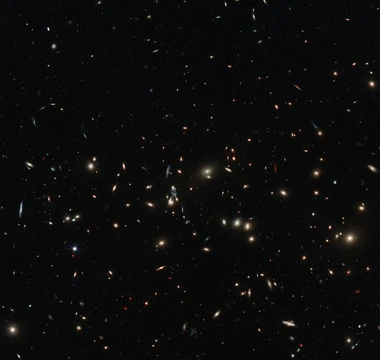
NGC 7331 Group
A visual grouping of galaxies, not a true cluster.

The NGC 7331 Group is a visual grouping of galaxies in the constellation Pegasus, anchored by its largest member NGC 7331. It is notable as an optical alignment rather than a gravitationally bound cluster, with four faint background galaxies known as 'the fleas' lying far behind the foreground NGC 7331.
- Largest member
- NGC 7331
- Distance of ngc 7331
- 40 million light-years (12.3 Mpc)
- Constellation
- Pegasus
- Discoverer of ngc 7331
- William Herschel
- Discovery date of ngc 7331
- September 6, 1784
- Catalog designation
- Holm 795
- Informal name
- Deer Lick Group
Lore & Background
The NGC 7331 Group was first cataloged by William Herschel, who discovered NGC 7331 on September 6, 1784. Swedish astronomer Erik Holmberg later cataloged the visual system as Holm 795 in his 1937 study of multiple galaxies. The popular informal name 'Deer Lick Group' was coined in the 1980s by American amateur astronomer Tom Lorenzin to commemorate an exceptional viewing session at the Deerlick Gap Overlook along the Blue Ridge Parkway in North Carolina, where he observed NGC 7331 along with its faint background companion galaxies. Spectroscopic measurements from the NASA/IPAC Extragalactic Database (NED) confirm that the group is an optical grouping caused by line-of-sight alignment rather than a gravitationally bound cluster. While NGC 7331 sits in the foreground at a heliocentric radial velocity of 816 km/s (redshift 0.002722), the four background companion galaxies—NGC 7335, NGC 7336, NGC 7337, and NGC 7340—exhibit recessional velocities between 6,200 km/s and 8,800 km/s (redshift 0.021 to 0.029 Z), placing them at distances from 290 to 370 million light-years. The true physical group bound to NGC 7331 consists of several satellite dwarf galaxies at matching distances, and NGC 7320 (which visually overlaps Stephan's Quintet), UGC 1206), and UGC 12160.
Reader's Guide
The NGC 7331 Group serves as a cautionary example in extragalactic astronomy, illustrating how visual proximity in the sky does not guarantee physical association. Despite historical catalogs grouping these objects together due to their close apparent positions, modern spectroscopic measurements reveal that the four 'flea' galaxies—NGC 7335, NGC 7336, NGC 7337, and NGC 7340—are background objects lying at distances between 290 and 370 million light-years, far beyond the 40 million light-year distance of NGC 7331. This optical alignment underscores the importance of radial velocity data in distinguishing true clusters from line-of-sight coincidences. The group's legacy includes its informal name, the Deer Lick Group, coined by amateur astronomer Tom Lorenzin in the 1980s, which has persisted in popular astronomy literature. The group is often referenced alongside other notable visual groupings such as Stephan's Quintet, Wild's Triplet, and Zwicky's Triplet, and it remains a popular target for amateur observers due to the striking contrast between the bright foreground NGC 7331 and the faint background companions.
Did You Know?
- The four faint background galaxies northeast of NGC 7331 are informally called 'the fleas'.
- NGC 7331 was discovered by William Herschel on September 6, 1784.
- The group's informal name 'Deer Lick Group' was coined by amateur astronomer Tom Lorenzin in the 1980s.
- The true physical group bound to NGC 7331 includes satellite dwarf galaxies and NGC 7320, UGC 1206), and UGC 12160.
More in Galaxy Clusters and Groups, Part 2 1-24
Spotted an error? Know more?
Reader corrections go straight into our review queue. Suggest an edit · How this site is sourced