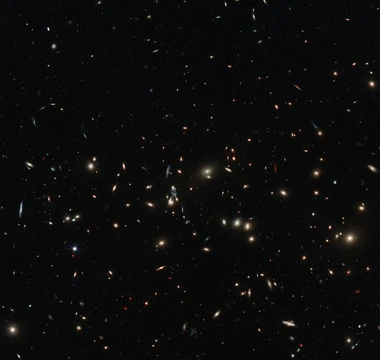
NGC 7079 Group
A galaxy group connecting the Pavo–Indus and Virgo Superclusters.

The NGC 7079 Group is a collection of galaxies in the constellation Grus. Its central member, NGC 7079, is a barred lenticular galaxy roughly 110.58 million light-years from Earth. Discovered by John Herschel on September 6, 1834, the galaxy is tilted about 51° relative to our line of sight. It is also classified as a LINER galaxy. NGC 7079 features a faint, cigar-shaped bar with ansae at its ends, surrounded by a very faint spiral structure. The disk’s rim contains a somewhat faint ring-like structure. Observations indicate a faint emission of doubly ionized oxygen gas within the galaxy, which rotates in the opposite direction of its stars. This counter-rotation is thought to result from the accretion of gas from outside the galaxy. The NGC 7079 Group itself includes NGC 7070, NGC 7070A, NGC 7097, NGC 7097A, ESO 287-37, ESO 287-39, ESO 287-41, and ESO 287-43. Together with other nearby groups, it belongs to the Pavo-Indus and Grus clouds, which form a bridge between the Pavo–Indus and Virgo Superclusters.
Quick Facts
- Epoch
- J2000
- Ra
- 21 · 32 · 35.2
- Dec
- -44 · 04 · 03
- Z
- 0.00895
- H Radial V
- 2,684 km/s
- Appmag V
- 11.6
- Constellation Name
- Grus
- Names
- ESO 287-36, AM 2129-441, MCG -7-44-22, PGC 66934
Facts from the source article.
Lore & Background
The NGC 7079 Group is a collection of galaxies that includes NGC 7079, a barred lenticular galaxy located about 110.58 million light-years away in Grus. NGC 7079 was discovered by astronomer John Herschel on September 6, 1834. It is classified as a LINER galaxy and is tilted about 51° to Earth's line of sight. The galaxy has a faint cigar-shaped bar with ansae at the ends, a very faint surrounding spiral structure, and a faint ring-like structure at the rim of its disk.
In NGC 7079, a faint emission of doubly ionized oxygen has been indicated. The ionized gas rotates in the opposite direction of the stars in the galaxy, a counter-rotation attributed to the accretion of gas from outside the galaxy. The group also contains NGC 7070, NGC 7070A, NGC 7097, NGC 7097A, and several ESO galaxies.
The NGC 7079 Group, along with other nearby groups, is part of the Pavo-Indus and Grus clouds of galaxies, which form a connection between the Pavo–Indus and Virgo Superclusters.
Reader's Guide
The NGC 7079 Group is significant as a component of the large-scale structure connecting the Pavo–Indus and Virgo Superclusters. Its most studied member, NGC 7079, provides insight into galaxy evolution through its counter-rotating ionized gas, which suggests external gas accretion. The group's membership includes multiple galaxies, such as NGC 7070, NGC 7070A, NGC 7097, and NGC 7097A, along with several ESO objects. The presence of a LINER galaxy (NGC 7079) with a faint bar, spiral structure, and ring-like disk adds to the group's interest for studies of galaxy morphology and dynamics. The group's location in the Grus constellation and its role in the Pavo-Indus and Grus clouds underscore its place in the cosmic web.
Did You Know?
- NGC 7079, a member of the group, has a faint cigar-shaped bar with ansae at the ends.
- The ionized gas in NGC 7079 rotates in the opposite direction of its stars.
- The NGC 7079 Group is part of the Pavo-Indus and Grus clouds connecting the Pavo–Indus and Virgo Superclusters.
More in Galaxy Clusters and Groups, Part 2 1-24
Spotted an error? Know more?
Reader corrections go straight into our review queue. Suggest an edit · How this site is sourced