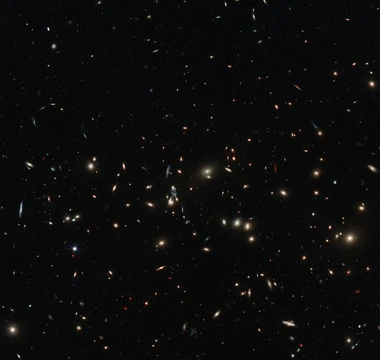
NGC 5866 Group
A small galaxy group in Draco, possibly part of a larger structure.

In the constellation Draco lies a small gathering of galaxies known as the NGC 5866 Group. Its name comes from NGC 5866, which has the highest apparent magnitude among the group’s members, though some catalogs instead list NGC 5907 as the brightest.
The group’s confirmed members are those consistently included in the Nearby Galaxies Catalog, the Lyons Groups of Galaxies (LGG) Catalog, and three group lists derived from the Nearby Optical Galaxy sample by Giuricin et al. Additional possible members—appearing in only one or two of those lists—are NGC 5866B, NGC 5963, UGC 9776, and UGC 9816.
To the northwest lie the M101 Group (home to the Pinwheel Galaxy and its companions) and the M51 Group (which contains the Whirlpool Galaxy, the Sunflower Galaxy, and others). The distances to these three groups are similar, hinting that they may actually form a single large, loose, elongated structure. However, most group identification methods, including those used by the references above, treat them as separate entities.
- Constellation
- Draco
- Named after
- NGC 5866
- Brightest member (disputed)
- NGC 5866 or NGC 5907
- Consistently identified members
- Listed in the Nearby Galaxies Catalog, the Lyons Groups of Galaxies (LGG) Catalog, and three group lists from Giuricin et al.
- Possible additional members
- NGC 5866B, NGC 5963, UGC 9776, UGC 9816
Lore & Background
The NGC 5866 Group is a small group of galaxies located in the constellation Draco. It is named after NGC 5866, the galaxy with the highest apparent magnitude in the group, though some galaxy group catalogs list NGC 5907 as the brightest member. The group's membership has been consistently identified in the Nearby Galaxies Catalog, the Lyons Groups of Galaxies (LGG) Catalog, and three group lists created from the Nearby Optical Galaxy sample of Giuricin et al. Other possible member galaxies—those listed in only one or two of these references—include NGC 5866B, NGC 5963, UGC 9776, and UGC 9816.
The NGC 5866 Group is located to the northwest of both the M101 Group (which contains the Pinwheel Galaxy and its companion galaxies) and the M51 Group (which contains the Whirlpool Galaxy, the Sunflower Galaxy, and several other galaxies). The distances to these three groups, as determined from the distances to their individual member galaxies, are similar, which suggests that the M51 Group, the M101 Group, and the NGC 5866 Group are actually part of a large, loose, elongated structure. However, most group identification methods—including those used by the references cited above—identify these three groups as separate entities.
Reader's Guide
The NGC 5866 Group is significant as a small galaxy group whose membership has been consistently identified across multiple major catalogs, including the Nearby Galaxies Catalog, the Lyons Groups of Galaxies Catalog, and the Giuricin et al. lists. Its naming reflects a common practice of designating groups after the galaxy with the highest apparent magnitude, though a discrepancy exists: some catalogs instead list NGC 5907 as the brightest member. The group's location northwest of the M101 Group and M51 Group, combined with similar distances to these groups, suggests they may form a large, loose, elongated structure. However, most group identification methods treat them as separate entities, highlighting the ongoing challenge in defining galaxy group boundaries. The group's legacy lies in its role as a case study for group membership criteria and the hierarchical structure of the local universe, as well as its inclusion in reference compendia for astronomers studying nearby galaxy groups.
More in Galaxy Clusters and Groups, Part 2 1-24
Spotted an error? Know more?
Reader corrections go straight into our review queue. Suggest an edit · How this site is sourced