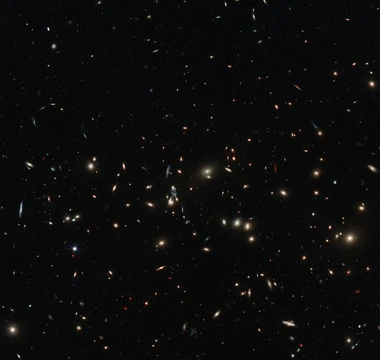
NGC 5679 Group
Triplet of galaxies in Virgo, imaged by Hubble in 2009.

The NGC 5679 group, also known as Arp 274, is a triplet of galaxies located about 400 million light-years from Earth in the constellation Virgo. It is notable for being listed in Halton Arp's Atlas of Peculiar Galaxies as an example of galaxies that appear to have connected arms, and for having been imaged by the Hubble Space Telescope in 2009.
Quick Facts
- Epoch
- J2000
- Ra
- Center: 14 · 35 · 08.763 / Left: 14 · 35 · 11.0 / Right: 14 · 35 · 06.354
- Dec
- Center: +05 · 21 · 32.41 / Left: +05 · 21 · 16 / Right: +05 · 21 · 24.41
- Constellation Name
- Virgo
- Z
- Center: 0.028900 / Right: 0.02487
- H Radial V
- Center: 8654 / Left: 7483 / Right: 7618
- Appmag B
- Center: 14.5 / Left: 16 / Right: 14.5
- Notes
- Interacting galaxy triple
- Names
- Center: NGC 5679B, PGC 52132, UGC 9383, MCG+01-37-035, VV 458 / Left: NGC 5679C, PGC 52129, MCG+01-37-036 / Right: NGC 5679A, PGC 52130, MCG+01-37-034, SDSS J143506.38+052124.5
Facts from the source article.
Lore & Background
The NGC 5679 group was cataloged as Arp 274 in Halton Arp's 1966 Atlas of Peculiar Galaxies, specifically among entries 269 through 274, which show galaxies that appear to have connected arms. Redshift measurements of the three galaxies give radial velocities of 7483, 8654, and 7618 km/s from left to right. The relatively high redshift of the center galaxy (8654 km/s) indicates it is about 65 million light-years (20 megaparsecs) farther away than the other two, making it likely a background object rather than a true group member.
The Hubble image from 2009, taken with blue, visible, infrared, and Hα filters, shows that all three galaxies, especially the left and right ones, are starburst galaxies undergoing intense star formation. Interstellar dust is visible between the star-forming regions. Two bright foreground stars, actually part of our own Milky Way, appear just above the galaxy on the right side. The image also confirms that the center galaxy is not interacting gravitationally with the others, as its arms are not distorted like those of typical interacting galaxies, contrary to earlier assumptions.
Reader's Guide
The NGC 5679 group holds significance as an example of how modern imaging can revise earlier interpretations of galaxy interactions. Originally cataloged by Halton Arp as a system with apparently connected arms, the group was long thought to be a gravitationally interacting triplet. However, the 2009 Hubble image revealed that the center galaxy is a background object, not physically associated with the other two, and that the remaining pair are starburst galaxies. This underscores the value of high-resolution multi-filter observations in disentangling line-of-sight alignments from true physical associations. The group also contributed a supernova discovery: SN 1982D, found by Arp and Sulentic in 1982. Its legacy lies in demonstrating that even well-studied peculiar galaxy systems may contain projection effects, and that starburst activity can occur in galaxies that are not necessarily undergoing major mergers.
Did You Know?
- The NGC 5679 group is also cataloged as Arp 274 in Halton Arp's Atlas of Peculiar Galaxies.
- The center galaxy has a radial velocity of 8654 km/s, placing it about 65 million light-years behind the other two.
- The Hubble image from 2009 used blue, visible, infrared, and Hα filters to reveal starburst activity.
- One supernova, SN 1982D, was discovered in NGC 5679 on 23 March 1982 by Halton Arp and Jack W. Sulentic.
More in Galaxy Clusters and Groups, Part 2 1-24
Spotted an error? Know more?
Reader corrections go straight into our review queue. Suggest an edit · How this site is sourced