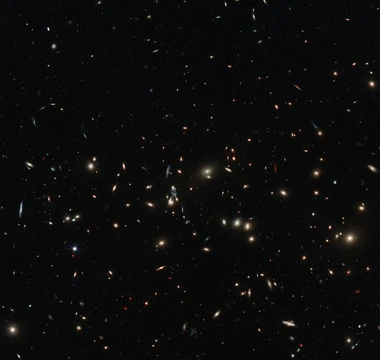
NGC 4666 Group
A small group hosting a starburst galaxy with a superwind.

The NGC 4666 Group is a small galaxy cluster located in the equatorial constellation of Virgo, part of the larger Virgo II Groups that extend from the southern edge of the Virgo Supercluster. It is notable for containing the starburst galaxy NGC 4666, which exhibits a vigorous superwind of outflowing gas observed in X-rays by the ESA XMM-Newton space telescope.
Quick Facts
- Epoch
- J2000
- Constellation Name
- Virgo
- Ra
- 12 · 45 · 08.676
- Dec
- −00 · 27 · 42.88
- Dist Ly
- 16.83 ±
- Appmag V
- 10.8
- Notes
- Starburst
Facts from the source article.
Lore & Background
The NGC 4666 Group is a small collection of galaxies that includes NGC 4666, NGC 4668, a dwarf galaxy, and NGC 4632. NGC 4666 was discovered by German-born astronomer William Herschel on February 22, 1784, and is described by John L. E. Dreyer as 'bright, very large, much extended 45°±, pretty suddenly brighter middle'. It is a member of an interacting system with NGC 4668 and the dwarf galaxy.
NGC 4666 has a morphological classification of SABc, indicating a weak bar around the nucleus with moderately wound spiral arms. It is viewed nearly edge-on, with its galactic plane inclined at 85°±2° to the line of sight, and its major axis aligned along a position angle of 40°. The galaxy hosts an active galactic nucleus that shows modest activity and is likely heavily obscured by gas and dust; its central point source has been detected in radio and X-ray bands.
This galaxy is a starburst galaxy with vigorous star formation, creating an unusual superwind of outflowing gas. The wind is not visible at optical wavelengths but is prominent in X-rays, as observed by the ESA XMM-Newton space telescope. The estimated star formation rate is 7.3 M☉ yr−1, with a density of 8.9×10⁻³ M☉ yr−1 kpc−2. Unlike many other starburst galaxies, the star formation is spread across the disk rather than being concentrated.
Reader's Guide
The NGC 4666 Group is significant primarily because of its member NGC 4666, a starburst galaxy that produces a superwind of outflowing gas detectable only in X-rays. This superwind, observed by the ESA XMM-Newton space telescope, highlights the galaxy's intense star formation activity, which is spread across the disk rather than concentrated—a characteristic that distinguishes it from many other starburst galaxies. The group's inclusion in the Virgo II Groups places it within the larger structure of the Virgo Supercluster, providing context for studies of galaxy interactions and evolution. Three supernovae have been observed in NGC 4666: SN 1965H (Type IIP), ASASSN-14lp (Type Ia), and SN 2019yvr (Type Ib), the latter of which had a progenitor star of approximately 19 M☉. These events contribute to understanding stellar life cycles and supernova mechanisms within a starburst environment. The group's legacy lies in its role as a nearby laboratory for studying starburst-driven outflows and galaxy interactions.
Did You Know?
- NGC 4666 was discovered by William Herschel on February 22, 1784.
- The star formation in NGC 4666 is spread across the disk rather than being concentrated.
More in Galaxy Clusters and Groups, Part 2 1-24
Spotted an error? Know more?
Reader corrections go straight into our review queue. Suggest an edit · How this site is sourced