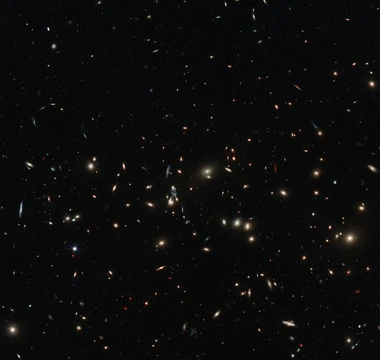
NGC 4593 Group
A galaxy group centered on the Seyfert galaxy NGC 4593.

The NGC 4593 Group is a galaxy group whose foremost member is the barred spiral Seyfert galaxy NGC 4593. It is notable for containing an active galactic nucleus with a supermassive black hole and for being located within the Local Supercluster, between the Local Supercluster and the Hydra-Centaurus Supercluster.
Quick Facts
- Epoch
- J2000
- Ra
- 12 · 39 · 39.4
- Dec
- -05 · 20 · 39
- Dist Ly
- 120 ± 57 Mly (34.3 ± 16.8 Mpc)
- Z
- 0.008312 ± 0.000020
- H Radial V
- 2,492 ± 6 km/s
- Appmag V
- 11.67
- Constellation Name
- Virgo
- Notes
- Seyfert galaxy
- Names
- MRK 1330, MCG -01-32-032, PGC 42375
Facts from the source article.
Lore & Background
The NGC 4593 Group is a galaxy group with NGC 4593 as its foremost member. Other members include the spiral galaxy NGC 4602 and the smaller galaxies MCG-01-32-37, MGC-01-32-33, SVEN 314, and SVEN 328. Markarov et al. consider NGC 4604 to be a member as well. SVEN 314 is a dwarf galaxy lying at a projected distance of 22 kpc and is the closest galaxy to NGC 4593. There is evidence that NGC 4593 is interacting with MGC-01-32-33, which lies about two disk radii away, as the spiral pattern of NGC 4593 is slightly distorted toward that galaxy, possibly due to tidal forces.
Other galaxies near the NGC 4593 Group include UGC 7798 and its group, IC 804, NGC 4626, NGC 4628, and NGC 4671. These galaxies were once considered part of the Virgo II Groups, but that classification is no longer accepted. They are now considered to lie between the Local Supercluster and the Hydra-Centaurus Supercluster, with the group itself still within the Local Supercluster.
Reader's Guide
The NGC 4593 Group is significant as a nearby galaxy group that hosts a Seyfert galaxy with an active nucleus, providing a laboratory for studying supermassive black holes and their interaction with the surrounding environment. The group's foremost member, NGC 4593, has a well-studied active nucleus with a black hole mass estimated via reverberation mapping and X-ray flux variations, and exhibits variable X-ray, ultraviolet, and optical emission with measured time lags. The group also shows evidence of tidal interaction between NGC 4593 and MGC-01-32-33, offering insight into galaxy dynamics. Its location within the Local Supercluster, yet between superclusters, places it in a transitional region of large-scale structure. The group's membership includes dwarf galaxies and spiral galaxies, making it a useful target for studies of galaxy evolution in a group environment. The disputed inclusion of NGC 4604 and the reclassification of nearby galaxies from the Virgo II Groups highlight ongoing refinement of group membership and large-scale structure.
Did You Know?
- The group's foremost galaxy, NGC 4593, is a barred spiral Seyfert galaxy discovered by William Herschel on April 17, 1784.
- The black hole at the center of NGC 4593 has an estimated mass of (9.8±2.1)×10⁶ M☉ based on reverberation mapping.
- SVEN 314, a dwarf galaxy, is the closest galaxy to NGC 4593 at a projected distance of 22 kpc.
More in Galaxy Clusters and Groups, Part 2 1-24
Spotted an error? Know more?
Reader corrections go straight into our review queue. Suggest an edit · How this site is sourced