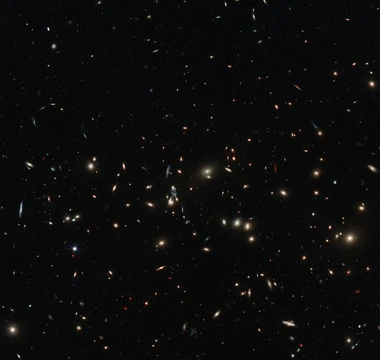
NGC 4555 Group
A small group with a dark-matter-rich elliptical galaxy.

The NGC 4555 Group is a group of 12 galaxies, with NGC 4555 as its brightest member. It is notable because its central galaxy, NGC 4555, is one of the few elliptical galaxies proven to have significant amounts of dark matter.
Quick Facts
- Epoch
- J2000
- Dec
- +26 · 31 · 23
- Ra
- 12 · 35 · 41.2
- Constellation Name
- Coma Berenices
- Z
- 6683 ± 24 km/s
- Appmag V
- 13.1
- Names
- IC 3545, UGC 7762, PGC 41975
Facts from the source article.
Lore & Background
NGC 4555 is a solitary elliptical galaxy about 40,000 parsecs (125,000 light-years) across, and about 310 million light-years distant. Observations by the Chandra X-ray Observatory have shown it to be surrounded by a halo of hot gas about 120,000 parsecs across, with a temperature of around 10,000,000 kelvin. The galaxy is one of the few elliptical galaxies proven to have significant amounts of dark matter; large amounts of dark matter are necessary to prevent the gas from escaping, as the visible mass is not large enough to hold such an extensive gas halo. The dark matter halo is estimated to have 10 times the mass of the stars in the galaxy. Although considered isolated, NGC 4555 is now considered to be a member and the brightest member of a group of 12 galaxies known as [T2015] nest 100082, or the NGC 4555 Group, and is part of the Coma Supercluster. Most elliptical galaxies are found in the cores of groups and clusters, and almost all those for which dark matter estimates are available are located in the centers of these larger systems, making it impossible to know whether the dark matter is associated with the galaxy or the surrounding cluster. NGC 4555, as a field galaxy, is not part of any group or cluster, and therefore provides strong evidence that dark matter can be associated with individual ellipticals.
Reader's Guide
The NGC 4555 Group is significant because its brightest member, NGC 4555, is a rare example of an isolated elliptical galaxy with a confirmed dark matter halo. Most elliptical galaxies with dark matter estimates are found in dense cluster cores, where the dark matter could belong to the cluster rather than the galaxy itself. NGC 4555's isolation as a field galaxy—though now recognized as part of a small group—allows astronomers to attribute its dark matter directly to the galaxy. The Chandra X-ray Observatory revealed a hot gas halo requiring dark matter 10 times the mass of the stars to retain it, proving that individual ellipticals can host substantial dark matter halos. This challenges the assumption that dark matter in ellipticals is always tied to larger cluster environments. The group's membership in the Coma Supercluster places it within a larger cosmic structure, but its small size and the galaxy's dark matter properties make it a key object for studying dark matter on galactic scales.
Did You Know?
- The hot gas halo around NGC 4555 is about 120,000 parsecs across and has a temperature of around 10,000,000 kelvin.
- The NGC 4555 Group is also known as [T2015] nest 100082 and is part of the Coma Supercluster.
More in Galaxy Clusters and Groups, Part 2 1-24
Spotted an error? Know more?
Reader corrections go straight into our review queue. Suggest an edit · How this site is sourced