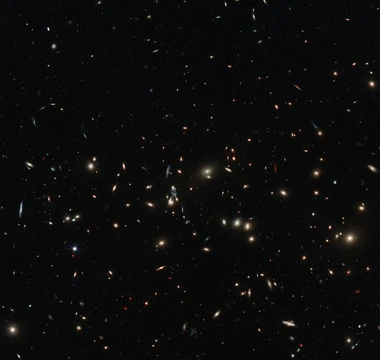
NGC 4325 Group
A dynamically young group with AGN-driven X-ray cavities and cool gas.

The NGC 4325 Group is a galaxy group dominated by the elliptical galaxy NGC 4325, located about 330 million light-years away in the constellation Virgo. It is notable for being a dynamically young system with evidence of past AGN activity, including X-ray cavities and a displaced cool gas region, and for its metal-rich filament structure.
Quick Facts
- Epoch
- J2000
- Ra
- 12 · 23 · 06.7
- Dec
- 10 · 37 · 16
- Dist Ly
- 102 Mpc
- H Radial V
- 7641 km/s
- Z
- 0.025489
- Appmag V
- 14.2
- Constellation Name
- Virgo
- Names
- NGC 4368, VCC 0616, CGCG 070-037, MCG +02-32-019, PGC 040183
- Mass
- 1.3111 (Stellar mass)/912 (Total Mass)
- Absmag V
- -22.12
- Group Cluster
- NGC 4325 Group
Facts from the source article.
Lore & Background
The NGC 4325 Group is part of the Coma Supercluster and contains 28 confirmed members, including the peculiar galaxy NGC 4320. NGC 4325, the dominant elliptical galaxy, exhibits star formation and dust, with a star formation rate of about 0.66 solar masses per year. The group's total X-ray mass is an order of magnitude lower than that of the Perseus cluster, and NGC 4325 is almost completely isolated.
Observations by ROSAT and Chandra reveal two small X-ray cavities in the intracluster medium (ICM) of the group, each about 16,000 ly (5 kpc) in diameter, located east and west of NGC 4325. These cavities lack corresponding radio emission, suggesting the radio lobes have faded. The gas in the group appears to have cooled over about 50 million years after a small AGN outburst, indicating a pre-outburst stage with another outburst expected within 50 million years.
At the southeastern edge of NGC 4325, an asymmetrical region of cool gas (0.6–0.7 keV) extends 98,000 ly (30 kpc) from the group center, aligned northwest to southeast. This region is displaced from the group center, possibly by a merger or AGN activity. NGC 4325 itself is slightly offset by about 9,800 ly (3 kpc) from the group's emission center, supporting a merger scenario. A metal-rich elongated filament in the core is thought to have formed from an AGN outburst, with enrichment from a galactic wind.
Reader's Guide
The NGC 4325 Group is significant as a nearby example of a dynamically young galaxy group undergoing evolution through mergers and AGN feedback. The presence of X-ray cavities and a displaced cool gas region provides direct evidence of past AGN activity, while the lack of radio emission indicates that the radio lobes have faded over time. The group's low total X-ray mass compared to the Perseus cluster highlights its relatively small scale. The metal-rich filament and secondary ring-like structure suggest ongoing dynamical processes that will shape the group through galaxy mergers. The estimated 50-million-year cooling timescale and predicted future outburst offer a window into the cyclical nature of AGN feedback in groups. The group's 28 confirmed members, including the peculiar NGC 4320, and its membership in the Coma Supercluster place it in a broader cosmological context.
Did You Know?
- The NGC 4325 Group has a velocity dispersion of about 298 km/s and a mass of 3.2 × 10^13 solar masses.
- Two small X-ray cavities, each 16,000 ly across, lie east and west of NGC 4325, with no corresponding radio emission.
- A metal-rich elongated filament in the group's core is thought to have formed from an AGN outburst and galactic wind.
More in Galaxy Clusters and Groups, Part 2 1-24
Spotted an error? Know more?
Reader corrections go straight into our review queue. Suggest an edit · How this site is sourced