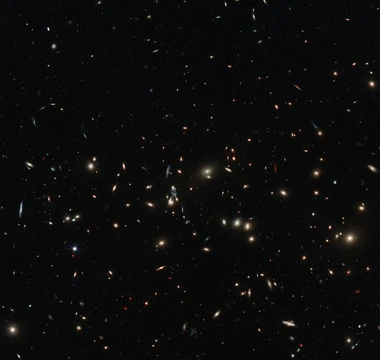
NGC 4151 Group
A group of nine galaxies in the Ursa Major Cloud.

The NGC 4151 Group is a small galaxy group consisting of nine galaxies, located in the constellation Canes Venatici. It is notable for containing the intermediate spiral Seyfert galaxy NGC 4151, one of the nearest galaxies to Earth with an actively growing supermassive black hole, and is part of the larger Ursa Major Cloud within the Virgo Supercluster.
Quick Facts
- Epoch
- J2000
- Ra
- 12 · 10 · 32.6
- Dec
- +39 · 24 · 21
- Dist Ly
- 15.8 ±
- Z
- 0.003262 / 995 ± 3 km/s
- Appmag V
- 11.5
- Constellation Name
- Canes Venatici
- Names
- UGC 7166, PGC 38739
Facts from the source article.
Lore & Background
The NGC 4151 Group is a collection of nine galaxies, with NGC 4151 as its most prominent member. NGC 4151 itself is an intermediate spiral Seyfert galaxy with a weak inner ring structure, located 15.8 megaparsecs (52 million light-years) from Earth. It was first mentioned by William Herschel on March 17, 1787, and was one of six galaxies described in Carl Seyfert's original paper defining such systems. The group is part of the Ursa Major Cloud, which in turn is part of the Virgo Supercluster.
The central black hole of NGC 4151 has a mass estimated between 2.5 million and 30 million solar masses, though some speculation suggests it may host a binary black hole with masses of about 40 million and 10 million solar masses, orbiting with a 15.8-year period—this remains a matter of active debate. The galaxy is sometimes nicknamed the 'Eye of Sauron' due to its appearance. One supernova, SN 2018aoq (Type II-P, mag 15.3), was observed in NGC 4151, discovered by the Lick Observatory Supernova Search on 1 April 2018.
Reader's Guide
The NGC 4151 Group is significant primarily because it contains NGC 4151, one of the nearest galaxies with an actively growing supermassive black hole. This proximity makes it a key target for studying active galactic nuclei and black hole accretion processes. The X-ray emission from NGC 4151 was first detected on December 24, 1970, by the Uhuru satellite, though there is controversy over whether Uhuru detected the BL Lac object 1E 1207.9+3945 instead; later HEAO 1 observations confirmed an X-ray source coincident with the optical nucleus. Two competing explanations for the X-ray emission have been proposed: one involving radiation from infalling material that stripped and recombined electrons, and another involving an accretion disk outflow that directly heats gas to X-ray temperatures. The group's place within the Ursa Major Cloud and Virgo Supercluster also provides context for large-scale structure studies. The debated binary black hole hypothesis adds further scientific interest, though it remains unresolved.
Did You Know?
- The NGC 4151 Group consists of nine galaxies.
- One supernova, SN 2018aoq, was observed in NGC 4151 on 1 April 2018.
More in Galaxy Clusters and Groups, Part 2 1-24
Spotted an error? Know more?
Reader corrections go straight into our review queue. Suggest an edit · How this site is sourced