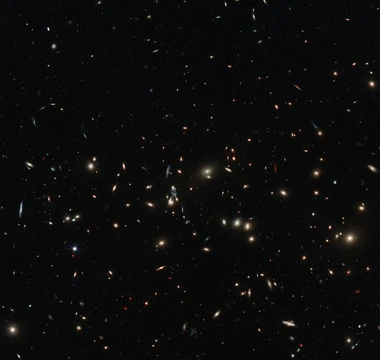
NGC 4111 Group
Second most massive subgroup of the Ursa Major Cluster.

The NGC 4111 Group is a galaxy group in the Ursa Major Cluster, of which NGC 4111 is the foremost galaxy. It is the second most massive subgroup in the Ursa Major Cluster, after the M109 Group.
Quick Facts
- Epoch
- J2000
- Ra
- 12 · 07 · 03.1
- Dec
- 43 · 03 · 57
- Dist Ly
- 43 ± 13 Mly (13.1 ± 4.1 Mpc)
- Z
- 792 ± 5 km/s
- Appmag V
- 10.7
- Constellation Name
- Canes Venatici
- Names
- UGC 7103, MCG +07-25-026, PGC 38440
Facts from the source article.
Lore & Background
The NGC 4111 Group is one of the subgroups of the Ursa Major Cluster, with NGC 4111 as its foremost galaxy. According to Makarov and Karachentsev, the group's members include UGC 6818, NGC 3938, NGC 4013, IC 749, IC 750, NGC 4051, UGC 7089, UGC 7094, NGC 4117, NGC 4138, and NGC 4183. The group is the second most massive subgroup in the Ursa Major Cluster, after the M109 Group.
NGC 4111 itself is a lenticular galaxy about 50 million light-years from Earth, discovered by William Herschel in 1788. It possesses both thin and thick discs, and its center features dusty filaments associated with a polar ring of gas and dust, thought to be the remains of a smaller galaxy. The galaxy also has an X-shaped, peanut-shell-shaped bulge and a low-ionization nuclear emission-line region (LINER) nucleus emitting X-rays, believed to be a low luminosity active galactic nucleus.
In HI imaging, NGC 4111 appears disturbed, with HI extending 28 arcminutes south of its central position, corresponding to 120 kpc at a distance of 15 Mpc, and connecting NGC 4111 with the nearby galaxies NGC 4117 and NGC 4118, which lie 7 arcminutes to east-northeast.
Reader's Guide
The NGC 4111 Group is notable as the second most massive subgroup of the Ursa Major Cluster, a large cluster of galaxies. Its foremost galaxy, NGC 4111, exhibits a polar ring of gas and dust, likely the remnant of a smaller galaxy, and hosts a low-luminosity active galactic nucleus. The group's member galaxies, as listed by Makarov and Karachentsev, include several notable objects such as NGC 3938 and NGC 4051. The disturbed HI morphology of NGC 4111, with a 120 kpc extension connecting to NGC 4117 and NGC 4118, suggests ongoing interactions within the group. This group provides a context for studying galaxy interactions, polar ring formation, and the role of active nuclei in a moderately massive subgroup of a larger cluster. Its significance lies in its position as a key component of the Ursa Major Cluster, offering insights into the dynamics and evolution of galaxy groups.
Did You Know?
- NGC 4111 appears disturbed in HI imaging, with a 120 kpc extension connecting it to NGC 4117 and NGC 4118.
- The group's member galaxies were listed by Makarov and Karachentsev and include NGC 3938, NGC 4013, and NGC 4051.
More in Galaxy Clusters and Groups, Part 2 1-24
Spotted an error? Know more?
Reader corrections go straight into our review queue. Suggest an edit · How this site is sourced