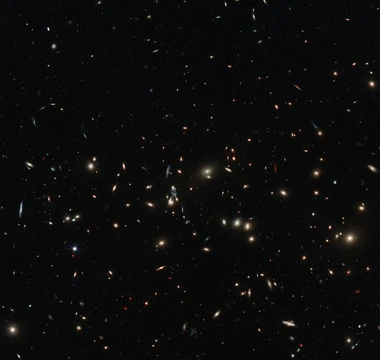
NGC 4036 Group
A small galaxy group in Ursa Major, part of the Virgo Supercluster.

The NGC 4036 Group (also known as LGG 266) is a small galaxy group in the northern constellation Ursa Major, part of the larger Ursa Major Cloud within the Virgo Supercluster. Its most notable member is the lenticular galaxy NGC 4036, a LINER-type active galaxy with a distinctive dust lane pattern and a history of a Type Ia supernova.
Quick Facts
- Epoch
- J2000
- Constellation Name
- Ursa Major
- Ra
- 12 · 01 · 26.891
- Dec
- +61 · 53 · 44.52
- Z
- 0.004817
- H Radial V
- 1,445 km/s
- Dist Ly
- 19.04 Mpc
- Group Cluster
- LGG 266
- Absmag V
- 10.66
- Names
- 2MASX J12012689+6153445, IRAS 11588+6210, LEDA 37930, UGC 7005, UZC J120126.7+615345, Z 292-59
Facts from the source article.
Lore & Background
The NGC 4036 Group is a galaxy group cataloged as LGG 266, located in the northern circumpolar constellation Ursa Major. It is part of the Ursa Major Cloud, which itself is a component of the Virgo Supercluster. The group's brightest member is NGC 4036, a lenticular galaxy discovered by William Herschel on 19 March 1790. This galaxy is described in the Carnegie Atlas of Galaxies as having an irregular pattern of dust lanes threaded through its disk in an 'embryonic' spiral pattern, indicating a mixed S0/Sa form.
NGC 4036 is a LINER-type active galaxy, showing emission lines of ionized gas in its nucleus. The galaxy is viewed nearly edge-on, with an inclination of 18° to the line of sight, and has a heliocentric radial velocity of 1,445 km/s. Its visual dimensions are 2.703′ × 1.027′, with a visual magnitude of 10.7. The group also includes NGC 4041, IC 758, UGC 7009, and UGC 7019. NGC 4036 and NGC 4041 form a pair with a projected separation of about 470 kly (143 kpc), located just 17 arc minutes apart.
One supernova has been observed in NGC 4036: SN 2007gi, a Type Ia supernova discovered by Kōichi Itagaki on 23 July 2007. It reached peak magnitude around August 14 and showed material moving outward at velocities of about 15,500 km/s, 50% higher than normally observed for this type. The supernova was located near the central bulge of the galaxy.
Reader's Guide
The NGC 4036 Group is significant as a nearby example of a small galaxy group within the Virgo Supercluster, offering insight into the dynamics and interactions of lenticular and spiral galaxies. Its most studied member, NGC 4036, is notable for its LINER activity, triaxial bulge, and tilted disk of stars orbiting the nucleus within 820 ly. Hubble Space Telescope images reveal a wispy disk of dust around the nucleus and the tendrilous remains of an ionization cone, features common in Seyfert galaxies. The group's proximity to the Big Dipper makes it accessible for amateur astronomers with moderate telescopes. The observation of SN 2007gi, with its unusually high expansion velocity, provides a valuable data point for understanding Type Ia supernova diversity. The group's membership in the Ursa Major Cloud and Virgo Supercluster places it in a broader cosmic context, helping to map large-scale structure in the local universe.
Did You Know?
- The NGC 4036 Group is also known as LGG 266.
- One supernova, SN 2007gi (Type Ia), was observed in NGC 4036 in 2007.
- The group is part of the Ursa Major Cloud, which is part of the Virgo Supercluster.
More in Galaxy Clusters and Groups, Part 2 1-24
Spotted an error? Know more?
Reader corrections go straight into our review queue. Suggest an edit · How this site is sourced