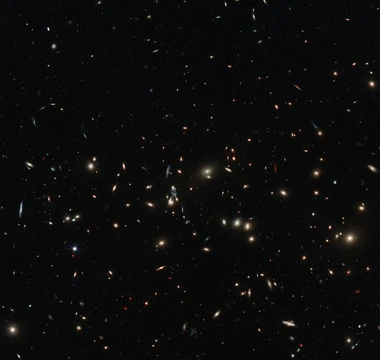
NGC 3783 Group
A loose group of 47 galaxies centered on active galaxy NGC 3783.

The NGC 3783 group is a loose collection of 47 galaxies situated in the Hydra-Antlia section of the Hydra-Centaurus Supercluster. Its central member is NGC 3783, a barred spiral galaxy with an active Seyfert 1 nucleus. This galaxy lies about 135 million light-years away in Centaurus and was discovered by John Herschel in 1835. Its velocity relative to the cosmic microwave background is 3234 ± 22 km/s, corresponding to a Hubble distance of roughly 155.6 million light-years. Two non-redshift measurements give a similar distance of about 155.74 million light-years. The galaxy is inclined 23° to our line of sight at a position angle of about 163°, and its morphological type SBa indicates a central bar and tightly wound spiral arms, though observers also note a luminous inner ring around the bar. Its bright, compact nucleus is a strong, variable X-ray source, powered by a rapidly rotating supermassive black hole with an estimated mass of 2.8 million Suns, surrounded by an accretion disk. Interferometric observations place the inner radius of the surrounding dust torus at 0.52 ± 0.16 light-years. The group itself has a mean distance of 117 million light-years and is centered at coordinates α = 11h 37m 12s, δ = –37° 30′ 57.6″, about 870,000 light-years from NGC 3783. Its mean velocity relative to the Sun is 2,903 ± 26 km/s, with a velocity dispersion of 190 ± 24 km/s. Diffuse X-ray emission from the group is roughly centered on NGC 3783.
Quick Facts
- Epoch
- J2000
- Constellation Name
- Centaurus
- Ra
- 11 · 39 · 01.721
- Dec
- –37 · 44 · 18.60
- Z
- 0.008506 ± 0.000100
- H Radial V
- +2,817 km/s
- Dist Ly
- 135.7 Mly (41.60 Mpc)
- Group Cluster
- NGC 3783 group
- Appmag V
- 13.43
- Notes
- Seyfert 1
Facts from the source article.
Lore & Background
The NGC 3783 group is a loose association of 47 galaxies, located at a mean distance of 117 million light-years (36 Mpc). Its mean velocity with respect to the Sun is 2,903 ± 26 km/s, with a velocity dispersion of 190 ± 24 km/s. The group is centered at coordinates α = 11h 37m 12s, δ = –37° 30′ 57.6″, which is about 870×10^3 ly (267 kpc) from the galaxy NGC 3783.
The diffuse X-ray emission of the group is roughly centered on NGC 3783, a barred spiral galaxy with an active Seyfert 1 nucleus. NGC 3783 itself has a velocity with respect to the cosmic microwave background of 3234 ± 22 km/s, corresponding to a Hubble distance of 155.6 ± 10.9 Mly (47.70 ± 3.35 Mpc). The group is situated in the Hydra-Antlia region of the Hydra-Centaurus Supercluster.
Reader's Guide
The NGC 3783 group is significant as a nearby example of a loose galaxy association within the larger Hydra-Centaurus Supercluster. Its central galaxy, NGC 3783, hosts a rapidly rotating supermassive black hole with an estimated mass of about 2.8 million solar masses, surrounded by an accretion disk and a dusty torus with an inner radius of 0.52 ± 0.16 ly. The group's diffuse X-ray emission, centered on NGC 3783, indicates the presence of hot intra-group gas, and the active nucleus undergoes variations in emission across the electromagnetic spectrum. The group's mean distance of 117 million light-years and velocity dispersion of 190 ± 24 km/s provide context for studying galaxy interactions and the influence of an active galactic nucleus on its environment. The group's legacy lies in its role as a laboratory for understanding the relationship between a Seyfert galaxy and its surrounding galaxy cluster, as well as the dynamics of a loose group within a supercluster.
More in Galaxy Clusters and Groups, Part 2 1-24
Spotted an error? Know more?
Reader corrections go straight into our review queue. Suggest an edit · How this site is sourced