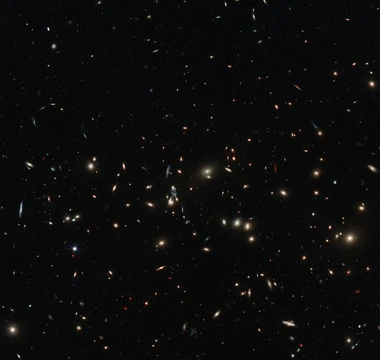
NGC 3631 Group
A small galaxy group in the Ursa Major Cloud.

The NGC 3631 Group (also known as LGG 241) is a small galaxy group located in the Ursa Major Cloud, which is part of the Virgo Supercluster. It is notable for containing at least ten member galaxies, including the grand design spiral galaxy NGC 3631, which gives the group its name.
Quick Facts
- Constellation Name
- Ursa Major
- Epoch
- J2000
- Ra
- 11 · 21 · 02.8753
- Dec
- +53 · 10 · 11.038
- Dist Ly
- 33.7 ± 17.7 Mly (10.3 ± 5.4 Mpc)
- Group Cluster
- NGC 3631 Group (LGG 241)
- Z
- 0.003839
- H Radial V
- 1151 ± 1 km/s
- Appmag V
- 10.1
Facts from the source article.
Lore & Background
According to A.M. Garcia, the NGC 3631 Group (also known as LGG 241) includes at least ten galaxies: NGC 3631, NGC 3657, NGC 3718, NGC 3729, NGC 3913, NGC 3972, NGC 3998, UGC 6251, UGC 6446, and UGC 6816. The group is part of the north Ursa Major groups, which in turn belongs to the Ursa Major Cloud, a component of the Virgo Supercluster.
The group's namesake, NGC 3631, is a grand design spiral galaxy seen nearly face on, with two principal spiral arms that branch into secondary arms. It has a moderate-to-high star formation rate of 4.6 solar masses per year and hosts a supermassive black hole with a mass of about 25 million solar masses. Four supernovae have been discovered in NGC 3631, including SN 1964A, SN 1965L, SN 1996bu, and SN 2016bau.
Reader's Guide
The NGC 3631 Group is significant as a nearby example of a small galaxy group within the larger Ursa Major Cloud and Virgo Supercluster. Its most prominent member, NGC 3631, has been studied for its grand design spiral structure, star formation activity, and supernova history. The group's membership, as defined by Garcia, provides a framework for understanding the dynamics and interactions of galaxies in a low-density environment. The presence of multiple supernovae in NGC 3631, including a Type Ib observed in radio waves, highlights the group's value for studying stellar explosions and their aftermath. The group's location in the Ursa Major Cloud also makes it a useful target for surveys of galaxy groups and their evolution within the local supercluster.
Did You Know?
- The NGC 3631 Group contains at least ten member galaxies, including NGC 3631, NGC 3657, NGC 3718, and NGC 3729.
- The group's namesake galaxy, NGC 3631, has hosted four supernovae: SN 1964A, SN 1965L, SN 1996bu, and SN 2016bau.
Frequently Asked Questions
What is the NGC 3631 Group?
It is a compact collection of at least ten galaxies nestled inside the Ursa Major Cloud, a substructure of the broader Virgo Supercluster. The group takes its name from NGC 3631, a striking grand design spiral that anchors the membership.
What is the NGC 3631 Group's alternate designation?
In several clustering catalogs it is listed as LGG 241, a Local Galaxy Group identifier that appears alongside the more familiar NGC-based name.
How many member galaxies does the NGC 3631 Group contain?
Current membership lists include at least ten galaxies, spanning well-known entries like NGC 3631, NGC 3657, and NGC 3913 as well as lesser-known objects such as UGC 6251 and UGC 6816.
Where exactly is the NGC 3631 Group in the cosmic neighborhood?
It sits within the Ursa Major Cloud, which is itself a component of the Virgo Supercluster, placing the group on the northern flank of our local supercluster structure.
Why do fans and astronomers care about the NGC 3631 Group?
Its headline member, NGC 3631, is a textbook grand design spiral with clearly defined arms, making the whole group a popular target for amateur imaging and for studying spiral structure in a relatively nearby, low-density environment.
More in Galaxy Clusters and Groups, Part 2 1-24
Spotted an error? Know more?
Reader corrections go straight into our review queue. Suggest an edit · How this site is sourced