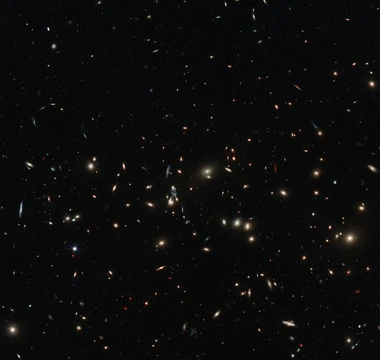
NGC 1947 Group
A small galaxy group near the Dorado Group.

The NGC 1947 group is a small galaxy group located in the constellation Dorado, lying close to the Dorado Group and forming part of the Southern Supercluster. Its brightest member is the peculiar lenticular galaxy NGC 1947, notable for its polar-ring structure and active LINER nucleus.
Quick Facts
- Epoch
- J2000
- Ra
- 05 · 26 · 47.6
- Dec
- -63 · 45 · 36
- Dist Ly
- 47.8 ± 11.7 Mly (14.65 ± 3.6 Mpc)
- Z
- 0.003669 ± 0.000080
- H Radial V
- 1,100 ± 24 km/s
- Appmag V
- 10.8
- Constellation Name
- Dorado
- Notes
- Polar-ring
- Names
- ESO 085-G87, AM 0526-634, IRAS 05264-6347, PGC 17296
Facts from the source article.
Lore & Background
The NGC 1947 group is defined by its brightest member, NGC 1947, a peculiar lenticular galaxy discovered by James Dunlop on November 5, 1826. The group also includes the galaxies ESO 085–065, ESO 085–088, and ESO 086–010. It lies close to the Dorado Group and is part of the Southern Supercluster.
NGC 1947 itself is characterized by dust lanes across its minor axis, indicating it is a polar-ring galaxy. It has one central dust lane and three less pronounced concentric rings. Although classified as lenticular, it lacks a disk, sharing more traits with elliptical galaxies. Molecular gas around its nucleus has an estimated hydrogen mass of 4.2×10^8 M☉, rotating perpendicular to the stars, with a warped inner region. The kinematics suggest the dust and gas were accreted from a gas-rich galaxy, as no tidal tails from an unequal mass merger are observed.
The nucleus of NGC 1947 is active, categorized as a LINER, likely powered by an accretion disk around a supermassive black hole.
Reader's Guide
The NGC 1947 group is significant primarily because its brightest member, NGC 1947, provides a clear example of a polar-ring galaxy with an active LINER nucleus. The group's proximity to the Dorado Group and its membership in the Southern Supercluster place it within a larger cosmic structure, though the article does not elaborate on the group's broader role. The peculiar characteristics of NGC 1947—its lack of a disk, concentric dust lanes, and externally accreted gas—offer insights into galaxy evolution and merger processes. The detection of molecular gas and the warped rotation of the gas relative to the stars underscore the complex dynamics that can arise from accretion events. The group's legacy, as described in the article, lies in its contribution to understanding polar-ring galaxies and the origins of their gas and dust, as well as the nature of LINER-type active galactic nuclei. No further significance or legacy beyond these details is provided by the source.
Did You Know?
- The NGC 1947 group includes four galaxies: NGC 1947, ESO 085–065, ESO 085–088, and ESO 086–010.
- NGC 1947, the brightest member, is a peculiar lenticular galaxy with polar-ring dust lanes.
Frequently Asked Questions
What is the NGC 1947 Group?
It is a small, loosely bound collection of galaxies situated in the constellation Dorado. The group sits in the neighborhood of the larger Dorado Group and is catalogued as a component of the Southern Supercluster.
Where in the sky can I find the NGC 1947 Group?
Look toward the southern constellation Dorado, where the group's members cluster near the well-known Dorado Group. Both structures are part of the broader Southern Supercluster filament.
What is the brightest member of the NGC 1947 Group?
The lenticular galaxy NGC 1947 itself holds that title, distinguished by its unusual polar-ring morphology and a low-ionization nuclear emission region (LINER) at its core.
Which galaxies are confirmed members of the NGC 1947 Group?
Current membership lists include NGC 1947, ESO 085–065, ESO 085–088, and ESO 086–010, making it a compact four-galaxy assembly.
How does the NGC 1947 Group relate to the Dorado Group?
The two groups are neighbors in the same region of the Dorado constellation, and together they contribute to the larger Southern Supercluster structure that stretches across the southern sky.
More in Galaxy Clusters and Groups, Part 2 1-24
Spotted an error? Know more?
Reader corrections go straight into our review queue. Suggest an edit · How this site is sourced