Faber–Jackson relation
Empirical relation linking luminosity and velocity dispersion in elliptical galaxies.

http://en.wikipedia.org/wiki/User:Cosmo0 · CC0
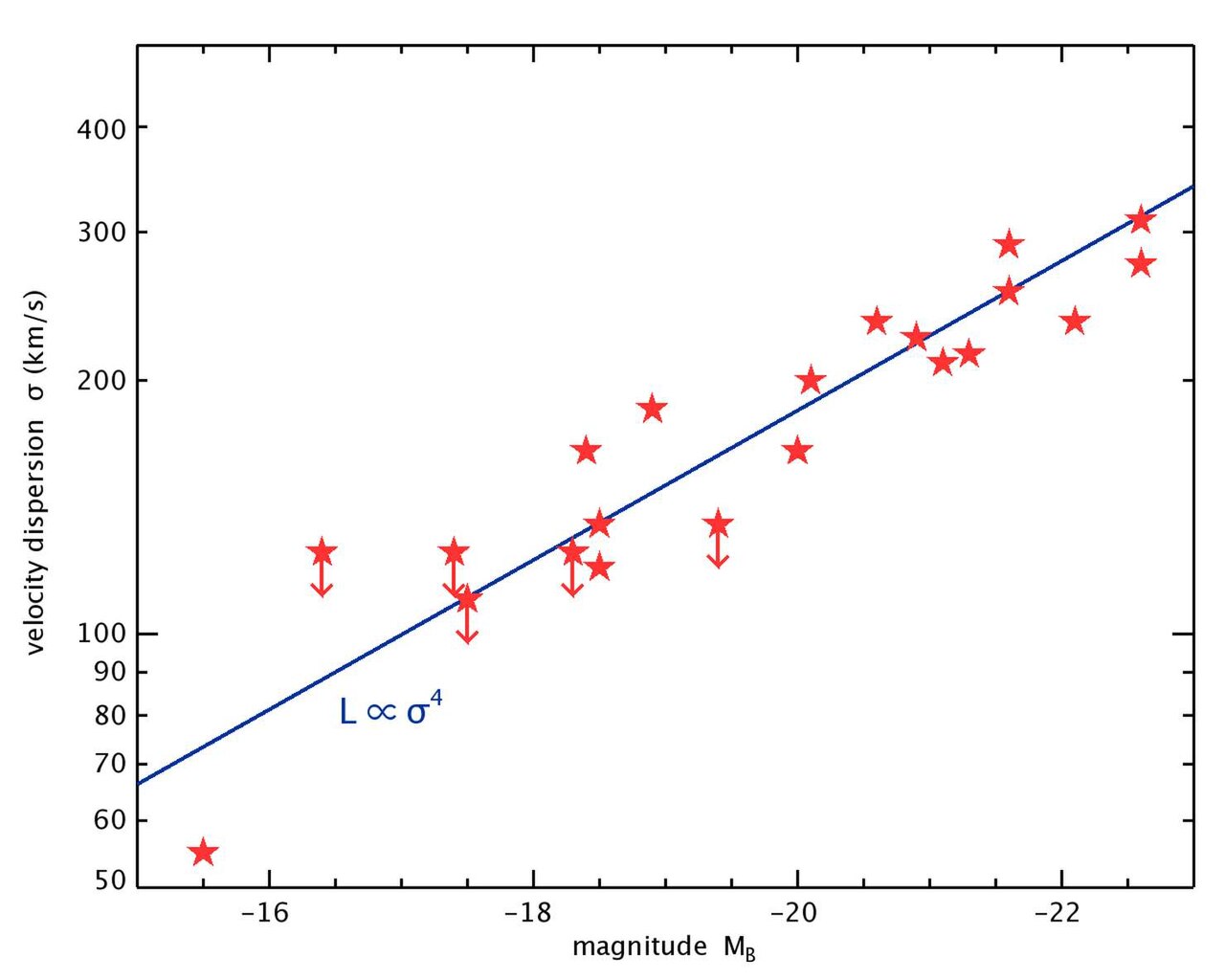
The Faber–Jackson relation is an empirical power-law relation between the luminosity L and the central stellar velocity dispersion σ of elliptical galaxies, first presented by astronomers Sandra M. Faber and Robert Earl Jackson in 1976. It is understood as a projection of the fundamental plane of elliptical galaxies and is notable as a tool for determining distances to external galaxies.
- Discoverers
- Sandra M. Faber and Robert Earl Jackson
- Year discovered
- 1976
- Mathematical form
- L ∝ σ^γ
- Typical index γ
- approximately 4
- Index for low luminosity ellipticals
- 2
- Index for luminous ellipticals
- 5
- Revised index for less massive galaxies
- 3.1
- Revised index for more massive galaxies
- 15.0
Lore & Background
In 1962, Rudolph Minkowski presented a first attempt to measure a correlation between luminosity and line width, as first described for early-type galaxies in the Virgo Cluster by W.W. Morgan and N.U. Mayall. Minkowski wrote that a 'correlation between velocity dispersion and [luminosity] exists, but it is poor' and that 'it seems important to extend the observations to more objects, especially at low and medium absolute magnitudes'. This was important because the value of γ depends on the range of galaxy luminosities fitted, with a value of 2 for low-luminosity elliptical galaxies discovered by a team led by Roger Davies, and a value of 5 reported by Paul L. Schechter for luminous elliptical galaxies.
The theoretical derivation from the virial theorem assumes constant mass-to-light ratio and constant surface brightness, but the assumption of constant surface brightness is unjustified from a fundamental theoretical point of view. Empirically, surface brightness exhibits a peak at about M_V = -23. The revised relation becomes L ∝ σ^3.1 for less massive galaxies and L ∝ σ^15.0 for more massive ones, causing the fundamental plane to split into two planes inclined by about 11 degrees to each other. Even first-ranked cluster galaxies do not have constant surface brightness; a claim supporting constant surface brightness by Allan R. Sandage in 1972 was shown by Donald Gudehus in 1975 to be based on incorrect logical arguments, with first-ranked cluster galaxies exhibiting a standard deviation of about half a magnitude.
Reader's Guide
The Faber–Jackson relation is significant as the first empirical power-law relation between luminosity and central stellar velocity dispersion for elliptical galaxies, providing a foundational tool for extragalactic distance measurement. Its importance is underscored by its role as a projection of the fundamental plane of elliptical galaxies. Recent theoretical work led by Harry Desmond and Risa H. Wechsler tested whether galaxy formation models based on dark matter can fully explain the relation; these models account for some key trends but predict more variation than observed, suggesting additional hidden relationships between galaxies and their dark matter halos. A 2024 study by Sadhu & Tian examined the baryonic Faber–Jackson relation in galaxy groups and clusters, finding its behavior aligns with predictions from MOdified Newtonian Dynamics (MOND), indicating that galaxy group dynamics may be explained primarily by baryonic mass and suggesting possible deviations from standard dark matter density profiles in some systems. The relation's legacy includes its use in distance determination and its role in revealing complexities in galaxy formation, such as the dependence of the power-law index on luminosity range and the splitting of the fundamental plane.
Did You Know?
- The Faber–Jackson relation was presented by Sandra M. Faber and Robert Earl Jackson in 1976.
- The index γ is approximately 4, but varies from 2 for low-luminosity ellipticals to 5 for luminous ones.
- Rudolph Minkowski in 1962 described the correlation between velocity dispersion and luminosity as 'poor'.
- A 2024 study by Sadhu & Tian found the baryonic Faber–Jackson relation aligns with predictions from MOND.
The Elliptical Counterpart
The Faber–Jackson relation occupies a specific niche within the family of galaxy scaling relations: it serves as the counterpart to the Tully–Fisher relation for systems that are not rotationally supported. While the Tully–Fisher relation links the luminosity or mass of a spiral galaxy to its asymptotic rotation velocity or emission-line width, the Faber–Jackson relation extends this conceptual framework to elliptical galaxies and other dispersion-supported systems. In the Tully–Fisher context, the 21-centimeter hydrogen line width captures the velocity dispersion of spiral arms, and more luminous spirals rotate faster. The Faber–Jackson relation, alongside the fundamental plane, represents the analogous bridge for galaxies whose internal kinematics are governed by pressure support rather than differential rotation. Together, these relations ensure that the galaxy population—whether disk-dominated or spheroid-dominated—can be probed through empirically grounded luminosity-kinematics correlations.
A Rung on the Distance Ladder
The Faber–Jackson relation, like its spiral-galaxy counterpart the Tully–Fisher relation, functions as a critical rung in the cosmic distance ladder. The core principle is elegant: a distance-independent observable—such as the width of a spectral emission line or, in the elliptical case, a velocity-dispersion measure—is linked to the galaxy's intrinsic luminosity, which is inherently distance-dependent. By measuring the line width or dispersion of a well-studied galaxy whose distance has been established through more direct techniques, astronomers calibrate the correlation. Once calibrated, the relation can be applied to more distant or less-studied systems: the observed line width yields an estimated luminosity, and comparing that to the apparent brightness reveals the distance. This calibrated distance can then serve to anchor yet another rung further up the ladder, extending reach to ever greater cosmological scales. The Tully–Fisher relation has been used to derive numerous values of the Hubble constant from its 1977 debut through 2024, and the Faber–Jackson relation plays a parallel role for the elliptical population.
Calibration and Measurement
The practical methodology behind relations like the Faber–Jackson and Tully–Fisher relies on a careful calibration procedure rooted in observational data. For the Tully–Fisher relation, Tully and Fisher in 1977 used galaxies in the Local Group, the M81 Group, and the M101 Group as calibrators, measuring hydrogen line profile widths via long-slit spectroscopy and comparing them to absolute magnitudes. They then applied the derived correlation to estimate distances to the Virgo and Ursa Major clusters. The Faber–Jackson relation, as the elliptical analogue, follows a similar logical structure: well-studied elliptical galaxies with independently determined distances anchor the correlation between a kinematic property and luminosity. The luminosity itself is computed by multiplying apparent brightness by four pi d squared, where d is the distance. Subsequent work across the broader family of scaling relations has shown that the tightness of the correlation depends on which luminosity band or mass proxy is chosen—optical, infrared K-band, stellar mass, or total baryonic mass—each yielding progressively tighter relations.
Theoretical Interpretations
The Faber–Jackson relation, situated within the same theoretical landscape as the Tully–Fisher relation, can be interpreted through competing gravitational frameworks. In the standard dark matter paradigm, a galaxy's internal kinematics—whether rotational velocity in spirals or velocity dispersion in ellipticals—are primarily governed by the mass of the surrounding dark matter halo. This makes the luminosity-kinematics correlation a manifestation of the deep connection between visible baryonic matter and the unseen dark matter component. In the alternative framework of Modified Newtonian Dynamics, the baryonic Tully–Fisher relation with its power-law index of exactly four emerges as a direct consequence of the modified gravitational force law operating at low accelerations. The Faber–Jackson relation, as the dispersion-supported analogue, sits within this same interpretive tension. The broader family of relations—from the optical Tully–Fisher to the stellar-mass and baryonic-mass variants—demonstrates that the tightest correlations arise when total baryonic mass is used, with residual scatter in the stellar-mass form correlating with kinematic morphology, where more dispersion-supported systems fall below the relation.
Gallery
More in Elliptical and Irregular Galaxies 1-24
Spotted an error? Know more?
Reader corrections go straight into our review queue. Suggest an edit · How this site is sourced