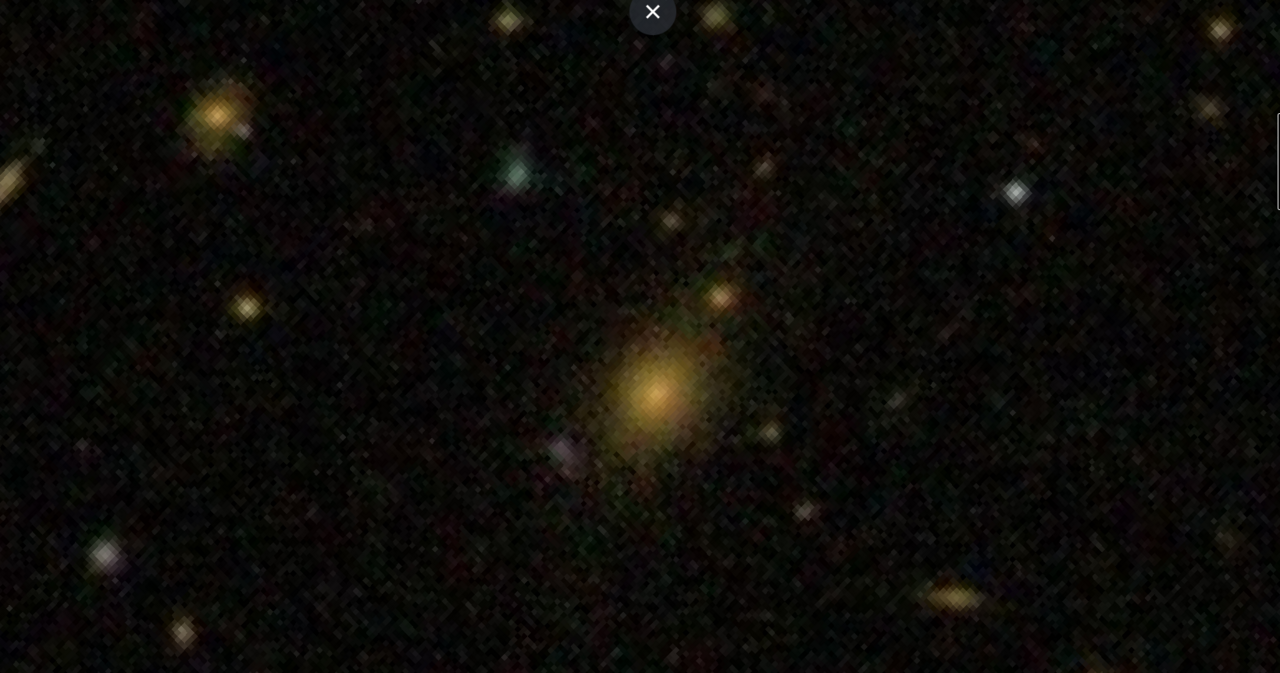
3C 28
Massive cD galaxy in Pisces, BCG of Abell 115.

Aladin Sky Server · Public domain
3C 28 is a massive Type-cD elliptical galaxy in Pisces, located 2.5 billion light-years away with a redshift of 0.1971. Discovered in 1959, it serves as the brightest cluster galaxy at the core of the northern subcluster within the merging Abell 115 cluster. This low-excitation Fanaroff-Riley class II radio galaxy emits a total radio luminosity of 2.3 × 10^26 W Hz⁻¹ sr⁻¹ at 178 MHz.
Its isophotal structure is disky, elongated from northwest to southeast, with a stellar population that is mostly reddened and dominated by young stars about two billion years old. The star formation luminosity is estimated at 5.3 × 10^10 L_SFIR. Radio mapping classifies it as a classical bend double, featuring two compact components on opposite sides of the galaxy, each with low-surface brightness tails. Two radio jets connect these components via a pair of lobes, and a faint, narrow filament crosses the gaps between the lobes, passing through the nucleus. One component shows a steepening spectral index.
Both components exhibit significant polarization: component A has a fractional polarization of 9 ± 2% at 60°, while component B shows 8 ± 2% at 25°. However, reanalysis of 1.4 GHz data indicates the source is unpolarized, with a polarization percentage of 2%. The lobes and radio structure are largely confined by the interstellar medium, with extended tails toward the west, likely due to buoyancy effects. A misalignment between the optical galaxy and its radio components and extended tails suggests ram pressure also plays a role.
High-luminosity X-ray emission centers on the galaxy, with a gas mass of 10^11 M☉ and a short cooling time of 5 × 10^8 years, attributed to thermal bremsstrahlung. The galaxy is classified as a remnant radio galaxy, lacking a detectable radio core, indicating its active galactic nucleus ceased activity 6 to 9 million years ago. As a result, the lobes are slowly dimming through adiabatic and radiative losses.
Quick Facts
- Epoch
- J2000.0
- Constellation Name
- Pisces
- Ra
- 00 · 55 · 50.60
- Dec
- +26 · 24 · 37.459
- Z
- 0.195298
- H Radial V
- 58,549 km/s
- Dist Ly
- 2.513 Gly
- Group Cluster
- Abell 115
- Appmag B
- 18.63
- Names
- 4C +26.02, PKS 0055+26, LEDA 138263, RBS 0131, 2MASX J00555058+2624366, DA 028, CTA 008, TXS 0053+261, NRAO 048
Facts from the source article.
Lore & Background
3C 28 was discovered in 1959. Its isophotal structure is classified as disky and its appearance is elongated northwest to southeast. The stellar population is mainly reddened and dominated by young stars aged around two billion years old. The galaxy is classified as a classical bend double based on radio mapping, with two compact components located on both sides displaying low-surface brightness tails. Two radio jets are connected together with the structure by a pair of radio lobes. A faint, narrow filament crosses the gaps of the lobes and passes its nucleus position. The spectral index of one component is noted as steepening.
Imaging showed both components display a fair bit of polarization: component A has fractional polarization of 9 ± 2% at 60°, component B has 8 ± 2% at 25°. However, 1.4 GHz data reanalysis found the source is unpolarized at a polarization percentage of 2%. The lobes and radio structure are mainly confined by interstellar medium, with extended tails towards the west suggesting buoyancy effects. There is a misalignment between the optical galaxy and its radio components, indicating ram pressure also played a role.
High luminosity X-ray emission centers on the galaxy with a gas mass of 10^11 M☉ and a short cooling time period of 5 × 10^8 per year, caused by thermal bremsstrahlung. The galaxy is classified as a remnant radio galaxy, showing an absence of a radio core, suggesting its active galactic nucleus ceased activity between 6 and 9 million years ago, causing the lobes' brightness to slowly dim through adiabatic and radiative losses.
Reader's Guide
3C 28 is significant as a remnant radio galaxy, providing evidence of a recently ceased active galactic nucleus. The absence of a radio core, with activity ending 6 to 9 million years ago, allows study of lobe dimming through adiabatic and radiative losses. Its classification as a classical bend double with unusual structure—two compact components, low-surface brightness tails, and a faint filament crossing the lobes—offers insight into radio galaxy morphology and evolution. The misalignment between optical and radio components, along with buoyancy and ram pressure effects, highlights the complex interaction between the galaxy and its environment. The X-ray emission, with a gas mass of 10^11 M☉ and short cooling time, underscores the role of thermal bremsstrahlung in the intracluster medium. As the brightest cluster galaxy in the merging Abell 115 cluster, 3C 28 helps illuminate the dynamics of galaxy clusters and the lifecycle of radio galaxies.
Did You Know?
- 3C 28 is the brightest cluster galaxy in the northern subcluster of the merging galaxy cluster Abell 115.
- The galaxy has a star formation luminosity of 5.3 × 10^10 L_SFIR and a stellar population dominated by young stars aged around two billion years.
- High luminosity X-ray emission centered on the galaxy has a gas mass of 10^11 M☉ and a cooling time of 5 × 10^8 per year.
Nature and Electromagnetic Signature
3C 28 belongs to the family of active galactic nuclei—compact regions at the heart of galaxies that radiate enormous amounts of energy far beyond what their surrounding stars could account for. This non-stellar glow is detectable across an extraordinary stretch of the electromagnetic spectrum, spanning radio and microwave wavelengths through infrared, optical, and ultraviolet bands, all the way up into X-ray and gamma-ray territory. What makes these objects remarkable is not merely their brightness but their persistence: AGN represent the most luminous steady emitters known in the universe. The precise observational character of any given AGN, including 3C 28, is shaped by a suite of physical parameters. The mass of the central black hole, the rate at which gas falls inward, the tilt of the accretion disk relative to the observer, the amount of dust veiling the nucleus, and whether relativistic jets are present all conspire to produce a distinct spectral and morphological fingerprint. Depending on this combination, AGN are sorted into numerous subclasses, with the most energetic members classified as quasars and those whose jets aim directly at Earth earning the designation of blazars.
The 3C Catalog and the Radio Revolution
3C 28 carries its name from the Third Cambridge Catalogue of Radio Sources, a landmark survey that transformed how astronomers mapped the sky. Before radio astronomy matured, only a handful of nearby active elliptical galaxies—Messier 87, Centaurus A, and Cygnus A among them—had been identified as radio emitters. The 3C survey pushed discovery far beyond these early examples, cataloguing a much broader population of radio sources and, crucially, matching many of them to their optical counterparts. In photographic plates, some of these matched objects appeared nearly point-like, almost indistinguishable from stars, which led to their classification as quasi-stellar radio sources. The survey's legacy is woven into the very nomenclature of the field: objects like 3C 28 are numbered entries in a catalog that became the springboard for identifying quasars, confirming the extragalactic nature of the phenomenon, and ultimately revealing that the most powerful engines in the universe reside at galactic centers rather than in any single star.
The Engine at the Core
The theoretical understanding of what powers an object like 3C 28 crystallized in the mid-1960s. Edwin Salpeter and Yakov Zeldovich independently proposed in 1964 that the staggering luminosities of quasars could only be explained by gas spiralling onto a supermassive black hole. Donald Lynden-Bell extended this reasoning in 1969, arguing that nearby Seyfert galaxies harbor the same kind of black hole in a quieter, dormant state. Since then, the consensus has held that AGN are powered by accretion onto black holes ranging from one million to ten billion times the mass of the Sun. Such a compact, massive object can convert gravitational and kinetic energy into radiation with extraordinary efficiency, and its high Eddington luminosity naturally accounts for the sustained, extreme brightness observed. The existence of these central black holes is further supported by the M–sigma relation, which links black hole mass to the velocity dispersion of the host galaxy's bulge, suggesting that most massive galaxies host one. X-ray observations from the 1960s and 1970s confirmed that the inner accretion disk is the origin of the hard radiation.
Cosmic Probes and the Shape of the Universe
Because AGN are the most luminous persistent emitters in the cosmos, they serve as natural beacons for exploring the deepest reaches of the universe. Their sheer brightness allows astronomers to detect and study objects at cosmological distances that would otherwise be invisible, making them invaluable tools for mapping the large-scale structure of the universe. Beyond their utility as distance markers, the way AGN evolve over cosmic time places powerful constraints on theoretical models of the cosmos. Research into objects catalogued in surveys like the 3C list spans a wide spectrum of inquiry: broad observational campaigns to find AGN across diverse luminosity and redshift ranges, investigations into how supermassive black holes grow over billions of years, detailed studies of accretion physics and the mechanisms that convert infalling matter into electromagnetic radiation, and the dynamics of jets and outflows that carry energy and material far from the nucleus. Equally important is the feedback question—how the energy released by black hole accretion and quasar activity shapes the evolution of the host galaxy itself, tying the fate of the central engine to the broader story of galactic life.
Gallery
More in Elliptical and Irregular Galaxies 1-24
Spotted an error? Know more?
Reader corrections go straight into our review queue. Suggest an edit · How this site is sourced