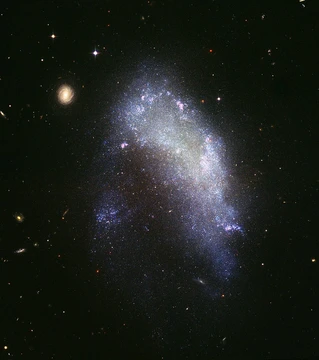
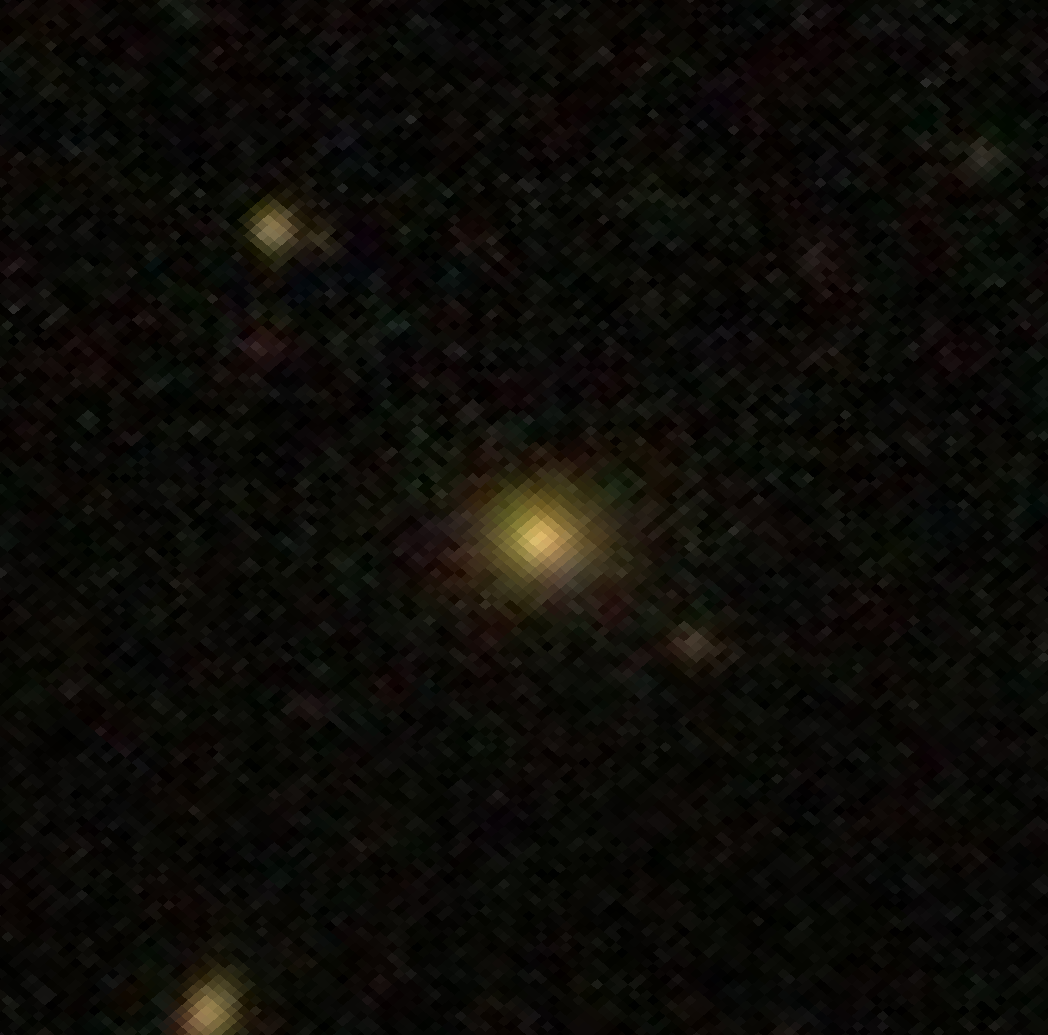
3C 63
A low-redshift Fanaroff–Riley Type 2 radio galaxy in Cetus.

Aladin Sky Server · Public domain
3C 63 is a radio galaxy in the constellation Cetus. It was first identified as an astronomical radio source in 1959, observed again in 1962, and later cataloged as PKS 0218−02 by the Parkes Observatory in 1966. With a redshift of 0.175, it is a low-redshift, high-excitation Fanaroff–Riley Class Type 2 radio galaxy.
Its host galaxy is a disturbed elliptical with a filamentary structure passing through its nucleus and a total surface brightness of 20.43. Broad-band imaging reveals several other galaxies within a radius of 125 kiloparsecs. The galaxy possesses an extended emission-line region containing interstellar gas that stretches 25 kiloparsecs along a position angle of 80°. On the western side, a series of emission lines align with the radio axis. The region also extends northward from a southern hotspot, forming an arc that wraps around the southern radio lobe at a distance of 33 kiloparsecs from the nucleus. Additional observations show the region has an S-shaped morphology, with gas moving at velocities of 550 kilometers per second and broad-line widths ranging from 500 to 600 kilometers per second at full width at half maximum.
The radio source itself is compact. Observations with the Very Large Array (VLA) reveal a radio core with either a slightly inverted or flat spectrum. The source has an X-shaped morphology, with faint radio emission regions forming wing features that are strongly polarized—up to 50% in total. Two bright hotspots are separated by 604 kiloparsecs, connected to the galaxy nucleus by a low-surface-brightness radio bridge that gradually extends toward the southwest. X-ray emission is also detected around the nucleus.
A 2021 study reported nuclear outflows in 3C 63. The outflowing gas appears as a circular structure with a radius of 1.14 kiloparsecs, elongated toward the southeast. A blue component was identified, moving at a velocity of 1900 kilometers per second.
Quick Facts
- Epoch
- J2000.0
- Constellation Name
- Cetus
- Ra
- 02 · 20 · 54.32
- Dec
- -01 · 56 · 52.59
- Z
- 0.175000
- H Radial V
- 52,464 km/s
- Dist Ly
- 774.06 ± 62.56 Mpc
- Names
- 4C −02.10, PKS 0218−02, LEDA 1105760, OD −031, NVSS J022054−015651, TXS 0218−021, Cul 0218−021
- Appmag V
- 17.80
Facts from the source article.
Lore & Background
3C 63 was first discovered as an astronomical radio source by astronomers in 1959, with additional observations in 1962, and later designated as PKS 0218−02 by the Parkes Observatory in 1966. The host galaxy is classified as a disturbed elliptical galaxy with a filament structure penetrating through its nucleus. Broad-band imaging shows it is surrounded by several other galaxies within a 125 kiloparsec radius.
The galaxy has an extended emission-line region with interstellar gas extending 25 kiloparsecs along a position angle of 80°. The western side of this region displays emission lines aligning with the radio axis, and the region extends north from its southern hotspot, forming an arc that wraps around the southern radio lobe by 33 kiloparsecs from the nucleus. The region has an S-shaped morphology, with gas velocities of 550 kilometers per second and broad-line widths between 500 and 600 kilometers per second at full width at half maximum.
The radio source is compact, observed with the Very Large Array to have a radio core with either a slight inverted or flat radio spectrum. The source has an X-shaped morphology with faint, strongly polarized radio emission regions (50% total polarization). Two bright hotspots are separated by 604 kiloparsecs, linked by a low-surface brightness radio emission bridge that elongates toward the southwest. X-ray emission is detected around the nucleus. A 2021 study reported detection of nuclear outflows with a circular gas shape of radius 1.14 kiloparsecs, elongated toward the southeast, and a blue component with a velocity of 1900 kilometers per second.
Reader's Guide
3C 63 is significant as a Fanaroff–Riley Class Type 2 radio galaxy, a class known for its edge-brightened radio lobes and powerful jets. Its low redshift (0.175) makes it a relatively nearby example for studying radio galaxy physics. The host galaxy's disturbed elliptical morphology and filament structure through the nucleus suggest recent interactions or mergers, which may have triggered the active galactic nucleus. The extended emission-line region, with its S-shaped morphology and alignment with the radio axis, provides evidence for jet-driven gas kinematics and feedback. The X-shaped radio morphology, with strongly polarized wings, indicates complex jet reorientation or interaction with the intergalactic medium. The detection of nuclear outflows in 2021, with a blue component moving at 1900 kilometers per second, reveals ongoing feedback processes that can regulate star formation and galaxy evolution. The surrounding galaxies within 125 kiloparsecs place 3C 63 in a group environment, offering context for how radio galaxies influence their surroundings.
Did You Know?
- The host galaxy is a disturbed elliptical with a filament structure through its nucleus.
- The radio source has an X-shaped morphology with faint, strongly polarized wing features at 50% total polarization.
- A 2021 study detected nuclear outflows with a blue component moving at 1900 kilometers per second.
A Member of the Cosmic Census
3C 63 occupies a single coordinate in a universe that, by current estimates, contains well over two trillion galaxies within the observable region. That staggering number is organized into a nested hierarchy: roughly one hundred thousand galaxies cluster together in the Local Supercluster, while the smaller Local Group cradles about fifty-one members, a community that includes our own Milky Way. 3C 63, like every other extragalactic object, is one thread in this vast web of gravitational association. Its existence is not remarkable in isolation; what is remarkable is the sheer scale of the population it belongs to. Every galaxy, whether a luminous spiral or a faint dwarf, contributes to the structural scaffolding that astronomers have spent decades mapping. The 3C designation simply marks it as a radio-bright source identified in a mid-twentieth-century survey, a label that places it firmly within the broader census of luminous objects scattered across the cosmic volume. In a universe of trillions, 3C 63 is both singular in its specific properties and utterly typical in its membership.
The Long Road to Systematic Cataloguing
For most of human history, galaxies beyond the naked-eye handful were invisible to organized science. The first genuine attempts at systematic galaxy catalogues emerged in the 1960s, when the Catalogue of Galaxies and Clusters of Galaxies recorded twenty-nine thousand four hundred and eighteen entries, and the Morphological Catalogue of Galaxies pushed that count to thirty thousand six hundred and forty-two objects with photographic magnitudes brighter than fifteen. By the 1980s, the Lyons Groups of Galaxies had organized four hundred and eighty-five groups containing nearly four thousand member galaxies. The project that most dramatically expanded the field was Galaxy Zoo, launched in July 2007, which enlisted the public to classify over one million galaxy images drawn from the Sloan Digital Sky Survey, the Hubble Space Telescope, and the CANDELS survey. 3C 63, bearing a designation from an earlier radio era, would have been cross-referenced in these successive cataloguing efforts, its properties refined each time a new survey swept the sky and added another layer of data to its entry.
The Peril of Unconfirmed Redshifts
The history of identifying the most distant galaxies is littered with claims that never survived scrutiny. MACS0647-JD, discovered in 2012 with a redshift of 10.7, was excluded from definitive lists because it lacked spectroscopic confirmation. UDFy-38135539, announced in 2009 at z=8.6, suffered a similar fate when follow-up observations failed to replicate its redshift. A1689-zD1, Abell 68 c1, Abell 2219 c1, IOK4, and IOK5 all fell into the same category of unverified claims. Even older entries stumbled: in 1975, 3C 123 was mistakenly assigned a redshift of 0.637 when its true value was 0.218, and STIS 123627+621755 had its redshift based on a misidentified emission line. These episodes underscore a critical lesson for any object bearing a 3C designation, including 3C 63: a catalogue entry without robust spectroscopic verification remains provisional. The distinction between a detected signal and a confirmed galaxy can span years of follow-up observation.
Taxonomy and Notable Distinctions
Astronomers sort galaxies into numerous overlapping categories that highlight different physical or observational traits. Some are well known by proper names rather than catalogue numbers or coordinate strings. A small subset is visible to the naked eye under exceptionally dark, high-altitude skies with stable atmospheric conditions, though even then, objects like the Sagittarius Dwarf Spheroidal Galaxy remain indistinguishable as separate entities. Other galaxies serve as prototypes, defining an entire morphological class. Still others are ranked by proximity, by distance, by brightness, by mass, by size, or by their involvement in gravitational interactions and mergers. 3C 63, as a radio-selected source, sits at the intersection of several of these taxonomic threads. Its 3C label marks it as a product of mid-century radio astronomy, while its broader properties—luminosity, structure, interaction history—would place it within the same classificatory framework that organizes every other galaxy from the nearest Local Group members to the most remote confirmed objects at the edge of the observable universe.
Gallery
More in Elliptical and Irregular Galaxies 1-24
Spotted an error? Know more?
Reader corrections go straight into our review queue. Suggest an edit · How this site is sourced