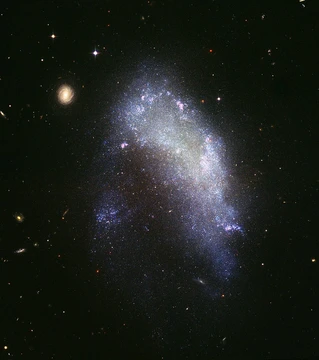
2MASX J10222849+5006200
One of the largest known galaxies, a detached-double-double radio galaxy.

2MASX J10222849+5006200, also known as LEDA 2362940, is a massive Type-cD elliptical galaxy located in the constellation of Ursa Major. With a redshift of 0.15, it lies 2.4 billion light-years from Earth and has a diameter of almost 660,000 light-years, making it one of the largest galaxies known. It is the brightest cluster galaxy (BCG) inside the galaxy cluster Abell 980.
Quick Facts
- Epoch
- J2000.0
- Constellation Name
- Ursa Major
- Ra
- 10 · 22 · 28.44
- Dec
- +50 · 06 · 19.83
- Z
- 0.158413
- H Radial V
- 47,491 km/s
- Dist Ly
- 701.03 ± 49.08 Mpc
- Group Cluster
- Abell 980
- Notes
- Oldest fossil radio galaxy containing double radio lobes
- Names
- OGC 286, LEDA 2362940, NVSS J102228+500620, SDSS J102228.44+500619.8, CXOGSG J102228.4+500619, RX J1022.4+5006:[ZEH2003]
- Mag J
- 13.4
Facts from the source article.
Lore & Background
2MASX J10222849+5006200 is classified as a low-excitation radio galaxy with a 1.4 GHz luminosity range between 2 × 10^23 and 3 × 10^25 W Hz⁻¹. It possesses an ellipsoidal stellar halo measuring about 80 kpc, with two diffuse ultra-steep spectrum radio sources extending roughly 100 kpc around the galaxy. In August 2022, Indian astronomers from Savitribai Phule Pune University, led by Surajit Paul, observed a burst of radio jet activity from its central black hole. They identified a first pair of radio lobes, described as the oldest such lobes the astronomers had seen, and detected diffuse radio structures formed 260 million years ago and 1.2 million years in length using the Giant Meterwave Radio Telescope.
Reader's Guide
The significance of 2MASX J10222849+5006200 lies in its classification as a 'Detached-Double-Double Radio Galaxy' (dDDRG) system. Following the primary pair of radio lobes, a team led by Gopal-Krishna found that the galaxy had drifted 250,000 light-years from its original position within the cluster's central region. During this drift, the galaxy erupted again in a new active phase, creating a younger set of radio lobes. Because both the old and young radio lobes lost their collinearity when the parent galaxy moved, the resulting structure became a dDDRG. This makes the galaxy a rare and valuable laboratory for studying radio jet activity, galaxy motion within clusters, and the evolution of radio lobes over hundreds of millions of years. The discovery of the oldest known radio lobes and the subsequent detection of younger lobes from the same galaxy highlight its unique role in understanding active galactic nuclei and cluster dynamics.
Did You Know?
- It is the brightest cluster galaxy (BCG) in the galaxy cluster Abell 980.
- Indian astronomers led by Surajit Paul discovered the oldest known pair of radio lobes from this galaxy in August 2022.
- The galaxy has drifted 250,000 light-years from its original position in the cluster center, creating a detached-double-double radio galaxy system.
More in Elliptical and Irregular Galaxies 1-24
Spotted an error? Know more?
Reader corrections go straight into our review queue. Suggest an edit · How this site is sourced