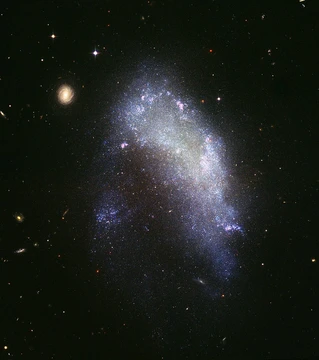
Elliptical galaxy
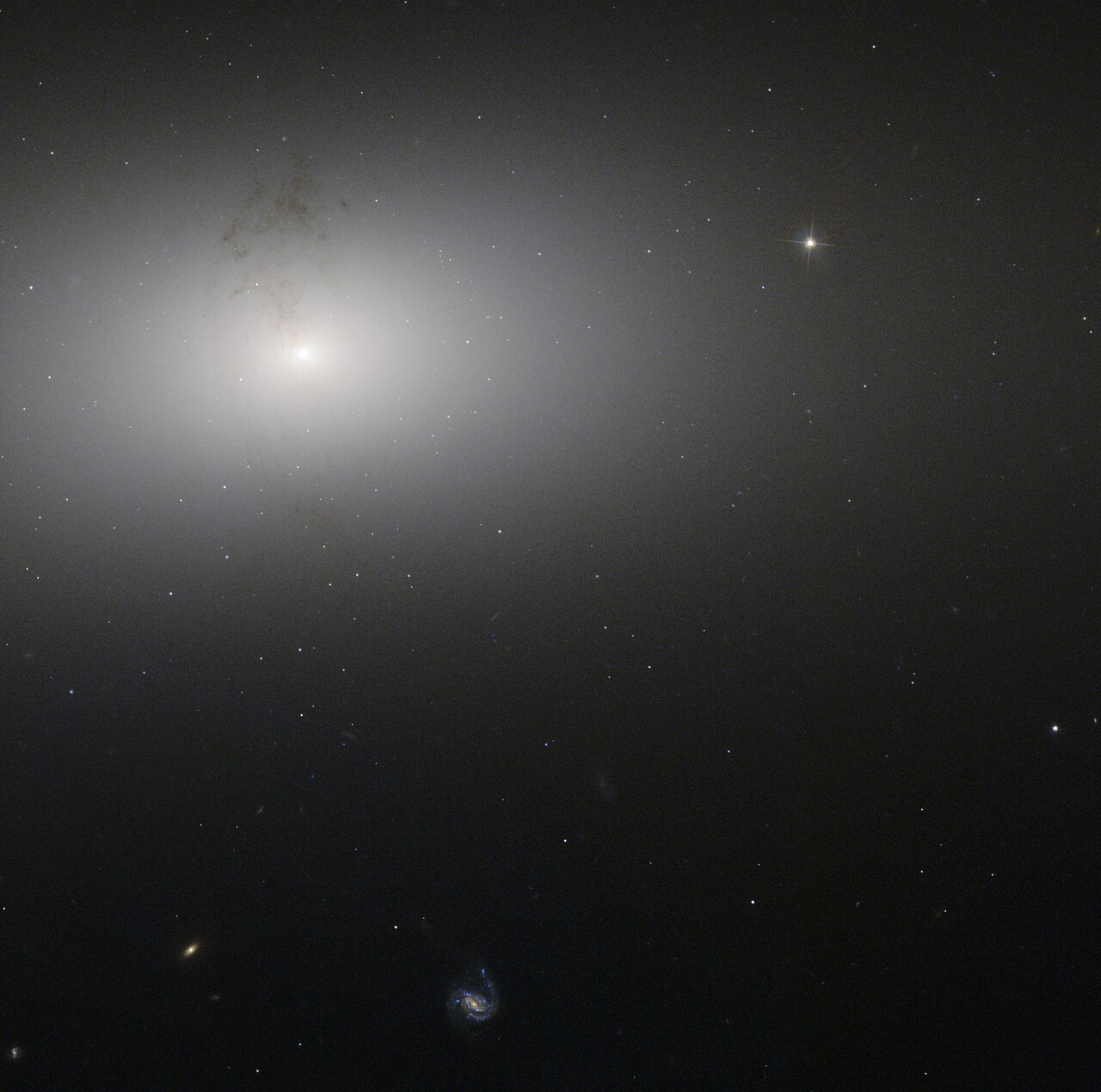
Elliptical galaxies are smooth, ellipsoidal masses of old stars with little gas.

NASA , ESA , R.M. Crockett (University of Oxford, U.K.), S. Kaviraj (Imperial Co · CC BY 4.0
Elliptical galaxies are roughly ellipsoidal in shape and appear smooth and nearly featureless. Edwin Hubble included them as one of the three main galaxy types in his Hubble sequence and his 1936 book *The Realm of the Nebulae*, alongside spiral and lenticular galaxies. Together with lenticular galaxies (S0), which have large-scale disks, and ES galaxies, which have intermediate-scale disks, ellipticals belong to the "early-type" galaxy population.
These galaxies are mostly made up of older, low-mass stars and contain very little interstellar gas or dust. As a result, star formation is minimal, though brief bursts can occur during mergers with other galaxies. Ellipticals tend to have many globular clusters and make up about 10–15% of galaxies in the Virgo Supercluster, though they are not the most common type overall. They are most often found near the centers of galaxy clusters.
Elliptical galaxies vary enormously in size, from dwarf ellipticals with tens of millions of stars to supergiants containing over one hundred trillion stars that dominate their clusters. Edwin Hubble originally thought ellipticals evolved into spirals, but this turned out to be incorrect. However, gas and smaller galaxies can sometimes be accreted to form a disk around an existing ellipsoidal structure. The stars in ellipticals are generally much older than those in spiral galaxies.
Examples include 3C 244.1, M49 (NGC 4472), M59 (NGC 4621), M60 (NGC 4649), M87 (NGC 4486)—whose supermassive black hole was the first imaged by the Event Horizon Telescope—M89 (NGC 4552), M105 (NGC 3379), NGC 4697, ESO 383-76, IC 1101, Hercules A, Maffei 1, CGCG 049-033, Centaurus A (NGC 5128), NeVe 1, and M86 (NGC 4406).
Elliptical galaxies are spherical or ovoid masses of stars with little star-making gas. Their sparse interstellar matter leads to low star formation rates, few open clusters, and few young stars. They are dominated by old stellar populations, giving them red colors. Large ellipticals often have extensive systems of globular clusters, typically in two populations: one redder and metal-rich, the other bluer and metal-poor.
The dynamics of elliptical galaxies resemble those of spiral galaxy bulges, suggesting similar formation processes, though this is debated. Their luminosity profiles follow Sersic’s law, and scaling relations link their structural parameters.
- Classification origin
- Edwin Hubble, 1936 work The Realm of the Nebulae
- Proportion in virgo supercluster
- 10–15%
- Size range diameter
- 3,000 to more than 700,000 light years
- Mass range
- 10^5 to nearly 10^13 solar masses
- Star count range
- tens of millions to over one hundred trillion
- Hubble type range
- E0 (spherical) to about E7
Lore & Background
Most elliptical galaxies are composed of older, low-mass stars, with a sparse interstellar medium, and they tend to be surrounded by large numbers of globular clusters. Star formation activity in elliptical galaxies is typically minimal; they may, however, undergo brief periods of star formation when merging with other galaxies. Elliptical galaxies are believed to make up approximately 10–15% of galaxies in the Virgo Supercluster, and they are not the dominant type of galaxy in the universe overall. They are preferentially found close to the centers of galaxy clusters. Originally, Edwin Hubble hypothesized that elliptical galaxies evolved into spiral galaxies, which was later discovered to be false, although the accretion of gas and smaller galaxies may build a disk around a pre-existing ellipsoidal structure. Every massive elliptical galaxy contains a supermassive black hole at its center, and the mass of the black hole is tightly correlated with the mass of the galaxy, evidenced through correlations such as the M–sigma relation. Elliptical galaxies are characterized by spherical or ovoid masses of stars, starved of star-making gases, with very little interstellar matter, resulting in low rates of star formation, few open star clusters, and few young stars; they are dominated by old stellar populations, giving them red colors. Large elliptical galaxies typically have an extensive system of globular clusters, generally with two distinct populations: one redder and metal-rich, and another bluer and metal-poor. The dynamical properties of elliptical galaxies and the bulges of disk galaxies are similar, suggesting they may be formed by the same physical processes, although this remains controversial. Unlike flat spiral galaxies with organization and structure, elliptical galaxies are more three-dimensional, without much structure, and their stars are in somewhat random orbits around the center.
Reader's Guide
Elliptical galaxies are significant as one of the three main classes in Edwin Hubble's classification system, which shaped modern galaxy taxonomy. They are a subset of the 'early-type' galaxy population, along with lenticular and ES galaxies. Their sizes range from dwarf ellipticals with tens of millions of stars to supergiants of over one hundred trillion stars that dominate their galaxy clusters. The Hubble classification of elliptical galaxies uses an integer from E0 to about E7 describing how elongated the galaxy image is, based on the ratio of major to minor axes. However, it has been known since 1966 that E4 to E7 galaxies are misclassified lenticular galaxies with disks inclined at different angles. Hubble recognized that his shape classification depends both on the intrinsic shape of the galaxy and the angle of observation. The formation of elliptical galaxies is an active area of ongoing research, with early models proposing rapid star formation at high redshifts and later models emphasizing mergers of disk galaxies. Studies show that both models are consistent with what is plausible for their formation. More recent work suggests that gas-rich (wet) mergers can produce lower mass, fast rotating ellipticals, while gas-poor (dry) mergers may help build higher mass, slow rotating systems. Nearby ellipticals have shown more massive systems are typically older. In recent years, evidence has shown that a reasonable proportion (~25%) of early-type galaxies have residual gas reservoirs and low-level star formation.
Did You Know?
- The largest elliptical galaxies can have diameters exceeding 700,000 light years.
- M87 (NGC 4486) is an elliptical galaxy whose supermassive black hole was the first black hole to be imaged by the Event Horizon Telescope.
Hubble's Taxonomy and the Early-Type Family
Edwin Hubble's 1936 treatise The Realm of the Nebulae placed elliptical galaxies alongside spirals and lenticulars as one of three principal morphological classes. Together with S0 lenticulars and ES intermediates, ellipticals form what astronomers now call the "early-type" population. Within the Hubble sequence, individual ellipticals receive a numerical suffix from 0 to 7, derived from the ratio of the minor to major axes of the galaxy's isophotes. A perfectly round object scores E0, while increasingly elongated images climb toward E7. Hubble himself acknowledged that this number reflects both intrinsic shape and the observer's viewing angle, so a genuinely elongated body seen face-on could masquerade as a round E0. Decades later, spectral observations confirmed that many objects catalogued as E4 through E7 are actually lenticular galaxies whose tilted disks mimic ellipsoidal profiles. Modern thinking further distinguishes two broad physical families: giant ellipticals with slightly boxy isophotes produced by anisotropic random stellar motion, and smaller "disky" ellipticals that harbour rotating disk components.
A World of Ancient Stars and Central Black Holes
Elliptical galaxies are essentially stellar graveyards. Their interiors are starved of the gas and dust that fuel star birth, leaving behind populations dominated by old, low-mass stars that lend the whole system a deep red hue. Open clusters and young stellar groups are exceedingly rare. Instead, the halos of large ellipticals are studded with vast swarms of globular clusters, often split into two distinct families: a redder, metal-rich group and a bluer, metal-poor group. Unlike the orderly, flat rotation of spiral disks, stars in an elliptical follow somewhat random three-dimensional orbits around the centre. Perhaps the most striking internal feature is the near-universal presence of a supermassive black hole. Surveys of forty-six ellipticals, twenty classical bulges, and twenty-two pseudobulges all revealed a central black hole, with its mass tightly linked to the host galaxy's stellar mass through relations such as the M–sigma correlation, which connects the velocity dispersion of surrounding stars to the black hole's weight.
From Dwarf Shells to Supergiant Leviathans
No other galaxy class spans such an extraordinary range of scale. At the small end, dwarf ellipticals may contain only tens of millions of stars and measure as little as three thousand light years across, a size comparable to a typical globular cluster. Yet these tiny bodies harbour a considerable reservoir of dark matter that clusters themselves lack, and many may not be closely related to their larger elliptical cousins. At the opposite extreme, supergiant or cD-type ellipticals stretch beyond seven hundred thousand light years and accumulate masses approaching ten to the thirteenth solar masses. Objects such as Hercules A, IC 1101 at the heart of Abell 2029, and ESO 383-76—among the largest galaxies known—embody this upper bound. The Hubble classification integer from 0 to 7 attempts to capture how elongated each galaxy appears, but because the number depends on viewing geometry as well as true shape, it tells only part of the story. This breadth of size and mass makes ellipticals the most structurally diverse family in the galaxy census.
Cluster Kings and Record-Breaking Phenomena
Elliptical galaxies are not the most numerous type in the cosmos, yet they hold court at the centres of galaxy clusters and compact groups, where they account for roughly ten to fifteen percent of all galaxies in the Virgo Supercluster. Hubble originally speculated that ellipticals would evolve into spirals, a hypothesis later disproven; however, the accretion of gas and smaller galaxies can still build a disk around a pre-existing ellipsoidal core, producing lenticular or ES morphologies. When ellipticals do merge, brief bursts of star formation can ignite. Their members include some of the most spectacular objects known: M87, whose central supermassive black hole became the first to be directly imaged by the Event Horizon Telescope; NeVe 1, the source of the Ophiuchus Supercluster eruption, the most powerful astronomical event ever recorded; CGCG 049-033, home to the longest galactic jet discovered; and Maffei 1, the nearest giant elliptical to our own Milky Way. Centaurus A, with its unusual dust lanes and radio-loud behaviour, straddles the boundary between elliptical and lenticular types.
Gallery
More in Elliptical and Irregular Galaxies 1-24
Spotted an error? Know more?
Reader corrections go straight into our review queue. Suggest an edit · How this site is sourced