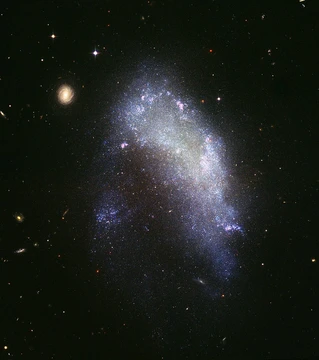
3C 180
A Seyfert type 2 galaxy with extended emission-line regions.

3C 180 is a Seyfert type 2 galaxy located in the constellation of Monoceros. It is notable as a high-excitation radio galaxy with a Fanaroff-Riley Type II classification, first recorded in the Third Cambridge Catalogue of Radio Sources in 1962. The host galaxy is a large elliptical galaxy residing inside a galaxy cluster, exhibiting a boxy appearance based on Hubble Space Telescope observations.
Quick Facts
- Epoch
- J2000.0
- Constellation Name
- Monoceros
- Ra
- 07 · 27 · 04.49
- Dec
- -02 · 04 · 42.30
- Z
- 0.220000
- H Radial V
- 65,954 km/s
- Dist Ly
- 2.736 Gly
- Names
- PKS 0724−01, 4C −02.31, DA 234, OI −041, 2MASX J07270487−0204301, NRAO 0265, TXS 0724−019, MSH 07−006, Cul 0724−019, PAPER J111.71−02.09
Facts from the source article.
Lore & Background
3C 180 was first recorded in the Third Cambridge Catalogue of Radio Sources in 1962. The galaxy's nucleus is described as disturbed, with weak radio emission based on long-slit spectroscopy observations. The dust morphology includes patches of faint and thin dust lanes. The galaxy is known to have an extended emission-line region (EELR) with a length of 45 kiloparsecs on both sides, oriented along the direction of the radio axis. A rotating structure in the EELR displays a full amplitude of 700 kilometers per second, though it also shows signs of velocity fluctuations. A series of arc-like features surround the galaxy's nucleus. A narrow-line region, described as lopsided, was discovered, with emission forming into a bi-conical series of shells extending both northeast and southeast from the core.
Reader's Guide
The significance of 3C 180 lies in its detailed structural features as observed through spectroscopy and imaging. The presence of an extended emission-line region spanning 45 kiloparsecs on each side, with a rotating structure showing velocity fluctuations, provides insight into the dynamics of gas around active galactic nuclei. The discovery of a lopsided narrow-line region forming bi-conical shells indicates complex outflow geometries. In 2021, confirmation of nuclear outflows with compact gas morphology reaching up to 8.5 kiloparsecs from the nucleus, and a maximum velocity of 2450 kilometers per second, underscores the galaxy's role in studying feedback processes. The blue component dominating the northwest area further highlights asymmetric outflow behavior. These characteristics make 3C 180 a valuable object for understanding radio galaxy evolution and the interaction between nuclear activity and the interstellar medium.
Did You Know?
- 3C 180 has an extended emission-line region (EELR) that extends 45 kiloparsecs on both sides.
- The galaxy's narrow-line region is lopsided and forms a bi-conical series of shells.
- Nuclear outflows in 3C 180 reach a maximum velocity of 2450 kilometers per second.
- The host galaxy is a large elliptical galaxy with a boxy appearance.
More in Elliptical and Irregular Galaxies 1-24
Spotted an error? Know more?
Reader corrections go straight into our review queue. Suggest an edit · How this site is sourced