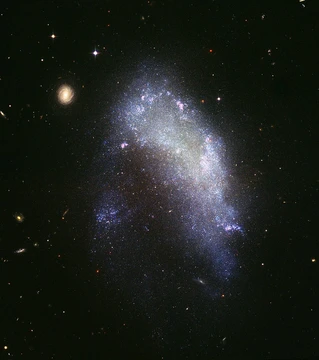
3C 132
A Fanaroff-Riley Type 2 low-excitation radio galaxy in Taurus.

NRAO VLA Archive Survey, (c) AUI/NRAO. · CC BY 4.0
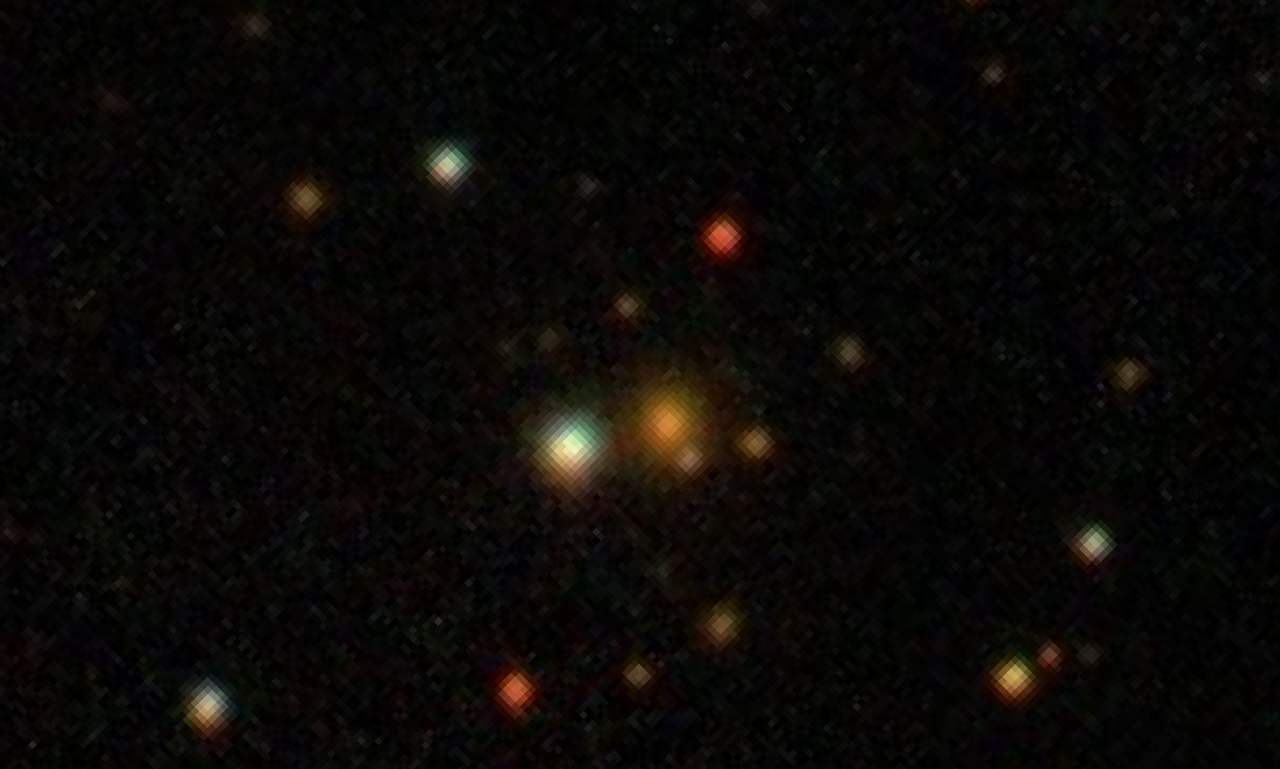
3C 132 is a radio galaxy located in the constellation of Taurus, first discovered in the Third Cambridge Catalogue of Radio Sources survey in 1962. It is notable as a Fanaroff-Riley class Type 2 low-excitation radio galaxy, with a host galaxy described both as an elliptical galaxy with a smooth, elongated appearance and as an interacting irregular galaxy, surrounded by several companions in a packed group, suggesting it resides inside a galaxy cluster.
Quick Facts
- Epoch
- J2000.0
- Constellation Name
- Taurus
- Ra
- 04 · 56 · 43.01
- Dec
- +22 · 49 · 22.95
- Z
- 0.214000
- H Radial V
- 64,156 km/s
- Dist Ly
- 2.661 Gly
- Appmag B
- 18.5
- Names
- 4C +22.11, PKS 0453+22, LEDA 2817548, B2 0453+22, 2MASX J04564292+2249230, NRAO 0198, NVSS J045643+224922, Cul 0453+227, G4Jy 0511
Facts from the source article.
Lore & Background
The host galaxy of 3C 132 is an elliptical galaxy with a smooth and elongated appearance, but is also described as an interacting irregular galaxy. It is surrounded by several companions forming a packed group, suggesting it resides inside a galaxy cluster. A face-on disk is found in the galaxy, described to have an elliptical isophotal morphology. Imaging made by the Hubble Space Telescope found a bright central nucleus, surrounded by faint diffused radio emission.
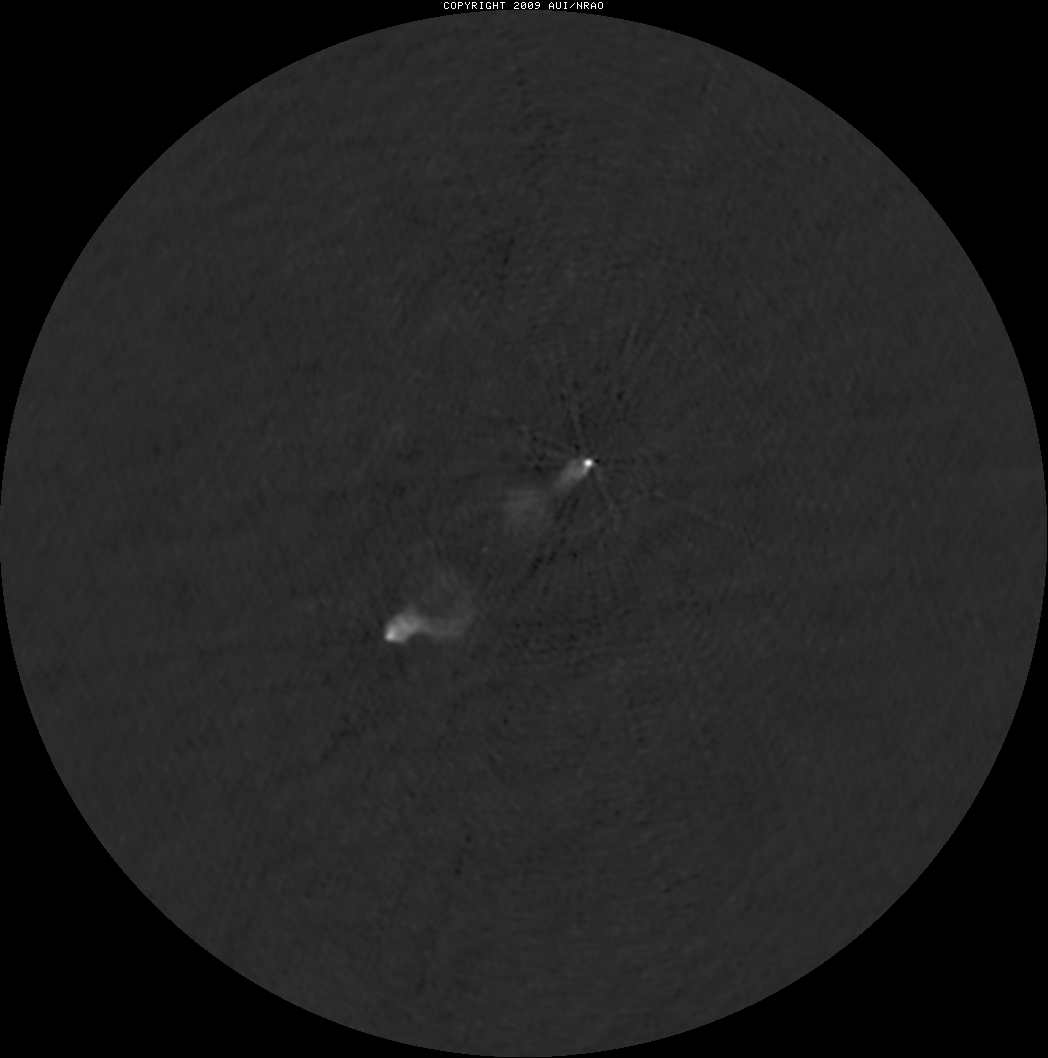
The radio source is a classical double, with two components having a flux ratio of 1.6 ± 0.3. When observed at high resolutions with the Very Large Array, it has hotspot regions protruding in a bottle-neck fashion, with brightening observed in its radio lobe located on the eastern side, just along the southern edge. The hotspot on the western side is 800 parsecs in extent, while the eastern one is estimated to be 2 kiloparsecs. A curved feature interpreted as backflow leaves the location of the western hotspot towards the southeast, bending at seven kiloparsecs from the hotspot before ending inside a region of diffused medium. A radio bridge is present in the source, perpendicular to its axis.
A study in 2014 showed the edge-brightened lobes on the southwest and northwestern sides have the same brightness, and the lobes are shown flaring towards the direction of the core. A knot feature described as faint is located inside the southeastern lobe, apparently bridging a delineated section and a diffused region.
Reader's Guide
3C 132 is significant as a Fanaroff-Riley Type 2 low-excitation radio galaxy, a class that helps astronomers understand the relationship between radio emission and galaxy environment. Its host galaxy's dual description—as both an elliptical and an interacting irregular galaxy—along with its packed group of companions and likely residence in a galaxy cluster, provides a complex context for studying galaxy interactions and cluster dynamics. The radio source's classical double structure, with a flux ratio of 1.6 ± 0.3 and hotspot sizes of 800 parsecs (western) and 2 kiloparsecs (eastern), offers detailed morphological data. The presence of a curved backflow feature, a perpendicular radio bridge, and edge-brightened lobes of equal brightness on the southwest and northwestern sides, as observed in a 2014 study, contribute to models of radio lobe evolution and energy transport. The faint knot in the southeastern lobe and the bright central nucleus surrounded by faint diffuse emission, as seen by the Hubble Space Telescope, further characterize the galaxy's multi-wavelength properties. The source's evidence of lunar occultations adds a historical observational dimension.
Place in the Cosmic Census
The observable universe contains an estimated two trillion or more galaxies, a staggering population that dwarfs any single object's significance. Within this vast expanse, the Local Supercluster encompasses roughly 100,000 galaxies, while the Local Group—a smaller neighborhood—holds approximately 51 members. Objects bearing 3C designations, such as the radio-source catalog entries referenced in astronomical literature, occupy a specific niche within this hierarchy. They are not isolated curiosities but part of a structured taxonomic framework that organizes the galaxy population by discovery method, brightness, distance, and morphological type. The existence of dedicated lists for naked-eye galaxies, prototype classes, interacting systems, and the most distant known objects illustrates how astronomers have layered multiple classification schemes atop one another. A 3C-designated galaxy therefore sits at the intersection of radio astronomy and optical cataloguing, bridging two observational traditions that together paint a fuller picture of the cosmic population.
The Cataloguing Era
Systematic efforts to enumerate galaxies began in earnest during the 1960s. The Catalogue of Galaxies and Clusters of Galaxies recorded 29,418 entries, while the Morphological Catalogue of Galaxies aimed for completeness at photographic magnitude 15 and above, listing 30,642 objects. By the 1980s, the Lyons Groups of Galaxies had identified 485 distinct groups containing 3,933 member galaxies, shifting focus from individual objects to their gravitational associations. These cataloguing milestones represent a progression from simple enumeration to structural understanding. Objects with designations like those in the 3C radio catalog were being cross-referenced with these optical surveys, creating a multi-dimensional map of the galaxy population. The sheer volume of entries—tens of thousands in a single catalogue—underscores how even a modest slice of the observable universe demanded dedicated, multi-decade recording efforts to capture.
Redshift Uncertainty and Correction
The history of galaxy distance measurement is punctuated by errors and retracted claims. In 1975, 3C 123 was assigned a redshift of 0.637, a figure later corrected to 0.218—a substantial overestimate that would have placed the object far beyond its true position. This single case mirrors a broader pattern visible across the timeline of most-distant-galaxy records: numerous candidates from the late 1990s and 2000s were excluded from definitive lists because their redshifts lacked spectroscopic confirmation, were based on misidentified emission lines, or simply could not be replicated by follow-up observations. Some objects, like Abell 1835 IR1916, were never even found again by subsequent surveys. The 3C 123 episode reminds us that even well-known, catalogued radio sources are not immune to measurement error, and that the astronomical record requires continuous revision as observational techniques improve.
From Photographic Plates to Citizen Science
The trajectory of galaxy classification has moved from small, hand-curated lists to massive, crowd-powered surveys. Early catalogues in the 1960s relied on photographic plates and manual inspection, yielding lists of roughly 30,000 objects. The 1980s brought group-based organization, and the 1990s saw the first redshift catalogues compiled by pioneers like Slipher, Humason, Mayall, and Sandage. The most dramatic leap came in July 2007 with the launch of Galaxy Zoo, a citizen-science project that has since classified over one million galaxy images drawn from the Sloan Digital Sky Survey, the Hubble Space Telescope, and the Cosmic Assembly Near-Infrared Deep Extragalactic Legacy Survey. This shift from a handful of professional astronomers to a global volunteer base transformed what was possible in morphological classification, ensuring that objects across every brightness range and distance could receive a visual type designation on a scale no single research group could achieve.
Gallery
More in Elliptical and Irregular Galaxies 1-24
Spotted an error? Know more?
Reader corrections go straight into our review queue. Suggest an edit · How this site is sourced