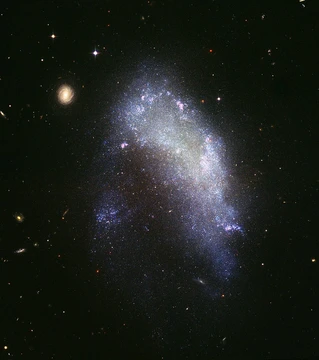
Dwarf elliptical galaxy
Small, common elliptical galaxies found in groups and clusters.

NASA Hubble · CC BY 2.0
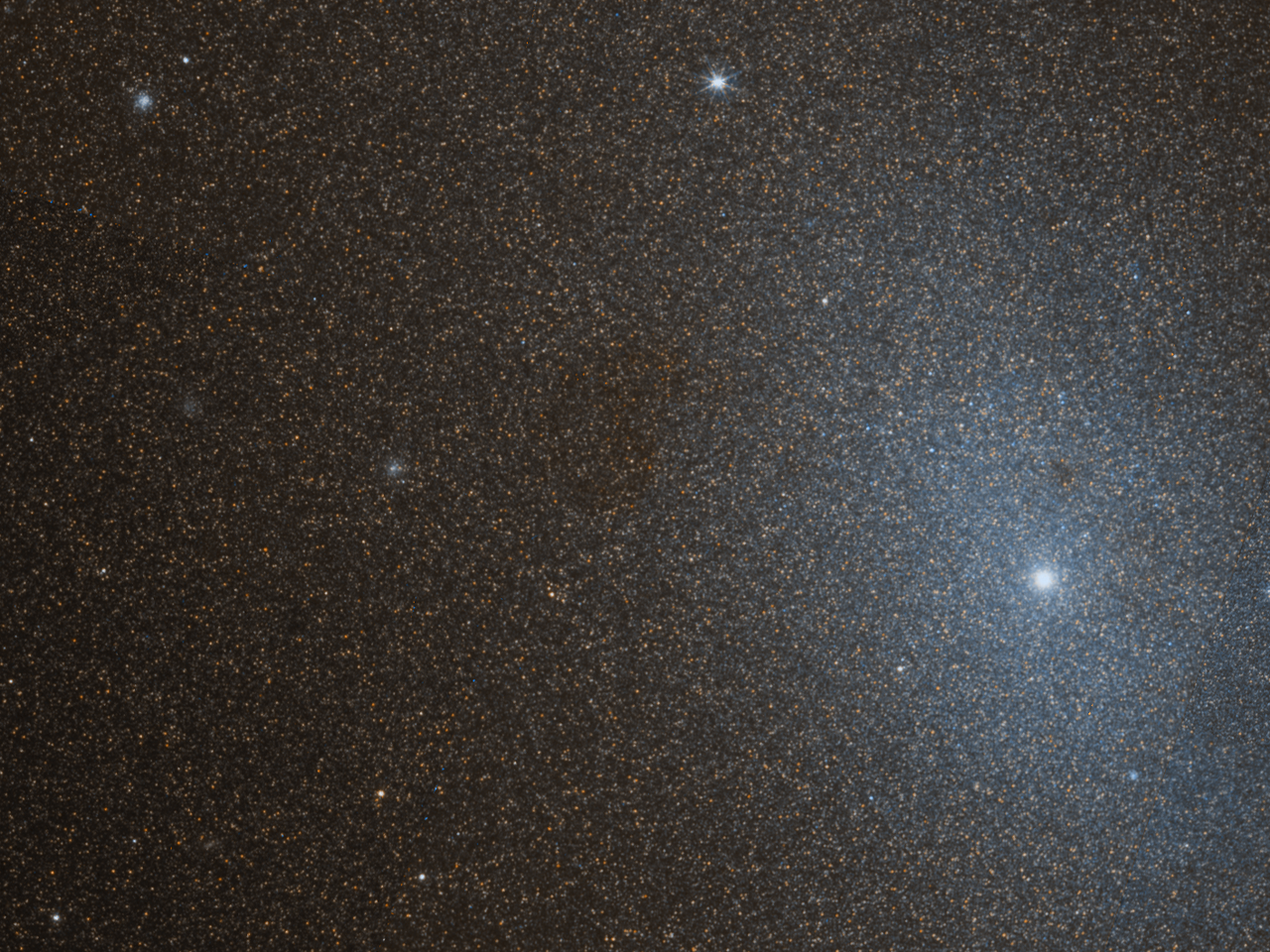
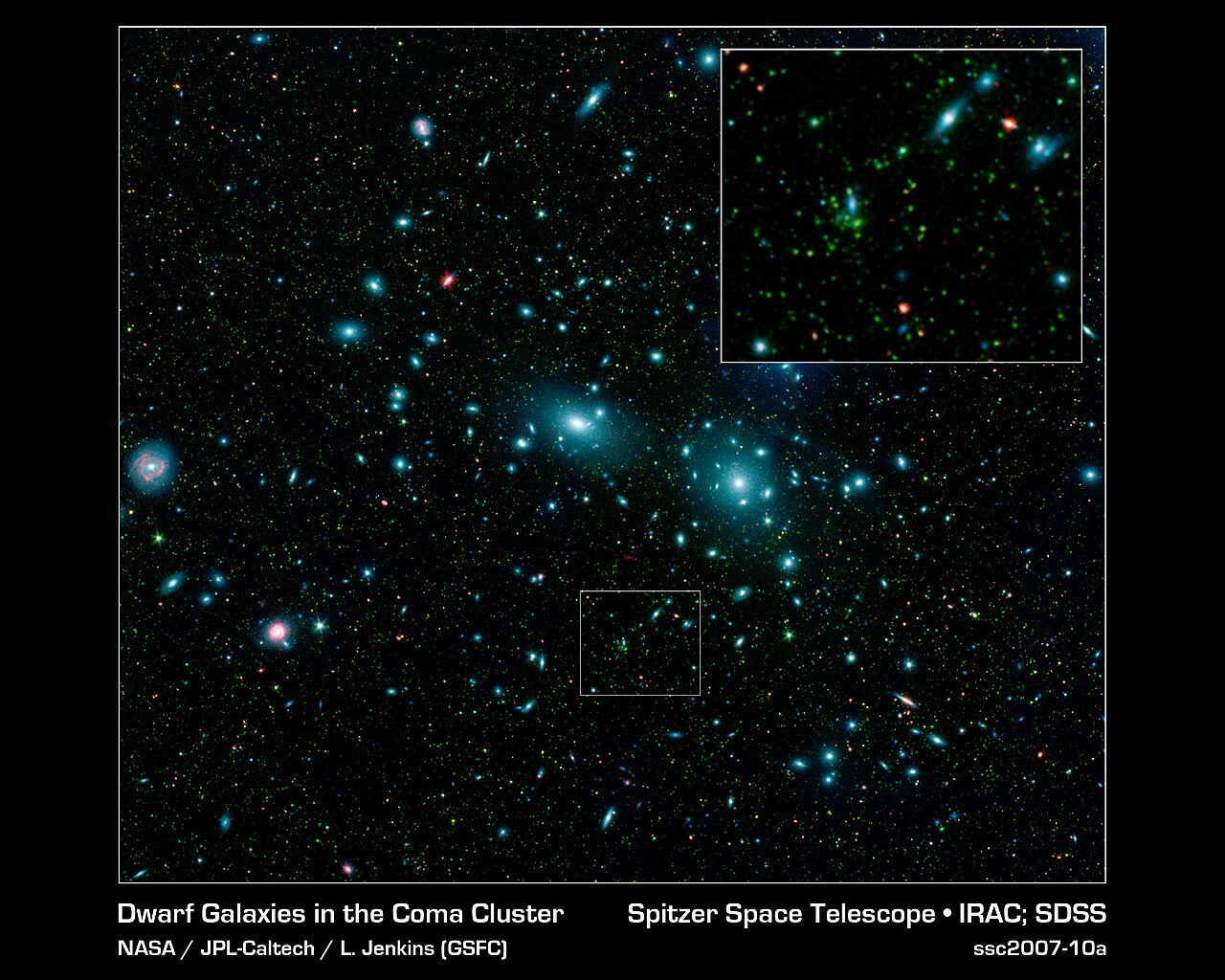
Dwarf elliptical galaxies, or dEs, are a smaller type of elliptical galaxy. They are frequently found in galaxy groups and clusters, often orbiting larger galaxies as companions. These objects are distinct from the rarer compact elliptical galaxies, with the Andromeda Galaxy's satellite M32 being the classic example of that separate class.
In 1944, Walter Baade identified NGC 147 and NGC 185 as dwarf ellipticals within the Local Group by observing their individual stars, made possible by their relative proximity. During the 1950s, similar galaxies were also found in the Fornax and Virgo clusters. Dwarf ellipticals are fainter than standard ellipticals, with blue absolute magnitudes between -18 and -14. While ordinary ellipticals were once described by de Vaucouleur's surface brightness model and dEs by an exponential profile, both types now fit well within a broader Sersic model. The Sersic index, which measures the shape of this brightness profile, changes smoothly with galaxy brightness, suggesting that dwarf and ordinary ellipticals belong to a single continuous family. A still fainter type, the dwarf spheroidal galaxy, may represent a genuinely different category.
The origins of dwarf ellipticals are debated. One idea, rooted in the Lambda-CDM cosmological model, holds that they are primordial: the first small objects of dark matter and gas to form. Through gravitational attraction, these small structures merged into larger ones, a process called hierarchical merging. If correct, dwarf galaxies could be the building blocks of today's large spirals, which themselves may merge into giant ellipticals. An alternative hypothesis, known as galaxy harassment, suggests that dEs are the remnants of low-mass spiral galaxies. Repeated gravitational interactions with larger galaxies in a cluster could strip away much of their stellar disk and reshape them into a rounder form. Evidence for this includes faint spiral arms and stellar disks seen in some dEs.
However, galaxy harassment cannot be the whole story. The isolated dwarf elliptical CG 611 shows the same features—coherent rotation and faint spiral arms—that were once taken as proof of a spiral origin requiring a cluster environment. CG 611 also has a gas disk rotating in the opposite direction to its stars, indicating it is growing by accreting material.
- Blue absolute magnitude range
- −18 < MV < −14
- Prototype compact elliptical
- M32
- Confirmed local group members
- NGC 147, NGC 185
- Clusters with des discovered 1950s
- Fornax, Virgo
Lore & Background
In 1944 Walter Baade confirmed dwarf ellipticals NGC 147 and NGC 185 as members of the Local Group by resolving them into individual stars, thanks to their relatively little distance. In the 1950s, dEs were also discovered in the nearby Fornax and Virgo clusters. Dwarf elliptical galaxies have blue absolute magnitudes within the range −18 < MV < −14, fainter than ordinary elliptical galaxies. The surface brightness profiles of ordinary elliptical galaxies was formerly approximated using de Vaucouleur's model, while dEs were approximated with an exponentially declining surface brightness profile. However, both types fit well by a more general function, known as Sersic's model, and there is a continuity of Sersic index as a function of galaxy luminosity, interpreted as showing that dwarf elliptical and ordinary elliptical galaxies belong to a single sequence. An even-fainter type, called dwarf spheroidal galaxies, may be a genuinely distinct class.
Reader's Guide
Dwarf elliptical galaxies may be primordial objects. Within the currently favoured cosmological Lambda-CDM model, small objects consisting of dark matter and gas were the first to form. Because of their mutual gravitational attraction, some coalesce and merge, forming more massive objects, a process called hierarchical merging. If this hypothesis is correct, dwarf galaxies may be the building blocks of today's large spiral galaxies, which in turn merge to form giant ellipticals. An alternative suggestion is that dEs could be the remnants of low-mass spiral galaxies that obtained a rounder shape through repeated gravitational interactions within a cluster, a process called galaxy harassment. Evidence for this has been claimed due to stellar disks and weak spiral arms seen in some dEs. However, the galaxy harassment scenario cannot be the full picture. The highly isolated dwarf elliptical galaxy CG 611 possesses the same physical attributes as dE galaxies in clusters—coherent rotation and faint spiral arms—attributes previously assumed to provide evidence that dE galaxies were once spiral galaxies prior to transformation requiring immersion in a cluster. CG 611 has a gas disk counter-rotating to its stellar disk, revealing that its disk is growing via accretion events. If CG 611 were to fall into a galaxy cluster, ram-pressure stripping by the cluster's hot X-ray gas halo would strip away its gas disk, leaving a gas-poor dE that immediately resembles other dEs in the cluster, undermining the idea that dE galaxies were once spiral galaxies.
Did You Know?
- Dwarf elliptical galaxies are smaller than ordinary elliptical galaxies and are common in galaxy groups and clusters.
- Walter Baade confirmed NGC 147 and NGC 185 as Local Group members by resolving them into individual stars in 1944.
- Dwarf elliptical and ordinary elliptical galaxies may belong to a single sequence based on Sersic index continuity.
Place in the Cosmic Hierarchy
Dwarf elliptical galaxies occupy the smallest rung of the elliptical family, containing only tens of millions of stars compared to supergiants that hold over a hundred trillion. Their diameters can be as small as 3,000 light years, making some of them no larger than a typical globular cluster. Yet despite their compactness, these tiny systems harbor a considerable amount of dark matter that is absent in globular clusters, setting them apart from those dense stellar groupings. The full range of elliptical galaxies spans from these dwarfs to objects exceeding 700,000 light years in diameter and nearly ten to the thirteenth power solar masses, a spread far broader than any other galaxy class. Dwarf ellipticals are not simply miniature versions of their giant cousins; most of these small galaxies may not be physically related to other ellipticals at all, suggesting they follow a distinct evolutionary path. They are not the dominant galaxy type in the universe, and while they make up roughly ten to fifteen percent of galaxies in the Virgo Supercluster, their overall cosmic prevalence remains modest.
A Stellar Landscape of Ancient Light
Dwarf elliptical galaxies are defined by their stellar aging. Their populations are dominated by older, low-mass stars, and the stars within them are, on average, far older than those found in spiral galaxies. This advanced age gives these systems their characteristic red colors. The interstellar medium inside a dwarf elliptical is remarkably sparse; there is very little gas and virtually no dust, which means the raw material for building new stars is essentially absent. As a result, star formation activity is minimal, open star clusters are rare, and young stars are scarce. The galaxy is, in a sense, a fossil: a quiet, three-dimensional mass of ancient light with stars drifting in somewhat random orbits around the center rather than tracing the orderly disks of spiral systems. The only exception to this stellar dormancy comes during rare merging events with other galaxies, which can trigger brief episodes of new star formation. Unlike their giant elliptical relatives, dwarf ellipticals do not typically host extensive globular cluster systems, and they lack the supermassive black holes that anchor every massive elliptical.
The Puzzle of Shape and Classification
Edwin Hubble's 1936 framework assigned each elliptical galaxy an integer from zero to seven based on how elongated its image appears. The number is calculated from the ratio of the major axis to the minor axis of the galaxy's isophotes, multiplied by ten. A perfectly round galaxy scores zero, earning the designation E0, while the most elongated visible examples approach E7. However, this system has a critical blind spot: since 1966, astronomers have recognized that many galaxies classified as E4 through E7 are actually lenticular galaxies whose disks are tilted at various angles to our line of sight. Spectral observations confirming the rotation of their stellar disks have validated this reclassification. Hubble himself acknowledged that his shape categories depend on both the true intrinsic geometry and the viewing angle, meaning some E0 galaxies are genuinely elongated. Within the dwarf elliptical subset, a further distinction is sometimes drawn between disky dwarfs that contain small-scale disks and the boxy isophotes of giant ellipticals, though this nomenclature is considered an abuse of terms given the broader early-type taxonomy.
The Early-Type Family and Formation Questions
Dwarf ellipticals belong to the early-type galaxy population, a group that also includes lenticular galaxies with their large-scale disks and ES galaxies with intermediate-scale disks. They are preferentially found near the centers of galaxy clusters and in compact groups, rather than scattered randomly through the cosmic web. A long-standing debate surrounds their origins: the dynamical properties of elliptical galaxies closely mirror those of the bulges in disk galaxies, and both follow Sersic's law in their luminosity profiles, suggesting they may be built by the same physical processes. Yet this connection remains controversial. Hubble originally proposed that ellipticals evolved into spirals, a hypothesis later disproven, though the accretion of gas and smaller galaxies can indeed build a disk around a pre-existing ellipsoidal structure. For dwarf ellipticals specifically, the question of whether they are simply small versions of giant ellipticals or entirely separate objects formed through different pathways remains unresolved, with most small galaxies potentially unrelated to their larger counterparts.
Gallery
More in Elliptical and Irregular Galaxies 1-24
Spotted an error? Know more?
Reader corrections go straight into our review queue. Suggest an edit · How this site is sourced