3C 135
A Fanaroff-Riley class 2 radio galaxy in Orion.

Aladin Sky Server · Public domain
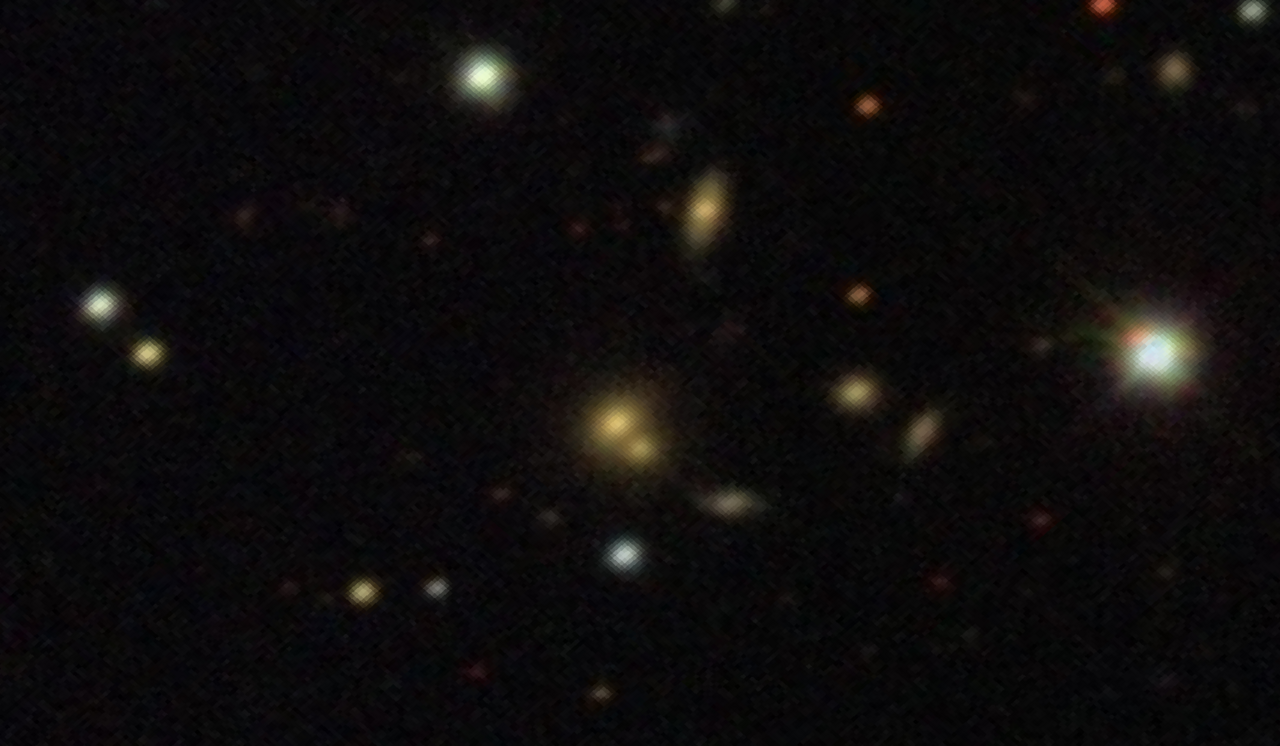
3C 135 is a Fanaroff-Riley class 2 radio galaxy and a Seyfert 2 galaxy in Orion. First cataloged as a radio source in 1962 by A.S. Bennett for the Third Cambridge Catalogue, its optical counterpart was identified four years later. The galaxy has a redshift of 0.127.
Classified as a high excitation radio galaxy, 3C 135 is hosted by a large elliptical galaxy with a boxy shape. A faint surface brightness feature runs along its minor axis. Its supermassive black hole is estimated at 8.09 ± 0.06 solar masses, and the host galaxy itself at 11.24 ± 0.03 solar masses. The galaxy sits in a dense cluster, with a small companion to the southwest.
An emission-line region aligns closely with the radio source, stretching along the jet axis. A disconnected radio emission area points toward the northwest hotspot, which is compact and shows rapid rotation in its core, with slowing velocity gradients toward its outer diffuse parts. Emission-line knots form a cone-shaped structure extending 77 kiloparsecs to the southwest. Symmetrical outflow lobes extend to the northwest and southeast.
The radio structure is compact. Very Large Array images reveal a low-surface brightness extension north of the southern lobe, while the northern lobe splits into two unequal segments with a constriction at the boundary. A small, bright outer component contains a double hotspot with an elongated, recessed primary hotspot. A faint one-sided jet enters the southern lobe, likely interacting with interstellar gas. Strong emission-line features appear on the southwest side, with receding features on the northwest.
Quick Facts
- Epoch
- J2000.0
- Constellation Name
- Orion
- Ra
- 05 · 14 · 08.35
- Dec
- +00 · 56 · 32.25
- Z
- 0.127380
- H Radial V
- 38,188 km/s
- Dist Ly
- 1.686 Gly
- Appmag V
- 17.00
- Appmag B
- 18.24
- Names
- 4C 00.18, PKS 0511+00, PGC 16952, DA 165, NRAO 0201, TXS 0511+008, 2MASX J05140834+0056316, 87GB 051132.2+005313, OG +020
Facts from the source article.
Lore & Background
3C 135 was first discovered as an astronomical radio source by A.S. Bennett conducting the Third Cambridge Catalogue of Radio Sources in 1962, before being optically identified in 1966 with its counterpart. The host is a large elliptical galaxy described as having a boxy morphology, with a tiny surface brightness structure situated along its minor axis. It is located inside a rich galaxy cluster, with several other galaxies surrounding it, and forms a close pair with a small companion galaxy located southwest from it.
An emission-line region is present in the galaxy, mainly aligning together with its radio source and described as elongating along the axis of its jet. There is a radio emission region found disconnected and towards the direction of the northwest hotspot, described as compact, displaying rapid rotations in its central regions and decreasing velocity gradients in its outer diffused structures. Emission-line knots form a conical structure in a southwest direction with a distance of 77 kiloparsecs, and extended outflows from the galaxy form two symmetrical lobes extending into northwest and southeast directions.
The radio structure is classified as compact. When imaged with the Very Large Array, it is found to have a low-surface brightness extension north from its southern radio lobe. The northern radio lobe is split into two segments described as unequal, with a constriction separation in the lobe boundary. There is a small outer component of high brightness levels and a defined double hotspot structure with an elongated recessed primary hotspot. A faint one-sided jet enters the southern lobe, with evidence pointing out it is also interacting with interstellar medium gas. Observations also found evidence of strong emission-line features on the southwest side of the galaxy but receding features on its northwest side.
Reader's Guide
3C 135 is significant as a Fanaroff-Riley class 2 radio galaxy and Seyfert 2 galaxy, providing a case study of a high excitation radio galaxy (HEG) hosted by a boxy elliptical galaxy. Its location within a rich galaxy cluster and its close companion galaxy to the southwest offer context for studying galaxy interactions and cluster environments. The galaxy's emission-line region aligns with its radio source and elongates along the jet axis, indicating a direct connection between radio activity and ionized gas. The presence of a disconnected radio emission region near the northwest hotspot, along with compact central rotations and decreasing velocity gradients in outer structures, suggests complex dynamics. The conical emission-line knots at 77 kiloparsecs to the southwest and symmetrical outflow lobes to the northwest and southeast highlight large-scale feedback processes. The radio structure's compact classification, combined with Very Large Array imaging revealing a low-surface brightness extension, an unequal split northern lobe, and a double hotspot with an elongated recessed primary hotspot, underscores the intricate morphology of the source. The faint one-sided jet entering the southern lobe and its interaction with interstellar medium gas, along with strong emission-line features on the southwest side and receding features on the northwest side, further characterize the galaxy's active nucleus and its impact on the surrounding medium.
Did You Know?
- The host galaxy is a large elliptical with a boxy morphology and a tiny surface brightness structure along its minor axis.
- The galaxy has a close companion located southwest, and emission-line knots form a conical structure 77 kiloparsecs away in that direction.
Mythology & Cultural Resonance
The constellation's deepest roots lie in the Greek legend of Orpheus, whose lyre produced music so transcendent that even stones were said to sway. His melodies silenced the Sirens during the Argonauts' voyage and later moved Hades himself to release Eurydice from the Underworld—only for Orpheus to falter at the final moment and lose her forever. Two ancient authors offer competing accounts of his death: Eratosthenes blames a failed sacrifice to Dionysus, while Ovid describes a mob of women whose fury overwhelmed his song. In both versions, Zeus set the lyre among the stars and the muses buried his bones. Beyond Greece, the figure has been reimagined endlessly. Arabs saw a diving vulture or eagle; the Welsh called it King Arthur's Harp; the Persian poet Hafiz named it the Lyre of Zurah; the Boorong people of Victoria recognized a Malleefowl; and the Incas worshipped it as an animal deity called Urcuchillay. Even Roman tradition linked it to Theseus, and medieval Christians dubbed it the Manger of the Infant Saviour.
Stellar Wonders & Deep-Sky Treasures
At the heart of Lyra blazes Vega, the constellation's brightest star and a cornerstone of the Summer Triangle asterism. A main-sequence star of spectral type A0Va sitting just 7.7 parsecs away, Vega subtly pulses as a Delta Scuti variable, shifting between magnitudes −0.02 and 0.07 over a mere 0.2 days. On average it ranks as the second-brightest star in the northern sky and the fifth-brightest overall, trailing only Arcturus, Alpha Centauri, Canopus, and Sirius. Beyond Vega, the constellation harbors remarkable stellar systems. Beta Lyrae serves as the namesake prototype for an entire class of close binary stars whose components are so tightly bound that they deform into egg shapes and exchange material. Epsilon Lyrae, nicknamed the Double Double, presents a far more intricate architecture of multiple stars. Lyra also shelters the Ring Nebula, the second planetary nebula ever discovered and still the most widely recognized of its kind.
A Record-Setting Star & Scientific Firsts
Vega's importance extends far beyond its brilliance. It has been described as arguably the most important star in the sky after the Sun, a distinction earned through a string of pioneering observations. It was the first star outside our own to be captured in a photograph, and the first to yield a clear spectrum displaying absorption lines. It also became the first single main-sequence star other than the Sun confirmed to emit X-rays. Surrounding Vega is a circumstellar debris disk comparable in structure to the Kuiper Belt, offering a nearby analog to our own outer Solar System. The star's relationship to Earth's rotational axis is equally remarkable: it served as the pole star around 12,000 BCE and is projected to reclaim that role again near 14,000 CE. These achievements collectively cement Vega's status not merely as a bright beacon but as a foundational object in the history of observational astronomy.
Position, Boundaries & Observability
Lyra occupies a compact 286.5 square degrees of the northern sky, ranking 52nd among the 88 constellations officially recognized by the International Astronomical Union. Its borders, formalized by Belgian astronomer Eugène Delporte in 1930, form a 17-sided polygon stretching from right ascension 18h 14m to 19h 28m and declination +25.66° to +47.71°. To the north lies Draco, to the west Hercules, to the south Vulpecula, and to the east Cygnus. The constellation's principal asterism comprises six stars, and in total 73 stars within its borders shine brighter than magnitude 6.5. For observers in temperate northern latitudes, Lyra hangs nearly overhead just after midnight at the onset of summer, while from the equator down to roughly the 40th parallel south it appears low in the northern sky during those same months. The IAU assigned the three-letter abbreviation Lyr in 1922, and the constellation traces its lineage back to Ptolemy's 2nd-century catalogue of 48 figures.
Gallery
More in Elliptical and Irregular Galaxies 1-24
Spotted an error? Know more?
Reader corrections go straight into our review queue. Suggest an edit · How this site is sourced