Dwarf spheroidal galaxy
Small, dark-matter-dominated galaxies with old stars and little gas.

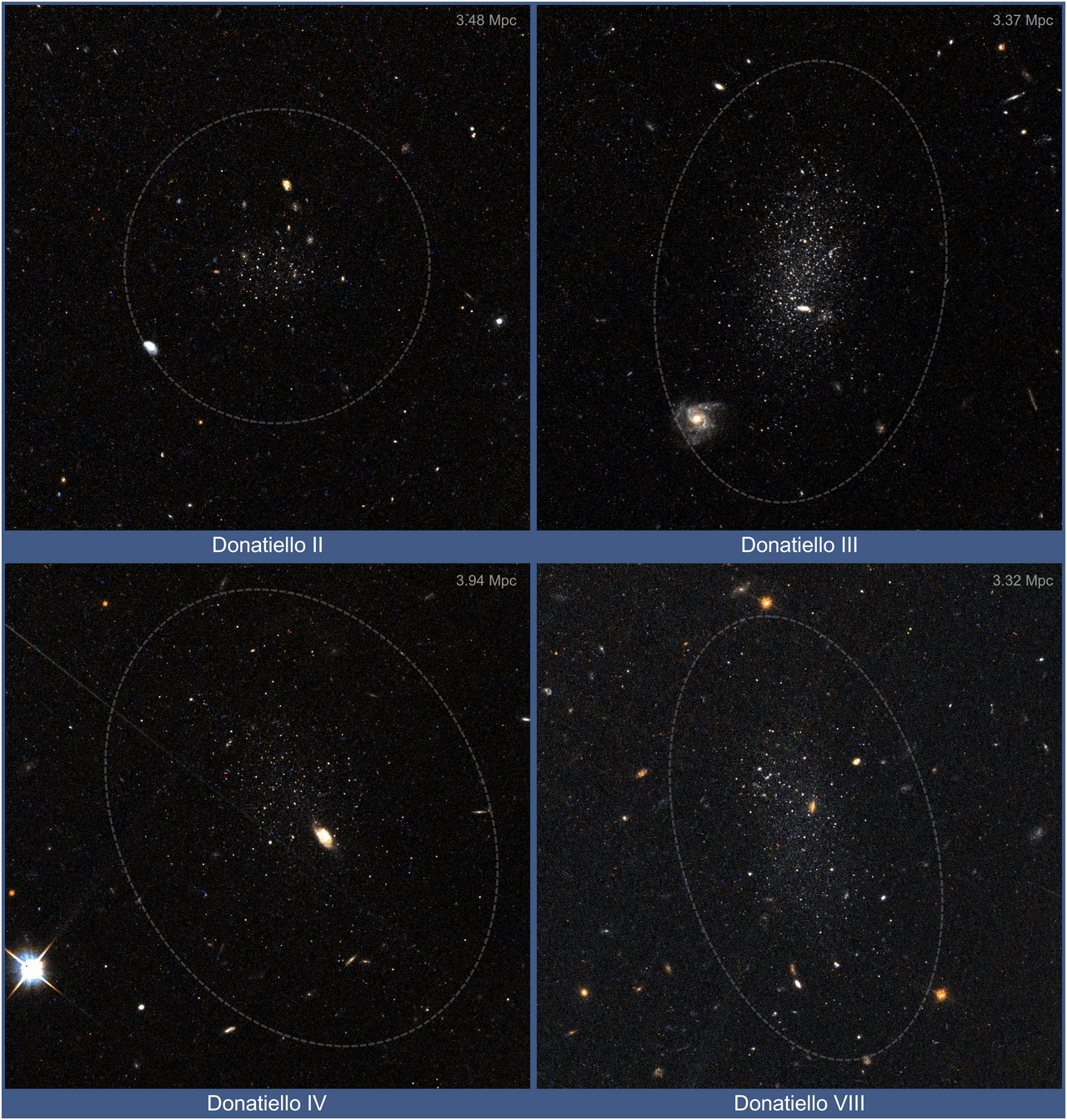
Science NASA, ESA, Eduardo Vitral (STScI), Roeland van der Marel (STScI), Sangmo · Public domain
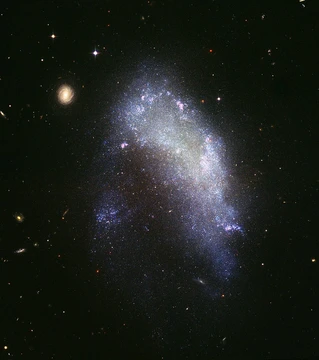
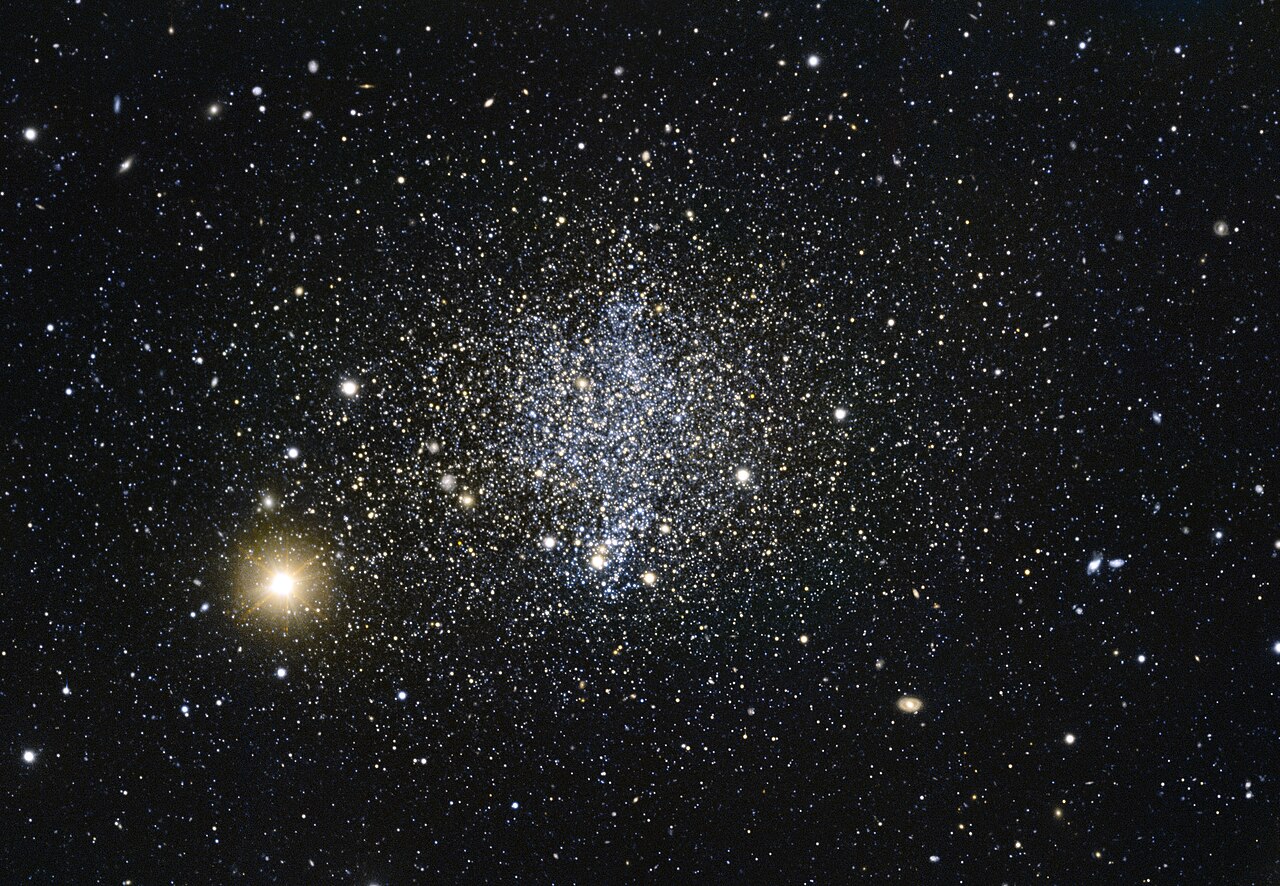
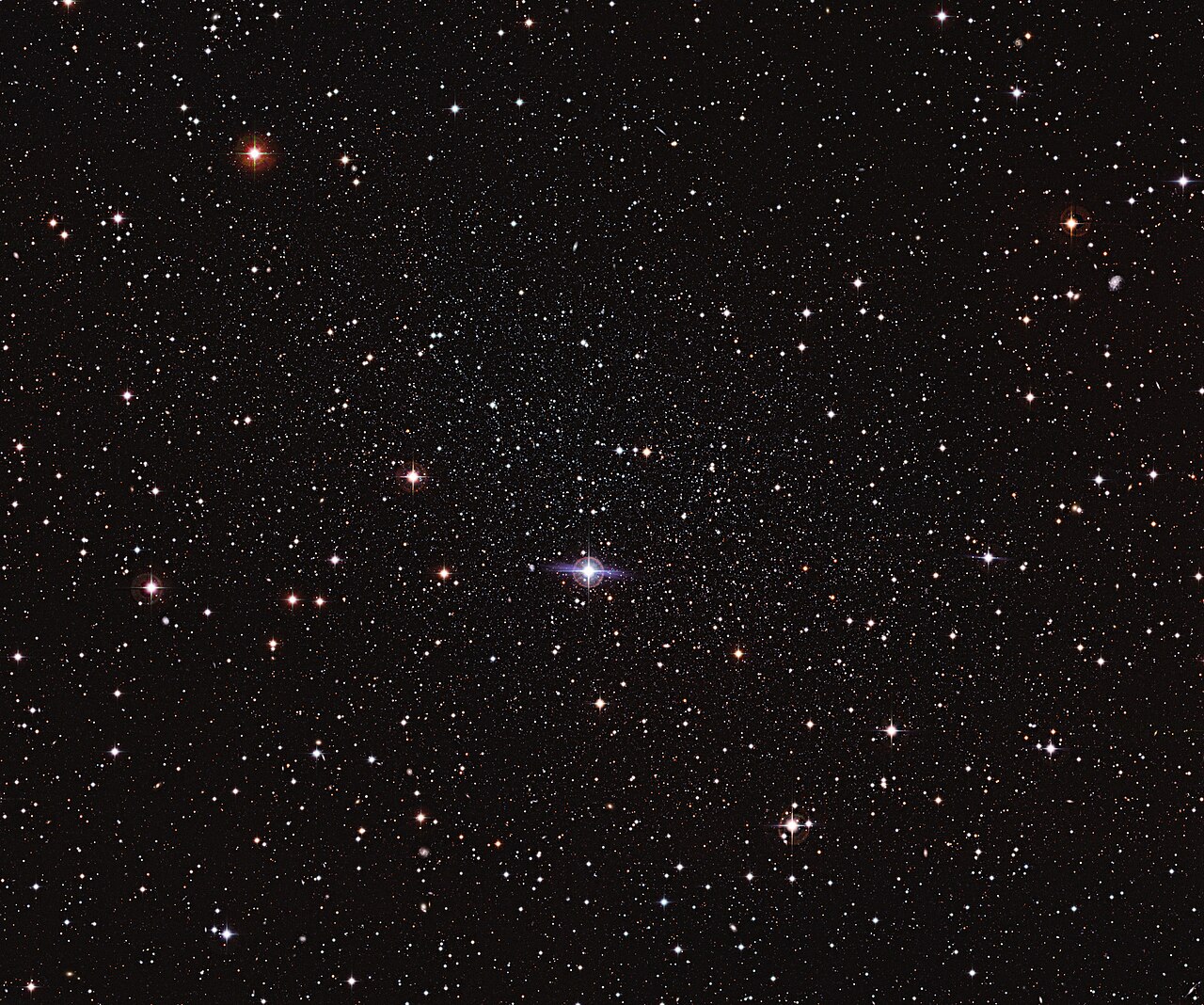
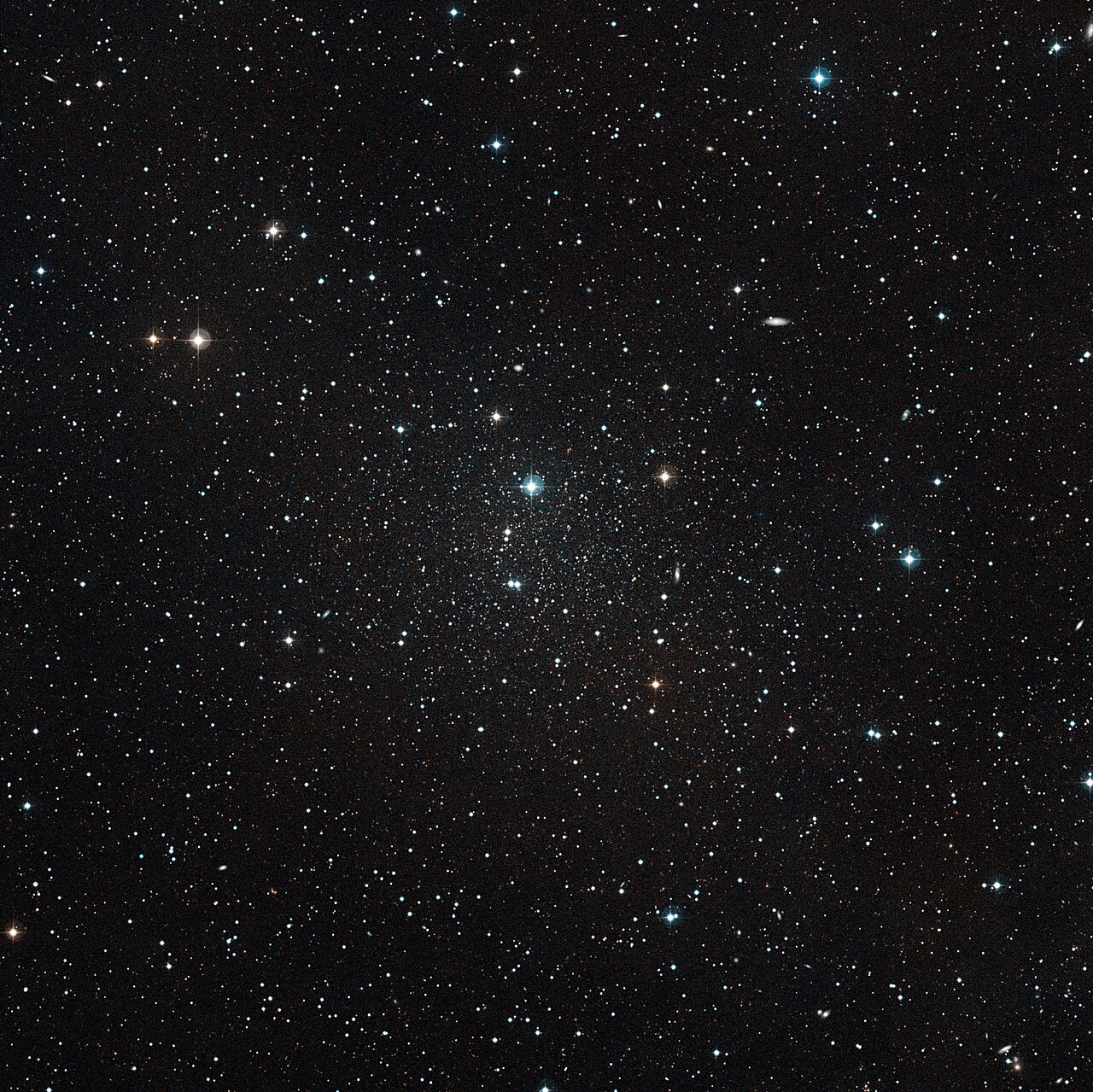
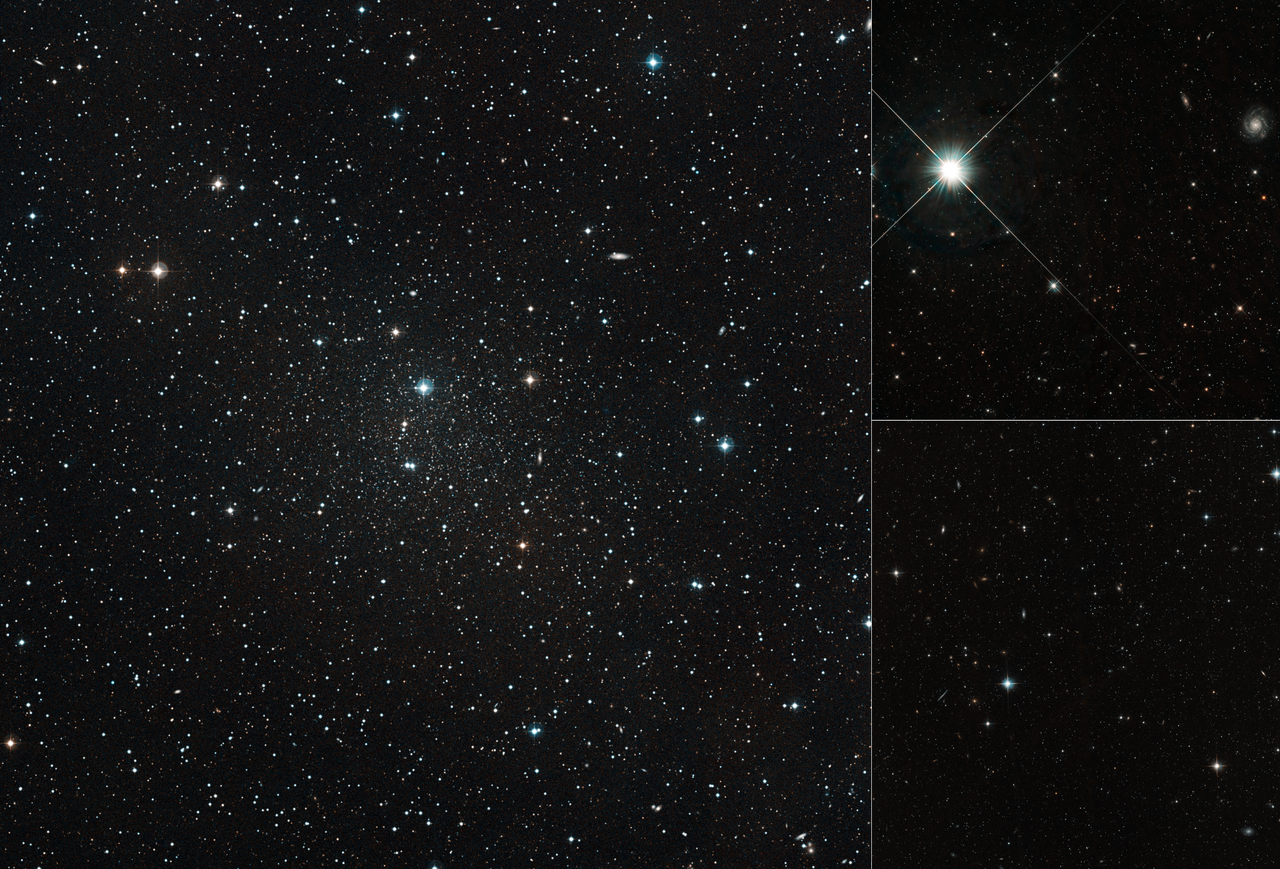
A dwarf spheroidal galaxy (dSph) is a small, faint galaxy with minimal dust and a population of old stars. These galaxies are found in the Local Group, orbiting the Milky Way and the Andromeda Galaxy (M31). They resemble dwarf elliptical galaxies in their lack of gas, dust, and recent star formation, but are roughly spheroidal and even less luminous.
Despite having larger radii than globular clusters, dwarf spheroidals are hard to detect because of their low luminosity and surface brightness. Their luminosities vary widely, spanning several orders of magnitude. The faintest known—Ursa Minor, Carina, and Draco—have mass-to-light ratios exceeding that of the Milky Way. They contain little to no gas and show no signs of recent star formation. In the Local Group, they are mainly found near the Milky Way and M31. The first two, Sculptor and Fornax, were discovered in 1938. By 2007, the Sloan Digital Sky Survey had found 11 more, and by 2015 many ultra-faint dSphs had been identified as Milky Way satellites, including nine potential new ones from the Dark Energy Survey. Each is named after its constellation, such as the Sagittarius dwarf spheroidal. Their stars are generally older than 1–2 billion years, having formed over many gigayears. For example, 98% of stars in Carina are older than 2 billion years, formed in three bursts roughly 3, 7, and 13 billion years ago. These stars are also metal-poor. Unlike star clusters, where stars form at roughly the same time, dwarf spheroidals experience multiple star-formation bursts.
The faintness of the lowest-luminosity dSphs has led some astronomers to question whether they are clearly distinct from globular clusters. However, recent studies show a difference: the total mass inferred from stellar motions in dwarf spheroidals is many times greater than the mass of the stars themselves. Their dynamical mass is around 10 million solar masses, very large given their low luminosity. At fainter luminosities, the distinction between a dSph and a star cluster is not universally agreed upon, but many astronomers decide based on dynamics: if an object appears to contain more dark matter, it is likely a dwarf spheroidal rather than a faint star cluster. In the standard Lambda cold dark matter model, dark matter presence is a key reason to classify dSphs separately from globular clusters, which show little to no dark matter.
- First discovered
- Sculptor and Fornax in 1938
- Lowest luminosity examples
- Ursa Minor, Carina, Draco
- Mass to light ratio
- greater than that of the Milky Way
- Dynamical mass
- around 10^7 M☉
- Velocity dispersion example
- Sextans: 7.9±1.3 km/s
- Star formation example
- Carina: 98% of stars older than 2 Gyr, formed in bursts around 3, 7, and 13 Gyr ago
Lore & Background
The first dwarf spheroidal galaxies discovered were Sculptor and Fornax in 1938. Despite their radii being much larger than those of globular clusters, they are difficult to find due to their low luminosities and surface brightnesses. The Sloan Digital Sky Survey resulted in the discovery of 11 more dSph galaxies by 2007, and by 2015 many more ultra-faint dSphs were discovered, all satellites of the Milky Way. Nine potentially new dSphs were discovered in the Dark Energy Survey in 2015. Each dSph is named after the constellation in which it is discovered, such as the Sagittarius dwarf spheroidal galaxy.
Dwarf spheroidal galaxies have little to no gas and no obvious signs of recent star formation. Their stars are generally much older than 1–2 Gyr and formed over many gigayears. For example, 98% of the stars in the Carina dwarf spheroidal galaxy are older than 2 Gyr, formed over three bursts around 3, 7, and 13 Gyr ago. Unlike star clusters, which form stars at roughly the same time, dwarf spheroidal galaxies experience multiple bursts of star formation. The stars in Carina are also metal-poor.
Evidence of dark matter is strong: the total mass inferred from stellar motions in dwarf spheroidals is many times that which can be accounted for by the stars themselves. Studies reveal a dynamical mass around 10^7 M☉ despite low luminosity. The Fornax dwarf spheroidal galaxy can be assumed in dynamic equilibrium to estimate dark matter, while UMa2 experiences strong tidal disturbances from the Milky Way. The Sextans dwarf spheroidal has a velocity dispersion of 7.9±1.3 km/s, inexplicable by stellar mass alone via the Virial Theorem. Similarly, the Hercules dwarf spheroidal's orbital path does not correspond to its contained mass.
Reader's Guide
Dwarf spheroidal galaxies are significant in astronomy primarily because of their extreme dark matter content. The article states that the total mass inferred from the motions of stars in dwarf spheroidals is many times that which can be accounted for by the stars themselves, with a dynamical mass around 10^7 M☉ despite low luminosity. This has led some astronomers to suggest they may deserve the title 'most dark matter-dominated galaxies.' The presence of dark matter is often cited as a reason to classify dwarf spheroidal galaxies as a different class of object from globular clusters, which show little to no signs of dark matter. However, the article notes that at fainter luminosities, it is not universally agreed upon how to differentiate between a dwarf spheroidal galaxy and a star cluster; many astronomers decide this based on the object's dynamics—if it seems to have more dark matter, it is likely a dwarf spheroidal. The article also highlights ongoing research into how much the internal dynamics of dwarf spheroidals are affected by the gravitational tidal dynamics of the galaxy they orbit, as seen with Sextans, Hercules, and UMa2. Their legacy lies in providing a laboratory for studying dark matter and galaxy formation in the Local Group.
Position in the Galaxy Family
Dwarf spheroidal galaxies occupy the smallest rung of the elliptical galaxy spectrum, a class first formally organized by Edwin Hubble in his 1936 work The Realm of the Nebulae. While the full elliptical family stretches from these compact dwarfs holding only tens of millions of stars all the way to supergiant systems boasting more than a hundred trillion, the dwarfs represent the lower extreme of a size range far broader than any other galaxy type. They belong to the broader early-type population, a grouping that also encompasses lenticular galaxies with their large-scale disks and ES types with intermediate-scale disks. Despite their place in this family, ellipticals as a whole are not the dominant galaxy type in the universe; in the Virgo Supercluster they account for roughly ten to fifteen percent of all galaxies. Dwarf spheroidals, being the smallest members, are a particularly modest subset of an already minority class, yet they remain important for understanding the full diversity of galactic structure.
Stellar Makeup and the Absence of New Stars
The stellar populations within dwarf spheroidal galaxies are dominated by old, low-mass stars, a hallmark shared across the elliptical class. Because these systems are starved of the gas and dust that fuel star birth, their interstellar medium is remarkably sparse, and ongoing star formation is virtually nonexistent. The result is a galaxy whose light is produced almost entirely by ancient stellar populations, lending it a distinctly red hue. Open star clusters and young stars are exceedingly rare. In the broader elliptical family, brief bursts of new star formation can occur when a galaxy merges with a neighbor, but such events are exceptional rather than routine. The stars inside ellipticals are, on average, far older than those found in spiral galaxies, and dwarf spheroidals inherit this ancient character. Large ellipticals are often accompanied by extensive systems of globular clusters, sometimes showing two distinct populations—one redder and metal-rich, the other bluer and metal-poor—though the dwarfs themselves are so small that their cluster environments differ markedly from those of their supergiant cousins.
Dark Matter and the Question of Kinship
Despite their diminutive size, dwarf spheroidal galaxies carry a property that sets them apart from the closest structural analogues: a considerable reservoir of dark matter. A dwarf elliptical can be no larger than a typical globular cluster in physical extent, yet it harbors dark matter in quantities that globular clusters simply do not possess. This distinction is critical because it means that, even when a dwarf spheroidal and a globular cluster appear similar in size and stellar content, they are fundamentally different objects. The presence of dark matter implies a different formation history and a different gravitational architecture. Furthermore, the evidence suggests that most of these small galaxies may not be closely related to the larger elliptical population at all. They may represent a separate evolutionary pathway or a distinct class that merely shares a superficial morphological resemblance with their more massive cousins. This uncertainty about their true lineage makes dwarf spheroidals a fascinating and unresolved chapter in our understanding of galactic diversity.
Shape, Classification, and the Viewing-Angle Problem
The Hubble sequence assigns each elliptical galaxy an integer from 0 to 7 based on how elongated its image appears, calculated from the ratio of the major to minor axes of its isophotes. A perfectly round galaxy receives the designation E0, while increasingly flattened images climb toward E7. However, this system has a well-known flaw: since 1966, astronomers have recognized that many galaxies classified as E4 through E7 are actually lenticular galaxies whose disks are tilted relative to our line of sight, making them appear more elongated than they truly are. Spectral observations confirming the rotation of these stellar disks have validated this reclassification. Hubble himself acknowledged that the shape number depends on both the galaxy's intrinsic geometry and the angle from which we observe it, meaning some objects labeled E0 may in fact be elongated. Among dwarf ellipticals, the disky subtype is recognized, containing small-scale disks, as opposed to the boxy giants whose shapes arise from anisotropic random stellar motion.
Gallery
More in Elliptical and Irregular Galaxies 1-24
Spotted an error? Know more?
Reader corrections go straight into our review queue. Suggest an edit · How this site is sourced