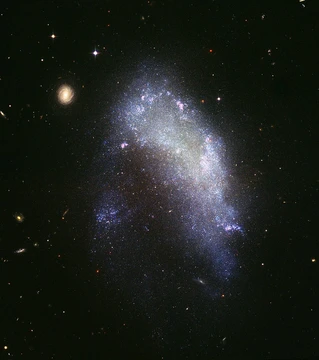
3C 66B
A giant elliptical radio galaxy with a prominent jet.

3C 66B is an elliptical radio galaxy located in the constellation Andromeda. It is notable for being a giant elliptical galaxy with a low-luminosity Fanaroff and Riley class 1 radio structure, featuring a strong jet and counter-jet that extend about 330 thousand light-years from its nucleus. The galaxy is an outlying member of Abell 347, part of the Perseus–Pisces Supercluster, and is separated by 6′ from the blazar 3C 66A, though the two are most likely unrelated.
Quick Facts
- Epoch
- J2000
- Constellation Name
- Andromeda
- Ra
- 02 · 23 · 11.4112
- Dec
- +42 · 59 · 31.385
- Z
- 0.021258
- Dist Ly
- 73.79 ±
- Group Cluster
- Abell 0347
- Appmag V
- 15.0
- Notes
- FRI RG, / gamma-ray source
Facts from the source article.
Lore & Background
3C 66B is a giant elliptical galaxy classified as a low-luminosity Fanaroff and Riley class 1 radio galaxy. Maps of its radio structure suggest that the emission is shaped by the galaxy's motion through an ambient medium. A strong jet and counter-jet extend about 330 thousand light-years (100 kpc) from the nucleus, and these jets have been observed in radio, infrared, optical, ultraviolet, and X-ray bands. Gamma ray emission has been detected from the direction of this galaxy, most likely emitted from the core region.
Observations with the Hubble Space Telescope in 1990 showed that the jet has a filamentary, double-stranded structure. When viewed in the optical, the northern jet shows four knots along its length, all of which are polarized, indicating a synchrotron basis. Very-long-baseline interferometry measurements of the galaxy's radio-emitting core demonstrated elliptical motion with a period of 1.05±0.03 years, strongly suggesting a supermassive black hole binary (SMBHB) at the center. This motion was expected to emit gravitational waves that would cause fluctuations in the pulse arrival times from the pulsar PSR B1855+09, but no such signature was found. Numerical simulations indicated this detection method may only be valid for an orbital eccentricity below 0.03.
Messier 87 (M87), about 55 million light-years away, is the largest giant elliptical galaxy near Earth and also contains an active galactic nucleus. The smooth jet of 3C 66B rivals that of M87.
Reader's Guide
3C 66B is significant as a nearby example of a giant elliptical radio galaxy with a well-studied jet structure that rivals that of Messier 87. Its classification as a low-luminosity Fanaroff and Riley class 1 radio galaxy places it in a category of objects whose radio emission is shaped by environmental interaction, as suggested by maps indicating the galaxy's motion through an ambient medium. The detection of its jet across multiple wavelengths—radio, infrared, optical, ultraviolet, and X-ray—makes it a valuable multiwavelength laboratory for studying relativistic outflows. The discovery of elliptical motion in its radio-emitting core, with a period of 1.05±0.03 years, provided strong evidence for a supermassive black hole binary at its center, a rare and important configuration for testing gravitational wave theories. Although the expected gravitational wave signature was not found in pulsar timing data, the null result helped constrain the orbital eccentricity of the binary to below 0.03. The galaxy's status as an outlying member of Abell 347, part of the Perseus–Pisces Supercluster, also places it in a larger cosmological context.
Did You Know?
- 3C 66B is separated by 6′ from the blazar 3C 66A, but the two are most likely unrelated.
- The galaxy's jet has a filamentary, double-stranded structure as observed by the Hubble Space Telescope in 1990.
- Very-long-baseline interferometry revealed elliptical motion in the core with a period of 1.05±0.03 years, suggesting a supermassive black hole binary.
- The smooth jet of 3C 66B rivals that of Messier 87, the largest giant elliptical galaxy near Earth.
The Amateur Who Found a New Galaxy
Giuseppe Donatiello, an Italian amateur astronomer and astrophotographer, stumbled upon Donatiello I in 2016 while poring over old long-exposure images he had captured years earlier. The original data came from a 6,000-second exposure of the sky around the Andromeda Galaxy, taken on two separate nights—November 2010 and October 2013—in Italy's Pollino National Park using a custom-built 12.7-centimetre telescope. Donatiello had originally aimed to photograph stellar streams and small companion galaxies near Andromeda. When he finally spotted the faint smudge in his archives, he cross-checked it against the Sloan Digital Sky Survey's ninth data release, which confirmed a dim object in the same patch of sky. He announced the find on Facebook in September 2016. David Martínez-Delgado of Heidelberg University saw the post and reached out, and together they arranged follow-up imaging with the Galileo National Telescope and the Gran Telescopio Canarias on La Palma in late November 2016. Their joint paper landed in Astronomy & Astrophysics in December 2018, with a preprint appearing on arXiv that October. A Hubble Space Telescope campaign has since been proposed to pin down the galaxy's exact distance and mass.
A Faint, Ancient Island of Stars
Donatiello I is classified as a dwarf spheroidal galaxy, a compact and dim island of stars sitting well outside the Local Group at an estimated distance of 2.5 to 3.5 megaparsecs, roughly 8.1 to 11.4 million light-years from Earth. Its total luminosity is approximately 200,000 times that of our Sun, giving it an absolute magnitude near −8.3 and a surface brightness of about 26 magnitudes per square arcsecond. The galaxy's effective radius is roughly 400 parsecs, and its shape is notably elongated, with an ellipticity of around 0.7. Like the dwarf spheroidals that orbit the Milky Way and Andromeda, Donatiello I is composed almost entirely of metal-poor red dwarf stars. No active star formation is taking place within it, meaning the galaxy has been quietly aging for billions of years. Its apparent angular diameter as seen from Earth is only about 60 arcseconds, making it an extremely challenging target even for large professional instruments.
An Unusually Lonely Neighbor
Despite sitting in the constellation Andromeda, Donatiello I stands out as one of the most isolated dwarf spheroidal galaxies known. Its nearest significant neighbor is the dwarf lenticular galaxy NGC 404, separated by roughly 65 kiloparsecs, or about 211,000 light-years—a vast gulf by galactic standards. The two objects are 72.4 arcminutes apart on the sky, and NGC 404 itself lies 60 arcminutes from the bright second-magnitude star Mirach. Donatiello I may be a satellite of NGC 404, though this physical association remains unconfirmed. Researchers have speculated that the dwarf spheroidal could have been caught up in, or shaped by, a possible merger between NGC 404 and an irregular dwarf galaxy roughly 900 million years ago. In the galactic coordinate system, Donatiello I sits at a longitude of 127.65 degrees and a latitude of −28.08 degrees, with a right ascension of 01h 11m 40.37s and a declination of +34° 36′ 3.2″ in the J2000 epoch. Its extreme isolation makes it a rare and valuable subject for studying how dwarf galaxies evolve in relative solitude.
Names, Nicknames, and a Place in the Catalogue
Every galaxy earns a designation, but Donatiello I carries a personal name in honor of its discoverer, Giuseppe Donatiello, the Italian amateur astronomer who first identified it. In the astronomical literature it is abbreviated as "Do I," following the convention of naming objects after their finders. Its more colorful nickname, "Mirach's Goblin," is a playful nod to its presumed neighbor NGC 404, which is itself called "Mirach's Ghost" because of its close angular proximity to the second-magnitude star Mirach in Andromeda. The goblin-and-ghost pairing gives the two objects a memorable folkloric identity that helps observers and writers distinguish them in the crowded Andromeda field. Donatiello I also appears on the curated list of galaxies named after people, cementing its place in the broader catalogue of celestial objects that bear human names. The discovery paper, published in Astronomy & Astrophysics in December 2018, further recommends Hubble Space Telescope observations to refine the galaxy's distance, size, mass, and its exact gravitational relationship with NGC 404, ensuring that the story of this small, lonely spheroidal is far from over.
Gallery
More in Elliptical and Irregular Galaxies 1-24
Spotted an error? Know more?
Reader corrections go straight into our review queue. Suggest an edit · How this site is sourced