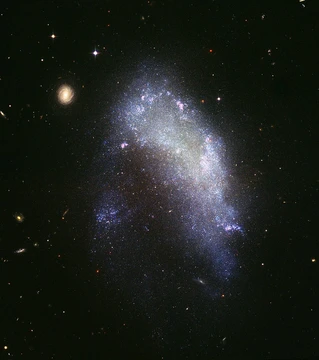
4C 49.22
A radio-loud quasar and blazar with a compact triple radio structure.

4C 49.22 is a radio-loud quasar in Ursa Major, first identified as a radio source in 1967. With a redshift of 0.333, it is classified as a flat-spectrum radio quasar and a blazar due to its electromagnetic variability. After an extended period of low gamma-ray activity, the Large Area Telescope detected a gamma-ray flare from it on 15 May 2011. Its host galaxy is an extremely luminous elliptical, with an off-center nucleus and a slight elongation toward the northeast. A faint, curved tidal arm suggests it has interacted with a small companion located about 10 arcseconds away. The central supermassive black hole has an estimated mass of 3.3 × 10⁸ solar masses.
The radio structure is compact. Very Long Baseline Array observations reveal a triple source with a north-south halo, a bright core with a flux density of 338 mJy at 5 GHz, and a flat spectrum between 1.6 and 15 GHz. The one-sided radio jet, studied via very-long-baseline interferometry, extends about three milliarcseconds and contains a knot feature 1.39 ± 0.1 milliarcseconds from the core. Its intensity increases toward the knot, then fades on the southwest side. The jet has a knotty appearance, with knot powers ranging from 2.0 × 10⁴⁵ to 1.4 × 10⁴⁸ erg s⁻¹. It is highly polarized, and its rotation measure increases from 15 rad m⁻² at the core to 25 rad m⁻² at the knot. X-ray studies show a hotspot in the southern lobe, further resolved into two components.
Quick Facts
- Epoch
- J2000.0
- Constellation Name
- Ursa Major
- Ra
- 11 · 53 · 24.46
- Dec
- +49 · 31 · 08.83
- Z
- 0.333640
- H Radial V
- 100023 km/s
- Dist Ly
- 3.848 Gly
- Appmag V
- 17.66
- Appmag B
- 17.94
- Names
- SBS 1150+497, 21P 164, 2MASX J11532449+4931090, LEDA 2821081, CoNFIG 114, LB 02136, LHE 310, NVSS J115324+493109, OM +484, RBS 1046, RX J1153.4+4931
Facts from the source article.
Lore & Background
4C 49.22 was first discovered as an astronomical radio source in 1967. Its radio spectrum is flat, classifying it as a flat spectrum radio quasar. The host galaxy is an extremely large luminous elliptical galaxy with an off-centered nucleus and a slight elongation towards the north-east. A faint tidal arm is curved, suggesting an interaction with a small companion 10 arcseconds away. The central supermassive black hole is estimated to be 3.3 × 10^8 M☉.
The radio structure is compact, observed by the Very Long Baseline Array as a triple with a halo structure oriented north to south. A bright radio core has an estimated flux density of 338 mJy at 5 GHz and a flat spectrum between 1.6 and 15 GHz. The one-sided radio jet, studied by very-long-baseline interferometry, is slightly extended for about three milliarcseconds and contains a knot feature at around 1.39 ± 0.1 milliarcsecond from the core. On the southwest side, the jet intensity increases brightly until the knot position, where it fades away. The jet has a knotty appearance, with knot features having a jet power between 2.0 × 10^45 to 1.4 × 10^48 erg s⁻¹. High polarization is present, and the rotation measure increases from 15 rad m⁻² at the core to 25 rad m⁻² at the knot. The jet has also been studied in X-rays, where a hotspot feature is located in its southern lobe and further separated into two components.
Reader's Guide
4C 49.22 is significant as a blazar and flat spectrum radio quasar, demonstrating the extreme variability characteristic of such objects, including a gamma-ray flare observed on 15 May 2011 after a prolonged low-activity state. Its host galaxy, an extremely large luminous elliptical with an off-centered nucleus and tidal features, provides evidence of a past interaction with a small companion, offering insight into galaxy mergers and their role in fueling active galactic nuclei. The compact triple radio structure and the one-sided, knotty jet with high polarization and varying rotation measure make it a valuable target for studying relativistic jet physics, particle acceleration, and magnetic field structures. The jet power estimates and the X-ray hotspot further contribute to understanding energy transport in such systems. Its discovery in 1967 as a radio source and subsequent multi-wavelength studies underscore its importance in the study of blazars and radio-loud quasars.
Did You Know?
- 4C 49.22 displayed a gamma-ray flare on 15 May 2011 after a long period of low gamma-ray activity.
- The central supermassive black hole mass is estimated to be 3.3 × 10^8 M☉.
- The radio jet has a knot feature at about 1.39 ± 0.1 milliarcsecond from the core, with jet power between 2.0 × 10^45 and 1.4 × 10^48 erg s⁻¹.
More in Elliptical and Irregular Galaxies 1-24
Spotted an error? Know more?
Reader corrections go straight into our review queue. Suggest an edit · How this site is sourced