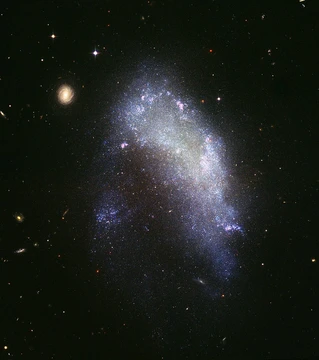
4C +41.26
Brightest cluster galaxy of Abell 1763, a wide-angle tail radio galaxy.

4C +41.26 (also cataloged as B3 1333+412) is a massive elliptical galaxy of type E in the constellation Canes Venatici. With a redshift of 0.228324, it lies about 3.3 billion light-years from Earth. It serves as the brightest cluster galaxy in Abell 1763 (ACO 1763).
This galaxy is a wide-angle tail (WAT) radio galaxy, hosted by a central dominant galaxy at the core of Abell 1763. It contains a double-lobed radio source with a power of about 10²⁶ W Hz⁻¹. The lobes are resolved, and the northern lobe is notably less polarized than the southern one. A radio core is present, with a total flux density of 3.23 ± 0.01 mJy, though a 2015 study suggested a flux density of 72.83 mJy. High-resolution radio imaging reveals a jet in the southern part, cutting through a plume feature and ending at a compact region. This jet has a minimum pressure of roughly 1.8 × 10⁻¹¹ dyn cm⁻² and a flux density of 5.07 mJy.
The galaxy’s total ultraviolet star formation rate is 1.06 M☉ per year, while its infrared star formation rate is estimated at 7.68 M☉ per year. Its stellar mass is 4.18 M☉. The core appears red in its inner color shape profile, with a surface brightness profile parameter of 24.47⁺⁰·¹⁹₋₀·₂₁ kiloparsecs. No hydrogen-alpha emission has been detected. A 2018 study found a supermassive black hole at the center, with a mass of 10.12 ± 0.05 M☉, based on the galaxy’s K-band bulge luminosity. The galaxy’s peculiar velocity is 650 kilometers per second.
Quick Facts
- Epoch
- J2000.0
- Constellation Name
- Canes Venatici
- Ra
- 13 · 35 · 20.09
- Dec
- +41 · 00 · 04.34
- Z
- 0.228300
- H Radial V
- 68,443 ± 9 km/s
- Dist Ly
- 1012.37 ± 70.87 Mpc
- Group Cluster
- Abell 1763
- Names
- B3 1333+412, LEDA 2174167, TXS 1333+412, RX J1335.2+410, OGC 0110, 7C 1333+4115, 2MASX J13352009+4100041, ATATS J133519.5+410002, NVSS J133519+410004
- Mag K
- 12.96
Facts from the source article.
Lore & Background
4C +41.26 is a wide-angle tail (WAT) radio galaxy hosted by a central dominant galaxy in the central region of Abell 1763. It contains a double-lobed source with a radio power of 10^26 W Hz⁻¹. The radio lobes are resolved, with the northern lobe notably less polarized than the southern lobe. A radio core is present with a total flux density of 3.23 ± 0.01 mJy, though a study in 2015 suggested the flux density is 72.83 mJy.
A high-resolution radio image shows a radio jet located in the southern part, cutting through a plume feature before ending at a compact region. This jet has a minimum pressure of about 1.8 × 10⁻¹¹ dyn cm⁻² and a jet flux density of 5.07 mJy. The galaxy's total ultraviolet star formation rate is 1.06 M☉ per year, while the total infrared star formation rate is suggested to be 7.68 M☉ per year. The core appears red based on its inner color shape profile, with a surface brightness profile parameter measured as 24.47⁺⁰·¹⁹₋₀·₂₁ kiloparsecs. No hydrogen-alpha emission is detected. A 2018 study found a supermassive black hole at the center with a mass of 10.12 ± 0.05 M☉, based on its K-band galactic bulge luminosity. The galaxy's peculiar velocity is 650 kilometers per second.
Reader's Guide
4C +41.26 is significant as the brightest cluster galaxy of Abell 1763, a massive elliptical that hosts a wide-angle tail radio source. Its double-lobed structure and resolved radio lobes, with differing polarization between north and south, provide insight into the dynamics of radio jets in dense cluster environments. The presence of a radio jet cutting through a plume feature, along with measured jet pressure and flux density, offers detailed data on jet propagation. The galaxy's star formation rates, both ultraviolet and infrared, indicate ongoing but modest star formation, while the absence of hydrogen-alpha emission suggests limited ionized gas. The supermassive black hole mass, derived from K-band luminosity, and the galaxy's peculiar velocity contribute to understanding the relationship between the central black hole and the host galaxy's motion within the cluster. The discrepancy in reported core flux density (3.23 mJy versus 72.83 mJy) highlights observational uncertainties that remain unresolved.
Did You Know?
- 4C +41.26 is the brightest cluster galaxy of Abell 1763.
- The galaxy has a supermassive black hole with a mass of 10.12 ± 0.05 M☉.
More in Elliptical and Irregular Galaxies 1-24
Spotted an error? Know more?
Reader corrections go straight into our review queue. Suggest an edit · How this site is sourced