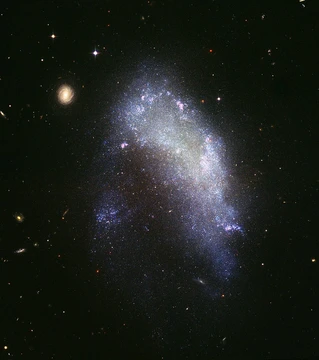
4C 39.32
Elliptical galaxy with a compact steep spectrum radio source.

4C 39.32, also designated B2 1025+29B, is an elliptical galaxy hosting an active galactic nucleus in Leo Minor. Astronomers first identified it as an extragalactic radio source in October 1982. The galaxy has a redshift of 0.36 and is classified as a compact steep spectrum (CSS) source.
This low-excitation radio galaxy has a compact yet complex structure. Observations with the Very Large Array (VLA) reveal a flat radio spectrum at high frequencies. Its central radio core is well resolved and dominates the overall spectrum. Extended radio emission appears amorphous, with a possible hotspot in the southern component. Multi-frequency VLA imaging shows an extended structure surrounding the main source components. At 1.4 GHz, the total radio luminosity measures 0.27 × 10²⁷ W Hz⁻¹.
A radio jet in 4C 39.32 leaves a trail toward the northwest, coinciding with an ultraviolet knot about five kiloparsecs from the core. This alignment suggests shock-triggered star formation in the knot’s stellar populations. The young stellar population is estimated to be between 0.06 and 0.1 years old, while the old population is less than 5 million years old. The host galaxy has a flat bulge with an effective radius of 3.5 kiloparsecs and an outer elliptical component. The nuclear point source is relatively faint compared to the bulge. The central supermassive black hole has an estimated mass of 9.15 ± 1.37 M☉. Neon emission lines in the spectrum show a flux of 0.05 ± 0.05 × 10⁻¹⁵ erg s⁻¹.
Quick Facts
- Epoch
- J2000.0
- Constellation Name
- Leo Minor
- Ra
- 10 · 28 · 44.27
- Dec
- +38 · 44 · 36.89
- Z
- 0.362162
- H Radial V
- 108,574 km/s
- Dist Ly
- 5.231 Gly (1603.87 Mpc)
- Appmag B
- 18.4
- Names
- 2MASS J10284427+3844369, 6C 1025+39, 87GB 102547.9+390008, B2 1025+390B, LEDA 2820609, IVS B1025+389, PS 150, RX J1028.7+3844
Facts from the source article.
Lore & Background
4C 39.32 was first discovered as an extragalactic radio source by astronomers in October 1982. It has been categorized as a radio galaxy of low excitation. Its radio source is both compact and complex, with a flat radio spectrum at high frequencies when observed with the Very Large Array (VLA). The central bright radio core is well resolved and dominates the entire source spectrum, while extended radio emission has an amorphous appearance. A hotspot is suggested to be located in the southern component, and an extended structure surrounds the main source components based on multi-frequency VLA imaging.
The galaxy contains a radio jet with a trail located in the northwest direction, which coincides with an ultraviolet knot feature about five kiloparsecs from the core. This alignment hints that stellar populations in the knot are caused by shock-triggered star formations. The host galaxy has a flat bulge structure with an effective radius of 3.5 kiloparsecs and an elliptical component on the outer side. The nuclear point source is relatively fainter compared to the bulge. The supermassive black hole at the center is estimated to be 9.15 ± 1.37 M☉.
Reader's Guide
4C 39.32 is significant as a compact steep spectrum (CSS) source, a class of radio galaxies that are important for studying the early stages of radio source evolution and interactions with the interstellar medium. Its low-excitation classification indicates a radiatively inefficient accretion mode, common in many massive elliptical galaxies. The detection of a radio jet aligned with an ultraviolet knot suggests ongoing shock-triggered star formation, linking the active nucleus to the host galaxy's stellar population. The galaxy's flat bulge and outer elliptical component provide structural context for its formation history. The estimated young stellar population age (0.06 to 0.1 years) and old population age (less than 5 million years) are notably young, though the article does not explain this discrepancy. The neon emission line flux of 0.05 ± 0.05 × 10^-15 erg s^-1 adds to its spectral characterization. As a radio source discovered in 1982, it contributes to the understanding of extragalactic radio sources in the local universe at moderate redshift.
Did You Know?
- 4C 39.32 has a redshift of 0.36 and is located in the constellation Leo Minor.
- Its supermassive black hole mass is estimated at 9.15 ± 1.37 M☉.
- The galaxy's radio jet trail in the northwest direction coincides with an ultraviolet knot about five kiloparsecs from the core.
- The total radio luminosity at 1.4 GHz is 0.27 × 10^27 W Hz^-1.
More in Elliptical and Irregular Galaxies 1-24
Spotted an error? Know more?
Reader corrections go straight into our review queue. Suggest an edit · How this site is sourced