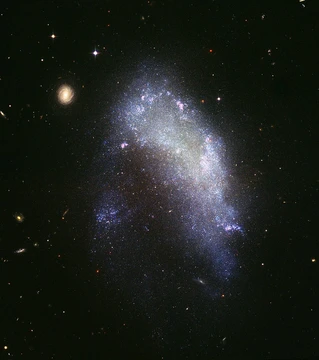
4C 31.04
A compact steep spectrum radio galaxy in Pisces.

4C 31.04 (also cataloged as MCG +05-04-018 and CGCG 502-027 NED02) is a radio galaxy in the constellation Pisces. It was first identified as a radio source in 1967, when astronomers linked it to a close pair of galaxies. With a redshift of 0.060, its radio emission is both compact and steep in spectrum, classifying it as a compact steep spectrum (CSS) galaxy.
The galaxy is a compact symmetrical object (CSO). Its host is a large elliptical galaxy, the brightest member of a small galaxy cluster. Star formation proceeds at about 4.9 solar masses per year, and the stellar population consists mainly of old, metal-rich stars. Hubble Space Telescope images reveal a dust lane cutting across the galaxy’s nucleus. A spiral companion galaxy lies 20 kiloparsecs away, with a redshift of 0.054.
The radio source is compact. Very Long Baseline Interferometry (VLBI) shows it as a double structure with uneven extended lobes: the eastern lobe is more compact and powerful, while the western lobe is weaker and distorted. At 1.7 GHz, a faint bridge of radio emission connects the lobes. Earlier VLBI observations at centi-arcsecond scales found the source elongated at a position angle of 115°. A radio core with an inverted spectrum has been detected. Based on hot spot motions of about 0.085 ± 0.016 milliarcseconds per year, the source’s total age is estimated at 550 years.
In 2007, strong detections of HCO line emission and absorption revealed a molecular disk. Its total gas mass is estimated between 0.5 × 10¹⁰ and 5 × 10¹⁰ solar masses. A 2024 study found that the galaxy’s lobes expand into a circumnuclear disk, stirring up molecular gas. A small blueshifted wing appears against the eastern lobe, with gas velocity dispersion reaching up to 40 kilometers per second. Gas clumps around the eastern lobe suggest interactions with gas clouds, powering H I outflows.
Quick Facts
- Epoch
- J2000.0
- Constellation Name
- Pisces
- Ra
- 01 · 19 · 34.97
- Dec
- +32 · 10 · 49.83
- Z
- 0.059715
- H Radial V
- 17,902 km/s
- Dist Ly
- 812 Mly
- Appmag V
- 14.5
- Appmag B
- 16
- Names
- 2MASX J01193495+3210495, PGC 4773, MCG +05-04-018, DA 41, OHIO C 328, WK 40, JVAS J0119+3210
Facts from the source article.
Lore & Background
4C 31.04 was first discovered as an astronomical radio source in 1967 by astronomers who identified it to be associated with a close double pair of galaxies. Its host galaxy is a large elliptical galaxy with a dust lane cutting through the nuclear region, as seen in Hubble Space Telescope imaging. A spiral galaxy companion is located 20 kiloparsecs from the host, with a redshift of 0.054.
The radio source is compact and, when observed with Very Long Baseline Interferometry (VLBI), appears double with extended radio lobes that differ from one another: the eastern lobe is more compact and strong, while the western lobe is weak with a distorted structure. A faint bridge of radio emission between lobes is imaged at 1.7 GHz frequencies. The source is elongated at a position angle of 115°, and a radio core with an inverted spectrum is detected. The total age of the source is estimated at 550 years based on hot spot features moving at about 0.085 milliarcseconds per year.
In 2007, a molecular disk was found based on strong detections of both HCO line emission and absorption molecules. A 2024 study found the lobes expand outwards into a circumnuclear disk region, causing turbulence of molecular gas. Evidence also shows a small part of a blueshifted wing against the eastern lobe, with gas velocity dispersion reaching up to 40 kilometers per second. Gas clumps around the eastern lobe indicate interaction with gas clouds and powering H I outflows.
Reader's Guide
4C 31.04 holds significance as a compact steep spectrum (CSS) radio galaxy and a compact symmetrical object (CSO), providing insights into the early stages of radio source evolution. Its estimated source age of only 550 years makes it a young radio galaxy, allowing study of lobe expansion and interaction with the surrounding interstellar medium. The detection of a molecular disk and evidence of lobe-driven turbulence and outflows highlight the feedback processes between the active galactic nucleus and its host galaxy. The presence of a dust lane and a companion spiral galaxy adds to its value as a system for understanding galaxy interactions and star formation in elliptical galaxies. The 2024 study further underscores its role in revealing how radio lobes can disturb molecular gas and drive outflows, contributing to the broader understanding of galaxy evolution.
Did You Know?
- Its host galaxy is a large elliptical galaxy that is the brightest member of a small galaxy cluster.
- The total age of the radio source is estimated to be 550 years.
- A molecular disk was found in 2007 based on strong detections of HCO line emission and absorption molecules.
More in Elliptical and Irregular Galaxies 1-24
Spotted an error? Know more?
Reader corrections go straight into our review queue. Suggest an edit · How this site is sourced