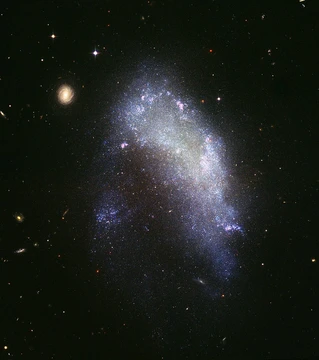
4C +30.31
Elliptical radio galaxy in Hercules with a complex emission-line region.

4C +30.31, also cataloged as B2 1658+30, is a radio galaxy in the constellation Hercules. It is an elliptical galaxy with a smooth appearance, as seen in Hubble Space Telescope images. Classified as a Fanaroff-Riley Type 1 radio galaxy, it is considered a weak radio source and resides in a rich galactic environment, with a companion galaxy present.
The galaxy features a complex extended emission-line region, spanning about 6.9 kiloparsecs at an orientation of 143°. Its central core appears unresolved and is associated with a bright region. A low-ionization nuclear emission-line region (LINER) is also thought to exist. Radio observations at 1.4 GHz reveal a double source, with a prominent jet pointing southwest and a counterjet embedded within a lobe’s low surface brightness area. The radio spectrum is flat at the nucleus but steepens in the outer regions. On kiloparsec scales, the morphology shows two resolved, extended radio lobes, with strong polarization levels of 40–50% detected at the lobe edges.
Quick Facts
- Constellation Name
- Hercules
- Epoch
- J2000
- Ra
- 17 · 00 · 45.23
- Dec
- +30 · 08 · 12.99
- Z
- 0.034424
- H Radial V
- 10320 ± 250 km/s
- Dist Ly
- 159.37 ± 12.32 Mpc
- Mag H
- 11.59
- Names
- B2 1658+30, PGC 59420, 2MASX J17004523+3008129, NSA 147601, TXS 1658+302
Facts from the source article.
Lore & Background
4C +30.31 was first discovered from a sample of 490 astronomical radio sources by E.T. Olsen in August 1967. In October 1972, it was identified with an elliptical galaxy counterpart. Based on Hubble Space Telescope imaging, the galaxy is categorized as elliptical with a smooth appearance. It is also a weak radio galaxy, with a companion present suggesting it lies in a rich galaxy environment. The extended emission-line region has a complex appearance, with its central source associated with a bright region; the region extends 6.9 kiloparsecs and has an orientation of 143°. The central core region appears unresolved. The galaxy has been classified as a Fanaroff-Riley Class Type 1 radio galaxy. When observed, a radio jet is seen on one side, embedded inside a region of diffused radio emission. Radio imaging at 1.4 GHz frequencies suggested the source is a double. The radio spectrum is initially flat in the nucleus but steepens in the outer regions. On kiloparsec scales, the morphology shows two resolved radio lobes that are extended, with a main jet pointing southwest. The counter jet is embedded within the lobe's low surface brightness region. A low-ionization nuclear emission-line region (LINER) is suggested to be present. A study found the edges of the lobes contain signs of strong polarization levels reaching between 40% and 50%.
Reader's Guide
4C +30.31 is significant as a Fanaroff-Riley Class Type 1 radio galaxy, a classification that indicates its radio morphology and power. Its identification with an elliptical galaxy counterpart in October 1972 helped link radio sources to optical hosts. The complex extended emission-line region, spanning 6.9 kiloparsecs, and the presence of a LINER suggest ongoing nuclear activity. The strong polarization levels (40–50%) at the lobe edges indicate ordered magnetic fields. The galaxy's location in a rich environment, with a companion, provides context for its evolution. Its legacy lies in illustrating the interplay between radio jets, emission-line gas, and the host galaxy's structure, as observed by the Hubble Space Telescope and radio imaging at 1.4 GHz.
Did You Know?
- The galaxy's extended emission-line region has an extent of 6.9 kiloparsecs and an orientation of 143°.
- The edges of the radio lobes show strong polarization levels between 40% and 50%.
More in Elliptical and Irregular Galaxies 1-24
Spotted an error? Know more?
Reader corrections go straight into our review queue. Suggest an edit · How this site is sourced