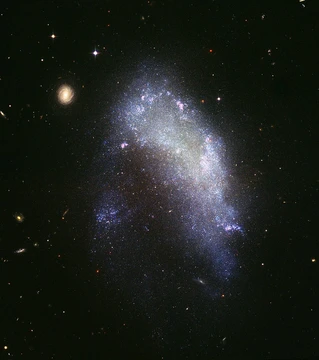
4C +29.30
Elliptical Seyfert galaxy with multiple radio activity episodes.

4C +29.30 is an elliptical galaxy located in the constellation Cancer. It is notable as a wide-angled tailed radio galaxy (WAT) and a Seyfert galaxy, with an active nucleus classified as a Fanaroff-Riley Class I (FR-I) radio galaxy that also shows characteristics of a Fanaroff-Riley Class II. The galaxy is of particular interest due to multiple episodes of radio activity revealed across broad scales, including evidence of jet reactivation and interaction with dense extranuclear gas.
Quick Facts
- Epoch
- J2000
- Constellation Name
- Cancer
- Ra
- 08h 40m 02.366s
- Dec
- +29d 49m 02.64s
- Z
- 0.064840
- H Radial V
- 19,439 kilometer per second
- Dist Ly
- 850 Mly (260.6 Mpc)
- Appmag B
- 0.20
- Appmag V
- 0.15
- Sbrightness
- 15.6
- Names
- IRAS 08369+2959, B2 0836+29B, CGCG 150-014, PGC 24369, KISSB 004, FIRST J084002.2+294900, IVS B0836+299, TXS 0836+299, 87GB 083657.9+295941, 2CXO J084002.3+294902
- Notes
- Radio galaxy, seyfert galaxy
Facts from the source article.
Lore & Background
The nucleus of 4C +29.30 is active, classified as a Fanaroff-Riley Class I radio galaxy producing an optical radio jet, though it also shows characteristics of a Fanaroff-Riley Class II. It exhibits weak extended emission with an angular size of ~520 arcsec (639 kpc) and a compact edge-brightened double-lobed source of 29 arcsec (36 kpc). The galaxy has been catalogued as an infrared point source by IRAS, WISE, and 2MASS. Its X-ray morphology, detected during a snapshot 8 ks Chandra Observation, shows a nucleus, jet, hotspots, and lobes. The nucleus has absorbed (N H ≈ 3.95+0.27-0.33 × 10^23 cm^-2) and unabsorbed luminosity L 2-10 keV ≈ (5.08 ± 0.52) × 10^43 erg s^-1, characteristic of a Seyfert Type 2. The galaxy displays an early-type morphology with moderate radio luminosity and signatures of jet reactivation. First studied by van Breugel et al. (1986), optical line-emitting gas was found to ~20 arcsec north of the nucleus, adjacent to the radio jet along position angle PA = 24°, suggesting recent activity after merging with a gas-rich disk galaxy. A 4.3 kpc × 6.2 kpc extended emission in ionized gas displays structures resembling rotated disks, spiral arms, and bars similar to an Sc spiral galaxy, along with a dust lane through its central region akin to Centaurus A. Low-surface-brightness radio emission extending to ~600 kpc has a steep radio spectrum, with the small-scale radio structure age estimated at ≲ 100 Myr, and inner double knots with spectral ages of ≲ 33 Myr, resolved into two nuclear knots of ~15 yr and ~70 yr.
Reader's Guide
4C +29.30 is significant for its multiple episodes of radio activity, as revealed by morphology and spectral properties across broad scales. The galaxy's ionized gas outflow properties were studied using Integral Field Unit observations from the Gemini North Telescope between January 12 and March 15, 2016. The total mass of ionized hydrogen gas was calculated, and the mass outflow rate and outflow kinetic power in the southern knot (blueshift ~ -600 km/s) and northern knot were estimated using a biconical geometry. The total mass outflow rate of 25.4 (+11.5/-7.5) M☉/yr and outflow kinetic power of 8.1 (+10.7/-4.0) erg/s are higher than those in other radio galaxies like 3C 293 and PKS 1345+12, but compatible with ESO 428-G14. The supermassive black hole, with an estimated mass of 100 million solar masses, drives two jets of particles speeding millions of miles per hour, with larger radio emission areas outside the galaxy. A dusty torus blocks optical light near the black hole, suggesting 4C +29.30 belongs to hidden/buried AGNs, a new class among Swift/BAT hard X-ray-selected AGNs. The galaxy's legacy lies in its complex, multi-episodic activity and its role in understanding jet-gas interactions and AGN fueling.
Did You Know?
- Its supermassive black hole has an estimated mass of 100 million times the Sun.
- The galaxy displays a dust lane through its central region similar to Centaurus A.
- The ionized gas mass outflow rate in 4C +29.30 is higher than in radio galaxies 3C 293 and PKS 1345+12.
More in Elliptical and Irregular Galaxies 1-24
Spotted an error? Know more?
Reader corrections go straight into our review queue. Suggest an edit · How this site is sourced