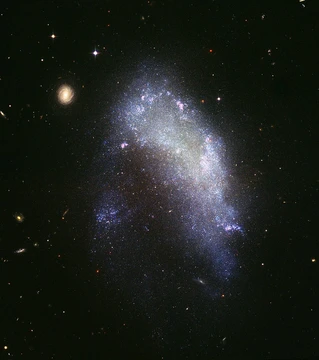
4C +26.42
Brightest cluster galaxy in Abell 1795 with active nucleus.

4C +26.42 is an elliptical galaxy located in the constellation of Boötes, approximately 863 million light-years from Earth. It is notable as the brightest cluster galaxy (BCG) in Abell 1795, an X-ray luminous rich cluster, and hosts an active galactic nucleus. The galaxy is a powerful radio source, classified as Fanaroff-Riley class I, and exhibits complex structures including filaments, molecular outflows, and a high Faraday rotation measure.
Quick Facts
- Epoch
- J2000
- Constellation Name
- Boötes
- Ra
- 13 · 48 · 52.54
- Dec
- +26 · 35 · 33.65
- Z
- 0.063309
- H Radial V
- 18,980 km/s
- Dist Ly
- 863 Mly (264.6 Mpc)
- Group Cluster
- Abell 1795
- Appmag V
- 0.037
- Appmag B
- 0.048
- Sbrightness
- 15.2
- Notes
- Radio galaxy, brightest cluster galaxy
Facts from the source article.
Lore & Background
4C +26.42 is a radio-loud, low-luminous elliptical galaxy with a strong double-lobed radio source stretching ≈10 kpc on both sides of the nucleus. It has a radial velocity of 365 km s−1 and a complex core structure. The galaxy contains a pair of coiled filaments known as the 'SE Filament,' with distances of ~42″ and 35″ and unresolved widths in Hα (< 0.7″ ~ 1 kpc), resembling magnetic field lines. A structure traced from a previous merger with another giant subcluster galaxy extends 400 kpc from the center in a north–south direction, with a low-surface brightness region at its largest radius pointing slightly east. The galaxy exhibits nebular line emission with a luminosity range of L(Hα) ≈ 1042 ergs s−1 within 20 kpc, embedded in a filament extending 80 kpc toward the southern nucleus. An excessive blue light is also present, possibly from young stars in globular clusters and massive star populations. Molecular outflows driven by radio bubbles show robust 109 M☉ gas flows in a pair of filaments ~7 kpc long, north and south of the nucleus. The north filament has a steep velocity gradient reaching −370 km s−1, while the south filament shows a shallow gradient, indicating gas flows caused by radio bubble expansion. Star formation rates in 4C +26.42 vary widely depending on the method used. Estimates range from less than 1–20 M☉ yr−1 to as high as 581–758 M☉ yr−1 under a top-heavy initial mass function. However, using Lyman-alpha detection and modern spectroscopy, the actual star formation rate is constrained to 8–23 M☉ yr−1, with a model based on far-ultraviolet colors suggesting 5–10 M☉ yr−1 over the past 5 billion years.
Reader's Guide
4C +26.42 is significant as a bright elliptical galaxy at the center of Abell 1795, an X-ray luminous rich cluster with a high cooling-flow rate. Its status as a Fanaroff-Riley class I radio galaxy with a strong double-lobed source and complex core structure makes it a key object for studying radio-loud active galactic nuclei in cluster environments. The galaxy's coiled filaments, molecular outflows driven by radio bubbles, and high Faraday rotation measure (exceeding 2000 rad m−2) provide insights into magnetic fields, gas dynamics, and feedback processes. The disputed star formation rates, ranging from low values to extremely high estimates under different models, highlight the challenges in measuring star formation in such galaxies. The discovery of a merger-related structure extending 400 kpc and the presence of O-type stars (2.4 × 10⁴) further underscore its role in understanding galaxy evolution and cluster interactions.
Did You Know?
- 4C +26.42 is the brightest cluster galaxy in Abell 1795, an X-ray luminous rich cluster with a cooling-flow rate of 300 M☉ yr−1.
- The galaxy has a pair of coiled filaments known as the 'SE Filament,' with unresolved widths in Hα less than 0.7 arcseconds.
- Its Faraday rotation measure exceeds 2000 rad m−2, with a magnetic field between 20 and 100 μG.
- The actual star formation rate is estimated at 8–23 M☉ yr−1, based on Lyman-alpha detection and modern spectroscopy.
More in Elliptical and Irregular Galaxies 1-24
Spotted an error? Know more?
Reader corrections go straight into our review queue. Suggest an edit · How this site is sourced