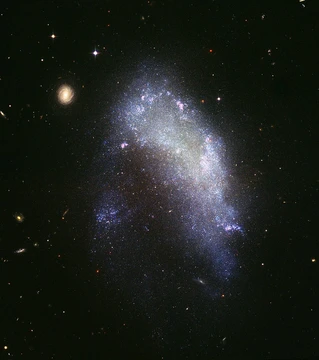
4C 12.03
X-shaped radio galaxy in Pisces with low-excitation active nucleus.

4C 12.03 is a radio galaxy located in the constellation of Pisces, first discovered as an astronomical radio source at the Parkes Observatory in 1966. It is notable for its X-shaped morphology and classification as a low-excitation radio galaxy (LEG), indicating a central supermassive black hole accreting interstellar medium at a lower rate.
Quick Facts
- Epoch
- J2000.0
- Constellation Name
- Pisces
- Ra
- 00 · 09 · 52.60
- Dec
- +12 · 44 · 04.70
- Z
- 0.156000
- H Radial V
- 46,758 km/s
- Dist Ly
- 2.009 Gly
- Appmag B
- 17.8
- Names
- 2MASX J00095259+1244048, LEDA 1415187, PKS B0007+124, 87GB 000718.0+122806, NVSS J000951+124333, TXS 0007+124, Cul 0007+124
Facts from the source article.
Lore & Background
4C 12.03 was first discovered as an astronomical radio source at the Parkes Observatory by astronomers in 1966, designated as PKS 0007+12. Its redshift of 0.156 was later identified in the summer of 1984 via low-resolution optical spectra observations. The galaxy is hosted by an elliptical galaxy displaying a low amount of emission lines in its spectrum, with a total flux density of 10.9 Jansky and a low frequency spectral index of 0.87 in the 178-750 MHz range. It is classified as a low-excitation radio galaxy (LEG), a type of active galaxy whose central supermassive black hole accretes interstellar medium at a lower rate. Observations with the Giant Metrewave Radio Telescope classified 4C 12.03 as having an X-shaped morphology, with a symmetrical structure and an angular extent of 3.8 x 4.0 arcmin2. A jet is present on the northern side, traveling up to a hotspot in the north direction. Both the northern and southern radio lobes and wings observed at high frequencies show signs of spectral steepening, with spectral indices for the lobes of -0.95 ± 0.12 and -0.86 ± 0.11, and for the wings of -0.70 ± 0.10 and -0.59 ± 0.14. The lobes show evidence of warm hotspots, and a radio core is clearly detected by the Very Large Array (VLA) at the northern jet base. A more detailed study published in 2021 found that 4C 12.03 has both jets on north and south directions, going towards both hotspots, forming the active axis. The wings of low-surface brightness are formed by the axis on the east-west side. Two components are discovered: the north component reaches the climax of the hotspot, while the south component is suggestive of either having a Fanaroff-Riley Class Type I or Type II. Radio emission on extended scales is detected in the radio lobes on the east-west side. Further observations found two brightness peaks forming an inner double structure, making this somehow a restarted active galaxy.
Reader's Guide
4C 12.03 is significant as an X-shaped radio galaxy with a low-excitation active nucleus, providing insight into the accretion processes of supermassive black holes at lower rates. Its discovery at the Parkes Observatory in 1966 and subsequent redshift measurement in 1984 established its extragalactic nature. The galaxy's X-shaped morphology, revealed by the Giant Metrewave Radio Telescope, and the detection of a radio core by the Very Large Array, highlight its complex structure. The spectral steepening observed in its lobes and wings, along with the presence of warm hotspots, indicates ongoing physical processes. The 2021 study's finding of two jets on the north-south axis and wings on the east-west axis, along with an inner double structure suggesting a restarted active phase, makes 4C 12.03 a valuable case for studying episodic activity in radio galaxies. The uncertainty in the Fanaroff-Riley classification of the south component (Type I or Type II) underscores the nuanced nature of its radio morphology.
Did You Know?
- 4C 12.03 was first discovered as a radio source at the Parkes Observatory in 1966, designated PKS 0007+12.
- The galaxy is classified as a low-excitation radio galaxy (LEG), with a central black hole accreting at a lower rate.
- Observations with the Giant Metrewave Radio Telescope classified it as having an X-shaped morphology.
More in Elliptical and Irregular Galaxies 1-24
Spotted an error? Know more?
Reader corrections go straight into our review queue. Suggest an edit · How this site is sourced