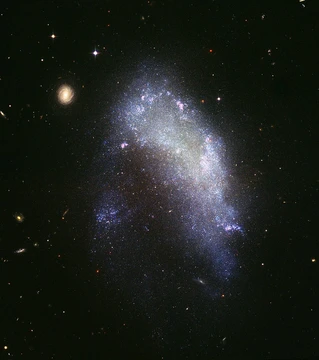
3C 381
A debated broad-line radio galaxy with an extended emission-line region.

3C 381 is a radio galaxy located in the constellation of Lyra, first recorded in the Third Cambridge Catalogue of Radio Sources survey in 1962. It is notable for its classification as a Fanaroff-Riley class Type 2 broad-line radio galaxy (BLRG), though its categorization as a narrow-line radio galaxy is debated, and for hosting an extended emission-line region (EELR) with disturbed kinematics.
Quick Facts
- Epoch
- J2000.0
- Constellation Name
- Lyra
- Ra
- 18 · 33 · 46.30
- Dec
- +47 · 27 · 02.64
- Z
- 0.167400
- H Radial V
- 50,185 km/s
- Dist Ly
- 2.146 Gly
- Appmag B
- 18.64
- Names
- PGC 62045, 4C +47.49, 2MASX J18334627+4727027, LHE 451, DA 455, OU +454, NRAO 0568
Facts from the source article.
Lore & Background
3C 381 is classified as a Fanaroff-Riley class Type 2 broad-line radio galaxy (BLRG), although the categorization of it being a narrow-line radio galaxy is debatable. Its host is a round elliptical galaxy located in a small galaxy group, described as having a high surface brightness profile and a smooth appearance. There is a companion galaxy located 5.5 arcseconds away with a low-surface brightness profile, and evidence shows these galaxies are gravitationally interacting, given the presence of tidal distortions and tidal tails pointing in both directions from the main galaxy's nucleus based on Hubble Space Telescope (HST) imaging. A faint extension feature is discovered in the north.
The radio structure of 3C 381 is compact. Based on high resolution Very Large Array (VLA) radio imaging, the source has hotspots. The hotspot on the northern side has a double substructure with a weak compact component located in the southwest, and another component located north-east, extended southwards and partially resolved. At the southernmost region a hotspot is also seen, but no compact component is present. Both radio lobes have a steep radio spectrum at the curving bases, but the southern lobe is much larger with an extent of 40.5 arcseconds. A faint doubly ionized oxygen emission filament curves around the north radio lobe boundary. Low-resolution mapping showed a bright bar feature in its northern lobe, connected with a radio emission bridge to the hotspot region.
The galaxy has an extended emission-line region (EELR) larger than the stellar component, with an extension of 12 arcseconds or 38 kiloparsecs in length. The kinematics are disturbed, with high velocity gas components located both inside the central and outer parts of the EELR, and velocity differences reaching up to around 600 kilometers per second.
Reader's Guide
3C 381's significance lies in its debated classification as either a broad-line or narrow-line radio galaxy, which highlights the complexities in categorizing active galactic nuclei. The presence of an extended emission-line region (EELR) with disturbed kinematics and high velocity gas components provides insight into the dynamics of gas in radio galaxies. The gravitational interaction with a companion galaxy, evidenced by tidal distortions and tails, offers a case study for galaxy mergers and their role in triggering radio activity. The compact radio structure with asymmetric lobes and hotspots, as revealed by VLA imaging, contributes to understanding jet propagation and lobe evolution. The measured black hole mass and star formation rate provide quantitative data for models of galaxy and black hole co-evolution. The EELR's size and velocity gradients are key for studying feedback processes from the active nucleus.
Did You Know?
- The galaxy has a companion located 5.5 arcseconds away, with which it is gravitationally interacting.
- The extended emission-line region (EELR) extends 12 arcseconds (38 kiloparsecs) and shows velocity differences up to 600 km/s.
- The southern radio lobe is much larger than the northern one, with an extent of 40.5 arcseconds.
More in Elliptical and Irregular Galaxies 1-24
Spotted an error? Know more?
Reader corrections go straight into our review queue. Suggest an edit · How this site is sourced