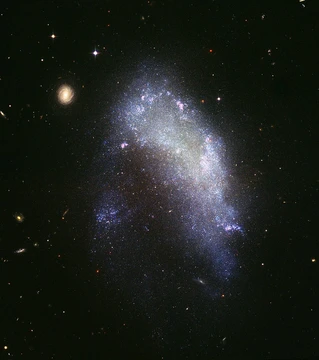
3C 357
A Fanaroff-Riley Type II radio galaxy in Hercules.

3C 357 is a radio galaxy in the constellation Hercules. It belongs to the Fanaroff-Riley Type II class and is hosted by a large, featureless elliptical galaxy with a bright core. The galaxy has a dust lane on its southwest side, visible in Hubble Space Telescope images down to the inner region. This dust lane splits into two parts: one near the nucleus and another extending outward toward the northwest, ending in a dust emission path. The galaxy also shows a disky isophotal structure with faint, thin tendrils.
The radio source is a double, oriented nearly east-west. At 4.86 GHz, Very Large Array (VLA) maps reveal a visible radio core and multiple hotspots, with a jet in the northwest lobe pointing toward a compact hotspot. At 1.4 GHz, the maps indicate a large-scale structure. Chandra X-ray Observatory snapshots show radio emission from the core but no radiation around it or associated with its hotspots.
Although the galaxy’s nucleus is depolarized, a study found four vectors in the emission region, perpendicular to the radius, suggesting the polarized light originates from scattering. In 2021, extended X-ray emission was detected around the galaxy, mainly along the radio axis.
Quick Facts
- Epoch
- J2000.0
- Constellation Name
- Hercules
- Ra
- 17 · 28 · 20.09
- Dec
- +31 · 46 · 02.74
- Z
- 0.166460
- H Radial V
- 49,903 km/s
- Dist Ly
- 2.135 Gly
- Appmag B
- 15.5
- Names
- 4C +31.47, B2 1726+31, 2MASX J17282013+3146030, PGC 60351, DA 435, NRAO 0528, TXS 1726+318
Facts from the source article.
Lore & Background
3C 357 was first discovered in the Third Cambridge Catalogue of Radio Sources survey in 1962 by A.S. Bennett. It is also documented in the Fourth Cambridge survey, designated as 4C 31.47. The galaxy is classified as a Type II Fanaroff-Riley Class radio galaxy, hosted by a large featureless elliptical galaxy with a bright central core. Imaging by the Hubble Space Telescope reveals a dust lane on the southwest side of the galaxy, visible downwards to the inner region. This dust lane is split into two separate parts: one near the nucleus and the other extending outwards from the nucleus towards the northwest direction with a dust emission path at its end. A disky isophotal structure is present in the galaxy with faint thin tendrils.
The radio source of 3C 357 is a double, orientated nearly east to west. A radio map taken by the Very Large Array at 4.86 GHz shows a visible radio core and multiple hotspots, with a jet located within the northwest radio lobe pointing towards a compact hotspot. At 1.4 GHz, the map shows evidence of a large-scale structure. Snapshots with the Chandra X-ray Observatory found radio emission from the core with no traces of any radiation around it or associated with its hotspots. Although the nucleus is depolarized, a study showed four vectors in the emission region, found perpendicular towards the radius, indicating the polarized light has a scattering origin. In 2021, extended X-ray emission was found detected around the galaxy, mainly along the radio axis.
Reader's Guide
3C 357 is significant as a Fanaroff-Riley Type II radio galaxy, a class known for its edge-brightened radio lobes. Its discovery in the Third Cambridge Catalogue in 1962 by A.S. Bennett places it among early radio source identifications. The galaxy's featureless elliptical host with a bright core and complex dust lane—split into two parts with a dust emission path—provides insight into dust dynamics in elliptical galaxies. The radio structure, including a double source oriented east-west, a visible core, multiple hotspots, and a jet in the northwest lobe, illustrates typical FR II morphology. The detection of extended X-ray emission along the radio axis in 2021 adds to understanding of the interaction between the radio source and the intracluster medium. The depolarized nucleus and polarized light with scattering origin offer clues to magnetic field configurations. The absence of X-ray radiation around the core or hotspots, as observed by Chandra, distinguishes its emission properties.
Did You Know?
- The galaxy hosts a dust lane split into two separate parts: one near the nucleus and one extending northwest with a dust emission path.
- Extended X-ray emission was detected around the galaxy in 2021, mainly along the radio axis.
More in Elliptical and Irregular Galaxies 1-24
Spotted an error? Know more?
Reader corrections go straight into our review queue. Suggest an edit · How this site is sourced