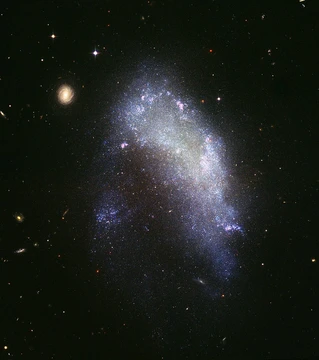
3C 351
A Fanaroff-Riley Class II quasar with asymmetrical radio lobes.

3C 351 is a radio-loud quasar located in the constellation of Draco, first recorded in the Third Cambridge Catalogue of Radio Sources survey in 1962. It is notable for its Fanaroff-Riley Class Type II classification, its host E3 elliptical galaxy with an undisturbed flat appearance, and its complex radio structure including asymmetrical lobes and a stubby jet.
Quick Facts
- Epoch
- J2000.0
- Constellation Name
- Draco
- Ra
- 17 · 04 · 41.37
- Dec
- +60 · 44 · 30.60
- Z
- 0.371523
- H Radial V
- 111,380 km/s
- Dist Ly
- 4.179 Gly
- Appmag V
- 15.40
- Appmag B
- 15.65
Facts from the source article.
Lore & Background
3C 351 was first recorded in the Third Cambridge Catalogue of Radio Sources survey in 1962. Optical monitoring in 1971 by Keith Tritton noted the object is variable, and it is classified as X-ray quiet. The quasar's host galaxy is an E3 elliptical with an undisturbed flat appearance and a position angle of 60°, based on Hubble Space Telescope imaging. A close companion galaxy lies 28 kiloparsecs from the host, but there are no signs of interaction. The supermassive black hole at its center is estimated to be 9.39+0.08-0.10 M☉, based on a single optical spectroscopy measurement.
The radio spectrum is steep, and the host displays a low-surface brightness extension in a northerly direction. Very Large Array (VLA) imaging shows a prominent double-lobed structure with a diffused radio emission bridge, a radio core, and a stubby jet extending 2 arcseconds. Deeper VLA imaging reveals the jet curving towards the hotspot direction. New VLA observations in 2007 found the lobes are mainly asymmetrical and of unequal brightness: the northeast lobe is split into several bright components with a recessed hotspot, while the southeast lobe is edge-darkened and diffused without a hotspot. Older VLA imaging from 1980 showed the hotspots have different structures and an outer curved component, confirming interaction with the surrounding interstellar medium. One resolved compact feature has been found by Very Long Baseline Interferometry (VLBI). Polarization is present, with the degree rising rapidly to between 20% and 25% away from the emission region north and west from the hotspot, and up to 50% to 65% on the western edge of the fan boundary. Polarization is also found inside parts of its jet.
Despite not belonging to a family of optically violent variable quasars (OVVs), 3C 351 exhibits variability fluctuations on long-term scales between 15.7 and 16.2, with amplitude variations lasting 477 days in total. A low observed state was noted in 1985. The Hamburg Quasar Monitoring (HQM) program in June 1994 found the quasar is possibly weakly variable. A rich system of narrow and broad absorption lines of various chemical elements has been found in its spectrum.
Reader's Guide
3C 351 is significant as a Fanaroff-Riley Class Type II quasar whose radio structure reveals complex interactions with its environment. The asymmetrical lobes—one split into bright components with a recessed hotspot, the other edge-darkened and diffused—indicate that the quasar's jets are interacting with the surrounding interstellar medium, as confirmed by older VLA imaging showing curved outer components. The presence of polarization, with degrees reaching up to 65% on the western fan boundary, provides insight into magnetic field alignment in the radio lobes and jet. The quasar's variability on long-term scales (15.7 to 16.2 magnitude over 477 days) and its possible weak variability noted by the HQM program in June 1994 contribute to understanding its accretion and emission processes. The rich absorption line system in its spectrum offers a laboratory for studying intervening material. The undisturbed host galaxy and lack of interaction with its companion 28 kiloparsecs away suggest the quasar's activity is not triggered by a recent merger, contrasting with many other active galaxies.
More in Elliptical and Irregular Galaxies 1-24
Spotted an error? Know more?
Reader corrections go straight into our review queue. Suggest an edit · How this site is sourced