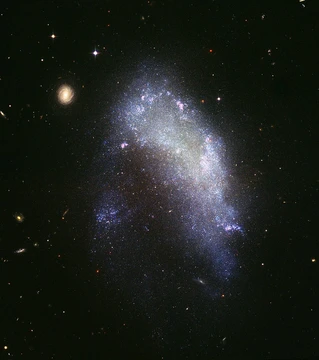
3C 346
Elliptical Seyfert galaxy with a relativistic jet and merging companion.

3C 346 is an elliptical galaxy located in the constellation Hercules, approximately 2.5 billion light years from Earth. It is notable for being classified as a Seyfert galaxy, a compact steep-spectrum source (CSS), and later confirmed as a Fanaroff-Riley class II source. The galaxy is also a narrow-line radio galaxy and part of a double galaxy system undergoing a merger with a nearby companion.
Quick Facts
- Epoch
- J2000.0
- Constellation Name
- Hercules
- Ra
- 16 · 43 · 48.59
- Dec
- +17 · 15 · 49.46
- Z
- 0.163025
- H Radial V
- 48,874 km/s
- Dist Ly
- 2.484 Gly (761.59 Mpc)
- Appmag B
- 17.2
- Names
- 4C 17.70, PKS J1643+1715, PGC 58857, DA 422, OS 170, NVSS J164348+171548
- Notes
- Radio galaxy
Facts from the source article.
Lore & Background
3C 346 is a narrow-line radio galaxy with a projected 0.5–3 keV luminosity of 1.4 × 10^44 erg s^-1. It exhibits a lack of X-ray emission, with most originating from a cluster environment at a temperature of 1.9+1.3-0.7. The galaxy is part of a double galaxy system and is merging with a nearby companion. It contains a jetted double radio source observed in X-rays and a bright hotspot region showing strong ultraviolet emission from synchrotron radiation.
The point-like emission of 3C 346 is unabsorbed, with NH ≤ 2 × 10^21 cm^-2, a spectral slope of αx = 0.69+0.16-0.14, and a flux of 7.4 × 10^-13 erg cm^-2 s^-1 as observed by ROSAT PSPC. Two years later, ASCA observations showed a different spectral slope of αx = 0.73+0.17-0.23 with the same flux level. The nucleus is luminous, with a core component from which a one-sided radio jet emerges with a projected extension of ~2 arcsecs, suggesting a small inclination angle to the line of sight. The jet contains bright knots at various distances from the core.
Using Hubble Space Telescope optical polarimetry, Very Large Array polarimetry at 14.9 and 22.5 GHz, and Chandra X-ray data, the optical and radio morphologies are similar, but the X-ray emission is offset by 0.80 ± 0.17 kiloparsecs from both optical and radio peaks. Polarization modeling indicates a relativistic upstream flow of βu = 0.91+0.05-0.07, an inclined shock front plane angle of η = 51° ± 11°, an upstream flow angle of θ = 14+8-7 degrees, and a jet deflection angle of 22°. An extended structure of ~12" surrounds the jet and its opposite side; at 1.7 GHz, two other components are separated by ~2.2", one stronger and compacted, the other a glowing knot inside the jet surrounded by extended emission.
Reader's Guide
3C 346 is significant as a multi-wavelength laboratory for studying relativistic jets and galaxy mergers. Its classification as both a compact steep-spectrum source and a Fanaroff-Riley class II source highlights its transitional nature. The galaxy's jet, detected from radio to X-rays, shows a one-sided morphology with bright knots, and polarization modeling reveals a relativistic upstream flow with specific shock geometry. The offset between X-ray and optical/radio peaks suggests complex emission mechanisms. The presence of a merging companion and a double radio source underscores its role in understanding jet-environment interactions. The galaxy's unabsorbed X-ray emission and varying spectral slopes between ROSAT and ASCA observations provide constraints on emission models. Its extended structure and multiple components at 1.7 GHz further illustrate the jet's evolution. Overall, 3C 346 offers insights into jet physics, galaxy mergers, and the nature of narrow-line radio galaxies.
Did You Know?
- 3C 346 is located nearly 2.5 billion light years away in the constellation Hercules.
- It is classified as both a compact steep-spectrum source (CSS) and a Fanaroff-Riley class II source.
- X-ray emission from 3C 346 is offset by 0.80 ± 0.17 kiloparsecs from its optical and radio peaks.
More in Elliptical and Irregular Galaxies 1-24
Spotted an error? Know more?
Reader corrections go straight into our review queue. Suggest an edit · How this site is sourced