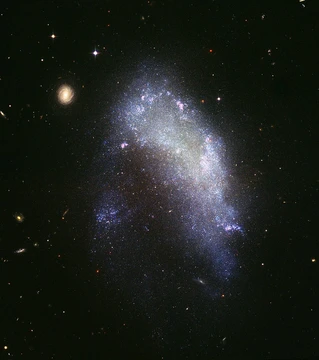
3C 332
A change-looking quasar and Fanaroff-Riley Type II radio galaxy.

3C 332 is a broad-line Fanaroff-Riley Type II radio galaxy located in the constellation of Corona Borealis. It is notable for its classification as a change-looking quasar, an active galactic nucleus exhibiting extreme variability that results in a transition from type 1 to type 2 AGN. Discovered in the Third Cambridge Catalogue of Radio Sources survey in 1962, it has a redshift of 0.151.
Quick Facts
- Epoch
- J2000.0
- Constellation Name
- Corona Borealis
- Ra
- 16 · 17 · 42.53
- Dec
- +32 · 22 · 34.38
- Z
- 0.151019
- H Radial V
- 45,274 km/s
- Dist Ly
- 2.063 Gly
- Appmag V
- 17.45
- Appmag B
- 18.25
- Names
- 4C +32.51, B2 1615+32, 2MASX J16174254+3222344, LEDA 1993953, DA 409, PGC 57750, NRAO 0498, Cul 1615+325, CoNFIG 246, THING 588018054588137497
Facts from the source article.
Lore & Background
3C 332 is described as an elliptical galaxy according to imaging made by the Hubble Space Telescope, with a relaxed appearance and no signs of a dust lane. It has a companion located southwest. As a Fanaroff–Riley Type II class radio galaxy with low luminosity, it exhibits polarization reaching values between 4% and 16%. There is evidence of diffused radio emission surrounding its bright central nucleus, which is found unresolved but aligned by 70°. Two radio lobes are present on each side of the galaxy, and a jet is seen heading in a southerly direction.
The magnetic field structure of 3C 332 appears to follow a brightness contour line, mainly dominated along its southern radio lobe, transversing in the direction of the northern radio lobe located near its central component. Surrounding the galaxy's hotspots there are high surface brightness regions with an emission ridge connecting both the central component and southern hotspot. In December 1990, a line profile was discovered in 3C 332, which might arise from its accretion disk, described as small with an unstable inner region that subsequently forms a hot torus, photoionizing the galaxy's outer disk region. A broad hydrogen-alpha (Hα) line was also found, with displaced peaks of between –7250 ± 200 and 9800 ± 200 kilometers per second.
Reader's Guide
3C 332's significance lies in its dual nature as both a broad-line Fanaroff-Riley Type II radio galaxy and a change-looking quasar, highlighting extreme variability in active galactic nuclei. Its discovery in the Third Cambridge Catalogue of Radio Sources survey in 1962 placed it among early radio source identifications. The Hubble Space Telescope imaging confirmed its elliptical morphology with a relaxed appearance and no dust lane, while its low-luminosity FR II classification and polarization between 4% and 16% provide insights into radio galaxy properties. The detection of a broad Hα line with displaced peaks and a line profile discovered in December 1990 suggests complex accretion disk dynamics, including a small, unstable inner region forming a hot torus. The supermassive black hole mass estimates—initially 8.08 M☉ and later reestimated in 2011 as 8.64 ± 0.01 M☉ with an Eddington limit of (5.3±0.1)×10^46 erg s−1—along with its bolometric luminosity of 2.5×10^45 erg s−1, contribute to understanding black hole growth and feedback in radio-loud AGN.
Did You Know?
- 3C 332 is a change-looking quasar, transitioning between type 1 and type 2 AGN due to extreme variability.
- Its supermassive black hole mass was reestimated in 2011 as 8.64 ± 0.01 M☉.
- A broad hydrogen-alpha line was found with displaced peaks between –7250 ± 200 and 9800 ± 200 km/s.
- The galaxy has a companion located southwest.
More in Elliptical and Irregular Galaxies 1-24
Spotted an error? Know more?
Reader corrections go straight into our review queue. Suggest an edit · How this site is sourced