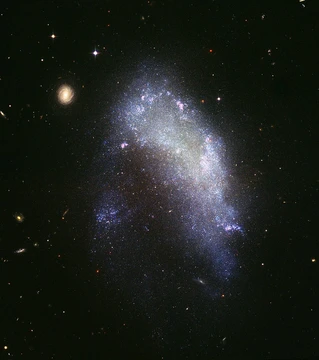
3C 326
A pair of interacting elliptical radio galaxies in Serpens.

3C 326 is a pair of gravitationally interacting elliptical galaxies located in the constellation of Serpens. Discovered in the Third Cambridge Catalogue of Radio Sources in 1962, the system is classified as a radio galaxy and is notable for its debated central radio source, which may be one of the largest known radio galaxies in terms of linear extent.
Quick Facts
- Epoch
- J2000.0
- Constellation Name
- Serpens
- Ra
- 15 · 52 · 09.00
- Dec
- +20 · 05 · 30.00
- Z
- 0.089000
- H Radial V
- 26,682 km/s
- Dist Ly
- 1.213 Gly
- Appmag V
- 17.08
- Names
- 4C +20.37, PKS 1550+20, CoNFIG 233, 3C 326 ID, PGC 56261/LEDA 1615975, 3C 326N and 3C 326S
Facts from the source article.
Lore & Background
The system comprises two galaxies: 3C 326N (PGC 56261), a large elliptical with a LINER nucleus and boxy appearance, and 3C 326S (LEDA 1615975), a smaller elliptical. A narrow dust lane is observed at the southern nucleus with an orientation close to its major axis at 105°. The galaxies are gravitationally interacting, as evidenced by a tidal bridge and distortions. The central radio source's location is debated; initially thought to reside in a giant galaxy observed by A.G. Willis in 1978 with an estimated linear extent of 1.7 megaparsecs (making it the second largest known radio galaxy after 3C 236), later observations in 1990 by S. Rawlings identified the source inside 3C 326N. However, uncertainty remains whether the core lies in 3C 326N or 3C 326S. The radio core is compact but weak, elongated east to west, with asymmetrical radio lobes: the western lobe is linear, broadens toward the center, and is heavily polarized (over 60%), while the eastern lobe is short and extends east and south-east. Non-thermal emission from the western lobe has a flux density of 232.1 ± 2.4 at 8.51 GHz.
Reader's Guide
3C 326 is significant as a radio galaxy system whose central source may be among the largest known, with a debated location that has shifted over time. The system's gravitational interaction is evident from a tidal bridge and distortions, and it hosts molecular hydrogen detections in 3C 326N, with pure rotation lines showing an integrated luminosity of 8.0 × 10^41 erg s⁻¹ and a warm gas mass of about 1.1 × 10^9 M☉, possibly from shock heating due to tidal accretion. A gas disk discovered in 3C 326N in 2011 exhibits broad hydrogen rotational-vibrational lines at full width at half maximum speeds of 500 km/s, and a cavity at the disk's end suggests a jet-inflated bubble expanding rapidly. The galaxy's spectrum is dominated by old stars aged greater than 10^10 years, with a total gas mass of 2 × 10^9 M☉ based on CO(1-0) line measurement. The system's low star formation rate (0.087+0.106−0.046 M☉ per year) and its radio properties contribute to understanding galaxy interactions and active galactic nuclei.
Did You Know?
- The system's tentative redshift is 0.089, placing it 1.2 billion light-years from Earth.
- 3C 326N has a supermassive black hole mass estimated at 5 × 10^8 M☉, while 3C 326S has 2 × 10^8 M☉.
- The western radio lobe is heavily polarized by more than 60%.
More in Elliptical and Irregular Galaxies 1-24
Spotted an error? Know more?
Reader corrections go straight into our review queue. Suggest an edit · How this site is sourced